Tag: Ritwik Ghatak

  • Ritwik Ghatak and the Lost Art of Self-Destruction

    Ritwik Ghatak and the Lost Art of Self-Destruction

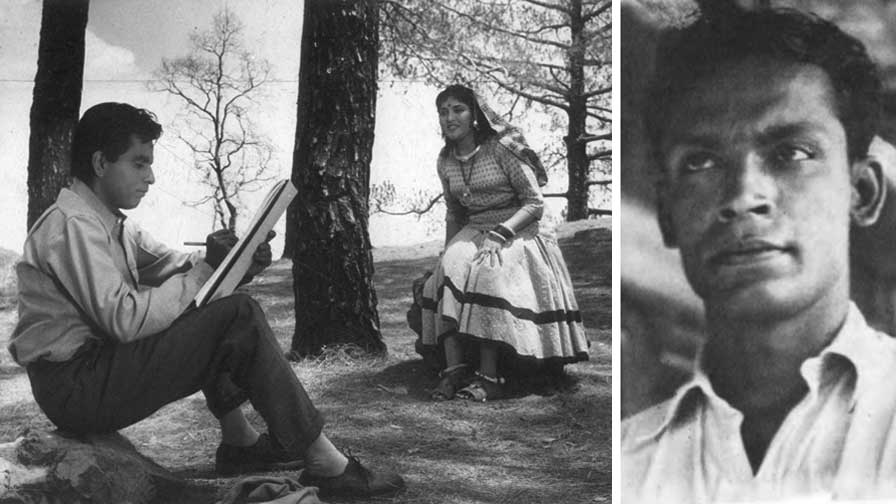
    This was around 1955. Ritwik Ghatak was in Bombay, sharing his living quarters with Hrishikesh Mukherjee. Producer Shashadhar Mukherjee had him employed at Filmistan Studios, writing stories and scripts for them. Ritwik had just been married to Surama Bhattacharjee. He wrote to his young bride, who was working at a school in the northeastern hill station of Shillong:

    “…it’s upsetting when I see the way they work. Truth be told, there is no work at all, I just have to write a bit of rubbish once in a way and go sit in office from 10 AM to 5 PM…. I just have to grit my teeth and keep trying to earn some money. I don’t know if I’ll be successful, but nothing else is possible here. Doing good work, doing my kind of work, showing what I am capable of and trying to establish myself, all of that looks out of reach right now. I just have to find a way to earn a monthly salary….look, Lokkhi, this life is not for us. Working for money is not something I have done before and it’s disgusting to me. Somehow, if I can pay off my debt of around Rs.1000 and be in a position to pay Bhupathi 100 Rs. month for a year or so, I will leave all this. This can’t go on. I look around me and see that even people who earn three or four thousand rupees a month are not happy. But I have found peace in doing the kind of work I like without earning so much as a paisa.”

    Having just married, the couple planned to start a new life, with her earning a salary as a school teacher, and him encashing his storytelling skills working in Filmistan. But the ‘job’ was tugging away at his gut. He was told he should try and write something that was more ‘Bombay-like’. Ritwik was disgusted. But he kept at it, trying to keep his head down and just do the work he was being paid for, like millions of people did every day – and still do. He was also biding his time till he could save enough and return to Calcutta and be back to ‘struggling’ as an independent artist. Struggle. A favourite word of the leftist intellectual, especially back in those days. And Ritwik Ghatak was a walking, talking, breathing embodiment of this.

    He ended up righting stories for his friend and roommate Hrishikesh Mukherjee’s debut directorial venture, Musafir (1957) and for his revered Bimal Da’s Madhumati (1958). Bimal Da, who broke into the scene with Udayer Pathe/ Humrahi (1944), a production of New Theatres, Calcutta and marked for its unusual representation of caste disparity. And then, the moment he created his own banner, he created the seminal Do Bigha Zameen (1953), which was a spiritual descendant to Vittorio De Sica’s Bicycle Thieves (1948). It followed that the young rebellious filmmakers and playwrights would look up to him. Bimal Roy was a poster boy for them. Was Ritwik’s anguish also caused by this giant of a filmmaker hiring him and having him write a reincarnation love story? He indicates in other letters to ‘Lokkhi’, which was Surama’s nickname, a number of concepts that germinated in his head but had to be nipped in the bud because they were not commercial enough, not ‘Bombay enough’.

    “I have planned a story for Filmistaan. I like it very much. An atomic research scientist falls asleep while doing his research, dreaming about a future world where a universal scientific community has taken shape. Of course, I have to keep space for a lot of song and dance and romance, and melodrama; I have to put in all the ingredients of a Bombay film.” He even wanted to consult legendary astrophysicist Dr. Meghnad Saha, so that his story had that ring of authenticity. But we know such a film never saw the light of the day. Shashadhar Mukherjee didn’t approve of it. There’s also an apocryphal story of him going to watch a trial show of Madhumati, which sealed the deal for Ritwik’s future career prospects in Bombay. He had just entered the theatre. The show had begun. One glance at the film and he knew this life wasn’t for him. There was no point in lying to himself anymore. He returned to Calcutta, bag and baggage. If he stayed back, he’d have seen the phenomenal success of Madhumati, and the untold riches and fame that would have obviously followed. And here’s the rub: Ritwik Ghatak hated ‘success’ with a vengeance. And in 2020, this is not any easier to understand than it was back then, in the 1950s. Every serious film director worth their salt has waxed eloquent on how Art is about not giving in to the system, about avoiding compromise at all costs. But Ritwik is probably the only filmmaker who took it all the way.

    Upon returning to Calcutta, he made a bevy of films where he gave vent to his maverick spirit and uncompromising vision. Partition was a tragedy that had left deep scars in his soul. To him, it was a tragedy his fellow Bengalis, especially those from East Bengal, never quite recovered from. Each of his characters was reeling from the rootlessness he experienced all his life. But also his disillusionment and anger. In a scene from Subarnarekha (1962), Abhiram, who writes about the pain, filth and sadness he sees around him, has been turned down by an editor for the umpteenth time. He says to his wife, “Everyone is willing to suffer. You can see it all around. But try to tell them about it, and they run away.” Ritwik himself had similar things to say in his classic meditation on filmmaking, Cinema and I:

    “My coming to films has nothing to do with making money. Rather, it is out of a volition for expressing my pangs and agonies about my suffering people. That is why I have come to cinema. I do not believe in ‘entertainment’ as they say it, or slogan mongering. Rather I believe in thinking deeply of the universe, the world at large, the international situations, my country and finally my own people. I make films for them. I may be a failure. That is for the people to judge..” And he didn’t care much whether the audience loved his work. Expressing what he wanted to say was more important. He said in an interview, “I have never made films for others. Truth be told, I don’t care if you dislike my films. I will do what I want to do, I will not go beyond that….Till I am alive, I can never compromise. Had it been possible, I would have done it much earlier, and would have sat pretty like a good boy. But I have not been able to do it so far, and nor will I ever be able to do it in the future. I will either live like that, or die trying.”

    Whether it’s Bimal in Ajantrik (1958), Nita in Meghe Dhaka Tara (1960) or Ishwar in Subarnarekha, each one of his major protagonists go through unspeakable pain and yet don’t quite achieve what they set out to achieve. When Ishwar (Abhi Bhattacharya) tries to hang himself, his old friend Haraprasad (Bijon Bhattacharjee) barges in. Later Haraprasad tells him – “Our failure is complete. We cannot even kill ourselves.” And just like his characters, Ritwik kept writhing in pain. Surama left him and took the kids along. It was obviously impossible to live with a man like that, who refuses to make even the basic adjustments necessary for survival. He drank country hooch and smoked beedi. Nabarun Bhattacharjee, the son of his friend Bijon and ace litterateur Mahashweta Devi, once spoke of how Ritwik shamelessly asked money to buy alcohol. Nabarun had just 18 paise left in his pocket. “What can you buy with this?”…”One peg of country liquor!” pat came the reply. His friend Bijon Bhattacharya often was the most striking aspect of his films. He would play Ritwik Ghatak’s stand-in, and say with a lot of pathos the things that Ritwik wanted to verbalise himself. He steps in as Nita’s father in Meghe Dhaka Tara, one of the theatre actors in Komol Gandhar (1961), and Ishwar’s friend Haraprasad in Subarnarekha. A brilliant actor, Bijon would prance about the frame, fuming and spouting poetry, mythology, chants and everyday truths – every time the camera fell short to express the things Ritwik wanted to talk about.

    In his last film Jukti Takko aar Golpo (Reason, Debate and a Story; 1974), Nilkantha (played by Ritwik himself) frustrates his wife so much with his idealism that she has to leave him. Much like his real life counterpart, Ritwik’s Nilkantha is left alone, licking his wounds and drinking himself to oblivion. There was a time he lived with Biswajeet Chatterjee (Bengali superstar Prosenjit’s father, he had a fairly successful run as a leading man in 1960s Bollywood). Biswajeet offered to remake Meghe Dhaka Tara, Ghatak’s most successful film, in Hindi. Plenty of moneys were offered. But Ritwik dragged his feet at the last hour. He refused for his film to be made in Hindi. It is said that even Rajesh Khanna, of all people, approached him with an offer, but was turned down. Ironically, Meghe Dhaka Tara inspired Tamil filmmaker K. Balachander to make his own version of it, Aval Oru Thodar Kathai (She is a Never-ending Story; 1974), with substantial modifications. The film was so successful that it gave rise to a franchise of its own, with it being remade in a number of languages, each version a huge box office draw. The Balachander version had a Hindi remake, Jeevan Dhara(1982) as well as a Bengali remake, Kabita (1977), featuring Kamal Hassan in his only appearance in a Bengali film. Ritwik of course didn’t live to see any of this. But he did live long enough to witness his protégé Mani Kaul being successful. By his own admission, the most glorious years of Ritwik Ghatak’s life were spent in the Pune Film Institute (FTII, Pune, now) where his shadow still looms large. Stories abound of how he used to sit under the Wisdom Tree with his talented chelas like Mani Kaul and Kumar Shahani, sharing with them the secrets of the universe. But when has a tiger changed its stripes? He used to turn up for screenings drunk, and when a good scene came up, he used to raise a din. It was for his students to make note of the great scene. He was made a director of the Institute. He was getting the recognition, the respect he craved, and there was money too. This would have turned the tide of his life. But he couldn’t stand it.

    When Ritwik joined Surama in Shillong, she thought he was there to take them along to Pune. The news of him getting on well at FTII had filled her with hope. But he revealed he had resigned from his post and left Pune for good. Surama was crestfallen. Around the late 60s, Ritwik’s alcoholism had intensified and his mind had started unraveling. He reported hallucinating women covered with blood. Women he referred to as the ‘Spirit of Bangladesh’. He was being given electric shock therapy. Ritwik Ghatak was an extraordinary man, and his extraordinariness had finally caught up with him and he spiralled into insanity. There were extended periods of lucidity where he gave the impression of having been cured. It was during these intervals that he made Titash Ekti Nodir Naam (1973) and Jukti Takko aar Goppo, the latter representing exceptional heights of creativity. And yet Jukti Takko aar Goppo depicted him the way he was. Around early 1976, Ritwik Ghatak was admitted to Calcutta Medical Hospital. But Surama had seen too much of this by now. She refused to come. On 6 February 1976, Ritwik Ghatak’s journey culminated, finally. He was at peace.

    Editor-filmmaker Arjun Gourisaria reminisced to online film magazine Cinemaazi that when he used to walk through the FTII campus as a new student, the seniors would say, “Zameen pe nazar rakh ke chal, yahan Ghatak chala karta thha!” (Keep your eyes on the ground, Ghatak used to walk here.) Such is the legend, the cult of the man. But despite all the aura around him as a filmmaker, Ritwik didn’t particularly care about the medium of film either. He said, “Looking back I can say that I have no love lost with the film medium. I just want to convey whatever I feel about the reality around me and I want to shout. Cinema still seems to be the ideal medium for this because it can reach umpteen billions once the work is done. That is why I make films—not for their own sake but for the sake of my people. They say that television may soon take its place. It may reach out to millions more. Then I will kick the cinema over and turn to T.V.!”


    Ritwik Ghatak (Nov 04, 1925 – Feb 06, 1976)

    https://filmcriticscircle.com/journal/ritwik-ghatak/


  • John Abraham, a donkey and the bottle

    John Abraham, a donkey and the bottle

    I know that you are no more.

    But I am, alive for you

    Believe me.

    When the seventh seal is opened

    I will use my camera as my gun

    and I am sure the echo of the sound

    will reverberate in your bones,

    and feed back to me for my inspiration.

    – John Abraham about Ritwik Ghatak


    John Abraham and Ritwik Ghatak. That combination sounds blasphemous already. But it shouldn’t. Because the John I am talking about blazed a trail through Indian cinema that nobody since has had the gall to follow. This is how Jacob Levich distinguished Ghatak from Ray: “Satyajit Ray is the suitable boy of Indian film, presentable, career-oriented, and reliably tasteful. Ghatak, by contrast, is an undesirable guest: he lacks respect, has “views”, makes a mess, disdains decorum” Pick up those colourful words used for Ghatak, and use them on John Abraham. Every word fits with equal resonance.

    John Abraham was the Enfant terrible of Malayalam cinema. His work, like his mentor’s, was marked with a blatant disregard for established mores, while displaying a longing for days gone by. The rebellious streak was a constant in him, till the day he breathed his last. Even during his FTII days, John had been suspended from the hallowed halls of the institute. Not once, not twice, but four times. And yet he graduated with a gold medal in direction and screenwriting. This contrast permeated through his as well as his mentor Ritwik Ghatak’s life.

    Ritwik Ghatak joined FTII in the year 1965. He had already made six of his most acclaimed films, had had a brief and rather unsavoury brush with what we know as Bollywood today. It was Ritwik’s brother, Sudhish Ghatak, who had wielded the camera for the venerable Phani Majumdar’s Street Singer, was responsible for Bimal Roy getting into New Theatres Studios as a camera assistant, back in the 1930s. Later Ritwik started his stint in filmdom by assisting him in Roy’s early works like Tathapi, where Ghatak was chief assistant. After Ritwik got married to his wife Surama Ghatak, a fiery revolutionary an active IPTA member, he was looking for stability by way of gainful employment and landed up in Bombay, working for Bimal Roy Productions. Ghatak wrote Bimal Roy’s classic Madhumati as well as Hrishikesh Mukherjee’s debut venture, Musafir. But despite the box office success of these films (or maybe, because of it) he was disillusioned and left the glitter of Bombay behind and returned to the grime of Calcutta. Back to the bottle, back to the endless Sunday sessions at Coffee House with the likes of Utpal Dutta, Satyajit Ray, Tapan Sinha. Meghe Dhaka Tara brought in acclaim and recognition, but Komol Gandhar floundered at the box office.

    Ghatak household was mired in financial insecurity. Ritwik and Surama were facing a bad patch in their conjugal life, and were living separately. The fact that he admitted to her of falling love with another woman, wasn’t helping. Ritwik’s life is like a series of self-destructive indulgences, punctuated by short bursts of lucidity, something which us lesser mortals will perceive as “normalcy”. During one of these phases, Ghatak decided to make things up with Surama and obtain a secured employment. That is when he took up the teaching job at FTII. There are fables about Ritwik Ghatak at the institute. One of them is about him dishing profound philosophy on life and cinema in a state of drunken stupor, to his disciples sitting under the Wisdom Tree. There were the likes of Mani Kaul, Kumar Shahani, Vidhu Vinod Chopra and Subhash Ghai. And then there was John.

    Ghai and Chopra never tired of speaking about the master and his influence on their lives. Ghai says he was the one helping Ghatak to his room after the drinking binges. Chopra tells stories of how Ritwik rambled to him in Bengali, and eventually suggested the moniker “Vidhu”, permanently added to his name. Mani Kaul and Kumar Shahani built their own oeuvre, with a distinct world view. But it was John Abraham from Kerala who ultimately carried the mantle of Ritwik Ghatak. If Ghatak had a cinematic heir, it would without a doubt be John.

    John Abraham wasn’t just a wide-eyed youngster who crowded into Pune Film Institute (as FTII was referred to back then) merely to make a career in the movies. He was barely 12 years younger to Ghatak, and was well in his mid-30s by the time he graduated. John was kind of wandering across disparate career opportunities when he chose to abandon everything and enrol for film school. He had been teaching in college, and worked briefly for Life Insurance Corporation as well. Which means this move must have been well thought out and extremely risky at the same time. John’s IMDB lists three diploma films he was associated with: Koyna Nagar, Priya and Hides and Strings. This is not unusual. Students have been known to work in others’ diploma films even after they had graduated. Also, Ritwik made some changes in the curriculum of the institute to emphasise on practice rather than theory.

    Not only Ritwik’s pedagogy, but his politics, worldview and philosophy had a great impact on John Abraham. And John was primed for it, having had his formal education in politics and history from the Mar Thoma College at Thiruvalla. Both Ritwik and John were short story writers. And just like his mentor, John had a brief brush with Bollywood. He assisted on a Waheeda Rehman starrer called Trisandhya but unlike Ghatak, John’s film probably never saw the light of the day. But in 1969, he would get the opportunity to work on another Hindi film, Mani Kaul’s Uski Roti – which pretty much set the stage for ‘Parallel Cinema’ in India. John not only assisted his friend, but also appeared in a minor role.

    John Abraham’s directorial debut was a rather conventional and tame Vidyarthikale Ithile Ithile, featuring mainstream Malayalam movie stars like Madhu aka Madhavan Nair and Jayabharathi. It was with his second film that he truly came into his own.

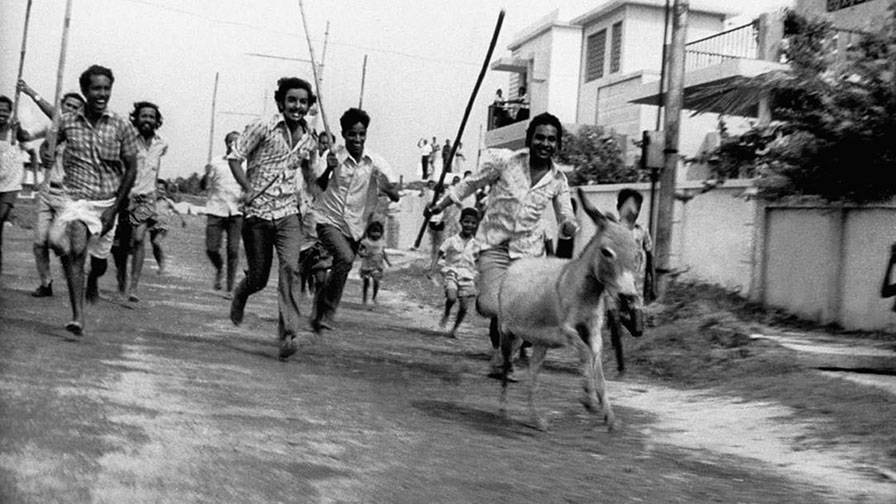
    Agraharathil Kazhutai is about an ill-fated donkey that finds himself in a neighbourhood dominated by chaste Brahmins. Though initially some kind souls treat the beast with some affection, he faces bullying for the most part (among others, at the hands of some students who draw Nietzsche-in parallels with the “Ass”). Eventually, scared of the ill-luck brought about by the animal, the donkey is killed off by the residents. Displaying John’s almost-brutal capacity of pitch-dark humour, the donkey’s murder unleashes death and destruction in the Brahminical village. And then, miracles start manifesting themselves.

    John was even more Ritwik than Ritwik, in some ways. Barring a couple of documentaries, Ghatak didn’t do any work outside of Bengali, the language and milieu he was most comfortable with. John’s breakout film Agraharathil Kazhutai was a Tamil film, though he primarily identified as a Malayali filmmaker. The film created waves. Earned a National Award, among other things. John Abraham also innovated an early example of crowdfunding in cinema. He launched the Odessa Collective in 1984, which went around campuses, small towns and villages in Kerala, staging street plays and screening old films, collecting money from people who volunteered to pay for the experience. The resultant money was utilised towards production and distribution of tightly budgeted indie films. One of them was Amma Ariyan, which has become the other definitive John Abraham film. Amma Ariyan, literally meaning a letter to mother, is about a man traveling with the dead body of a stranger, trying to take him to his mother. The lead was played by Joy Matthew who in 2012 created waves with his Malayalam film Shutter, inspiring remakes in Tamil, Telugu, Punjabi, Tulu and Marathi.

    John’s persona, much like his master, attained mythical status. His quirk, his spontaneous refusal to comply, an outrageously self-destructive streak, all of this added to the allure, perhaps. Anecdotes abound to establish this. Amma Ariyan was being screened at the Flaiano film festival and John was waiting for his flight to Italy. His partners in crime, when they reached the airport, noticed John had forgotten his shoes. He right there, standing barefoot, waiting for his flight to Italy! Similarly, on another occasion, he took off his pants and gifted them to a rickshaw driver when the man complimented him on his jeans.

    A 50-year-old Ritwik Ghatak died, derelict, consumed by the bottle and in the mouth of madness. Little more than a decade later, on 31 May 1987, John Abraham fell from the terrace during a party. He had been drinking copiously. He died a day later, two months short of his 50th birthday.


    “I have lived on the lip

    of insanity, wanting to know reasons,

    knocking on a door. It opens.

    I’ve been knocking from the inside.”

    – Rumi


    [divider text=”Go to TOP” size=”1″ margin=”0″]

    IMDB link of John Abraham

    [youtube_advanced url=”https://www.youtube.com/watch?v=NJHrYokoE1A” width” width=”300″ height=”200″ responsive=”no” controls=”alt” autoplay=”yes”]