Tag: Adoor

  • Exploring the Ascent of Malayalam Art Cinema: V. K. Cherian’s “Noon Films & Magical Renaissance of Malayalam Cinema”

    Exploring the Ascent of Malayalam Art Cinema: V. K. Cherian’s “Noon Films & Magical Renaissance of Malayalam Cinema”

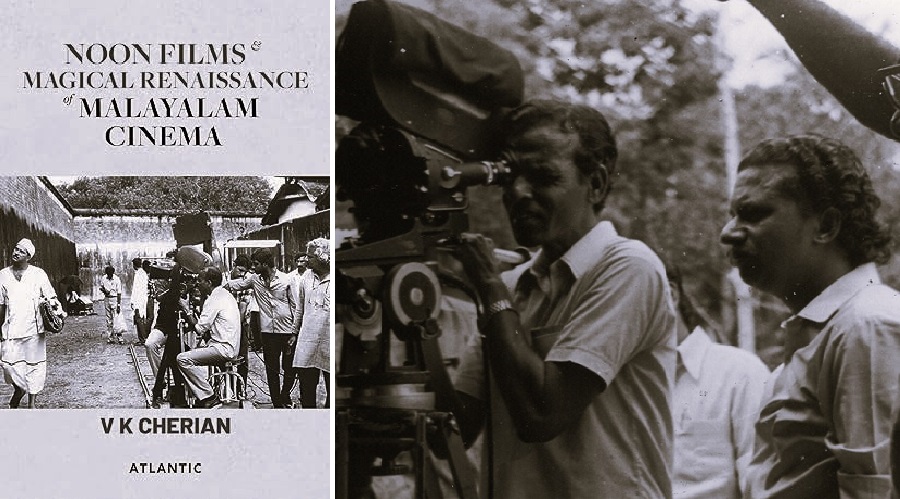
    The 29th International Film Festival of Kerala (IFFK), held in December 2024, witnessed a record-breaking attendance of 13,000 delegates—arguably the highest for any film festival in India. The book by V. K. Cherian, “Noon Films & Magical Renaissance of Malayalam Cinema” published by Atlantic Publishers & Distributors in 2025, examines the renaissance of Malayalam cinema and sheds light on the cultural ecosystem that fosters Kerala’s vibrant cinema culture. As the author emphasizes, Malayalam cinema has, from its inception, been deeply intertwined with social themes. Unlike the early films in other parts of India, the pioneering Malayalam silent film Vigathakumaran (The Lost Child, 1928) avoided mythological narratives. Subsequent Malayalam films continued in this vein, emphasizing social dramas. Building on this distinctive approach, the book explores the groundwork that catalysed the remarkable renaissance of Malayalam cinema from the 1970s onward.

    The library movement in Kerala, spearheaded by P. N. Panicker, transformed the state’s literacy landscape. The author highlights Panicker’s remarkable efforts in establishing countless libraries across Kerala, fostering a culture of reading and intellectual growth, and playing a key role in achieving the state’s high literacy rate and broader development. Examining how left-wing organizations utilized theatre, cinema, and literature for political outreach, the author cites the play “Ningalenne Communistakki” (You Made Me a Communist), which was later adapted into a film. This pivotal moment set the stage for the emergence of three significant figures who became catalysts of the renaissance.

    The author identifies the catalysts dubbed the “A Team” by Malayalam poet Dr. Ayyappa Paniker: Adoor Gopalakrishnan, G. Aravindan, and John Abraham. Their contributions to Malayalam cinema are portrayed as cornerstones of Indian New Wave cinema, also known as parallel cinema. Although this movement often centred on social critique, Adoor and Aravindan ventured beyond its boundaries. Even John Abraham, in his final film Amma Ariyan (Report to Mother, 1986), adopted a different approach to modernity, signalling a broader creative scope within the New Wave.

    Among the esteemed A Team trio, Adoor Gopalakrishnan emerges as a trailblazer in Kerala’s film society movement, founding the transformative Chitralekha Film Society. This initiative, the author notes, mirrors Satyajit Ray’s profound influence on Bengali cinema. Adoor’s legacy expanded further with the establishment of the Chitralekha Film Studio in Thiruvananthapuram, a bold move during an era when Chennai dominated film production. Significantly, the author emphasizes how this step enabled the Malayalam film industry to shift its base from Chennai, fostering a unique identity free from Chennai’s commercial influences. Following the commercial success of his second film, Kodiyettam (The Ascent, 1978), Adoor challenged industry norms by ensuring his films were screened in three shows daily, rejecting the practice of relegating art films to noon slots—a practice that earned such films the moniker of “noon films,” referenced in the book’s title.

    The book pays tribute to General Pictures’ Ravindranathan Nair, who patronized Malayalam art cinema by producing five films by Aravindan, and some of the later works by Adoor and M.T. Vasudevan Nair. The interview with Issac Thomas Kottukapally, who collaborated with Aravindan on three films, highlights Aravindan’s creative genius. The third member of the A Team trio, John Abraham, was also an FTII alumnus like Adoor. His second film, Agraharathil Kazhuthai (Donkey in a Brahmin Village, 1977), is a landmark in Tamil cinema. The author references Abraham’s thoughts on conceiving the idea of a Brahmin raising a donkey within a Brahmin colony. It is worth noting that the scriptwriter Venkat Swaminathan’s knowledge of the Tamil poet Subramania Bharati’s life and work significantly influenced the film. For his swan song, Abraham spearheaded the formation of the Odessa Collective, raising funds through grassroots efforts by traveling to villages and collecting donations from the public.

    The final chapter examines the most significant contribution to Malayalam cinema by the eminent author, screenwriter, and film director M.T. Vasudevan Nair, who passed away in December 2024. His film Nirmalyam (Remains/ Yesterday’s Offerings, 1973) stands as a major milestone in Malayalam cinema history, yet it hasn’t received the recognition it truly deserves. It is fitting that Cherian has analysed this film in detail while paying tribute to M.T. as a towering figure. The book raises an important question about the lack of a new generation of filmmakers in Kerala comparable to the legendary A Team trio, though it doesn’t delve deeply into this issue. Despite some photographs in the book appearing elongated, it provides an insightful account of the renaissance of Malayalam cinema. After reading it, Kerala’s vibrant film culture—evident in the overwhelming number of delegates at IFFK 2024—becomes more comprehensible. Cherian’s exploration of this renaissance highlights the heights Kerala has achieved in the seventh art and underscores its enduring cultural significance.

    VK Cherian, “Noon Films & Magical Renaissance of Malayalam Cinema,” Atlantic, 183 pages, Rs. 806/-

  • Celluloid to Digital — India’s Film Society Movement

    Celluloid to Digital — India’s Film Society Movement

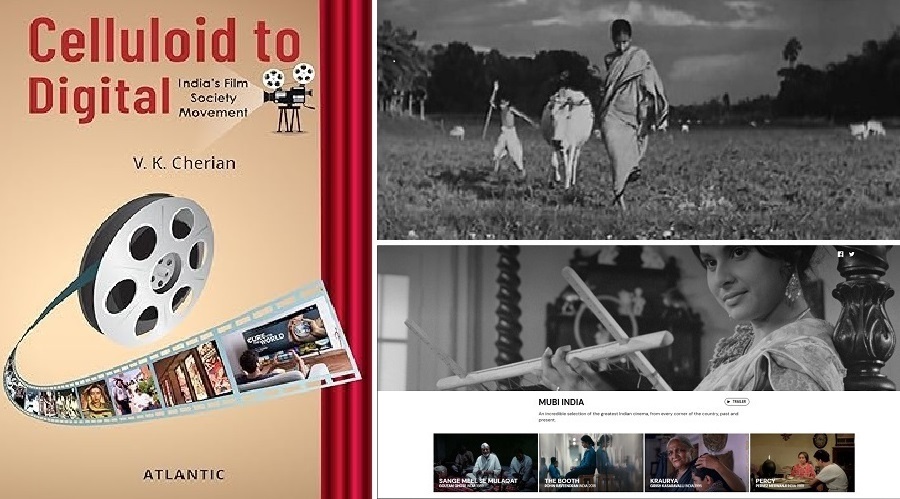
    Taking Stock of Seven Decades of Fostering Film Culture: Musings on V. K. Cherian’s book “Celluloid to Digital — India’s Film Society Movement”

    India’s film society movement mirrors the nation’s own journey, as captured in V. K. Cherian’s comprehensive 2016 book, “India’s Film Society Movement: The Journey and its Impact.” A revised edition by Atlantic Publishers & Distributors (2023) expands on the pandemic’s impact. Spanning seven decades, the book chronicles the movement’s history with fascinating, meticulously collected anecdotes. Exploring the interplay of technological shifts, economic changes, and government policies, it unveils their influence on this significant movement.

    A film society activist himself, the author brings firsthand experience to the subject. He explores how Jawaharlal Nehru prioritized cinema alongside other cultural fields in his nation-building efforts. The central government’s 1951 S. K. Patil committee on films led to the creation of the International Film Festival of India (IFFI), the Film and Television Institute of India (FTII), the Film Finance Corporation (FFC), and the National Film Archive of India (NFAI). However, the author poignantly highlights Nehru’s unrealized vision for a “Chalachitra Akademi.”

    The book meticulously details the pioneers of the movement and the emergence of various film societies. While the Calcutta Film Society (founded 1947 by Satyajit Ray, Chidananda Das Gupta, and others) is often hailed as the first, the author sheds light on an earlier Mumbai society from the 1940s. Crucially, the Calcutta Film Society ignited the cinematic passion of Ray, Mrinal Sen, and Ritwik Ghatak, shaping them into filmmakers. Satyajit Ray’s Pather Panchali (1955) further revolutionized the movement, fostering appreciation of cinema as an art form.

    While Pather Panchali’s success likely paved the way for a national film society organization, the book highlights Marie Seton’s crucial role. This British critic’s multi-city lectures spurred the 1959 formation of the Federation of Film Societies of India (FFSI). The author compares Adoor Gopalakrishnan’s efforts in Kerala to Satyajit Ray’s in Bengal, illustrating how budding filmmakers cultivate audiences through film education. In neighboring Karnataka, the Suchitra Film Society emerged in Bangalore in 1971 under the leadership of H. N. Narahari Rao (who edited a book on the film society movement published in 2009) and his associates. Suchitra’s unique model, with a dedicated cultural complex, has enabled it to endure through present times. However, replicating this model elsewhere may prove challenging.

    The granting of censorship exemption to the Federation of Film Societies of India (FFSI) from 1966 facilitated access to films from consulates. However, as noted by the author, this positive step had its drawbacks in the 1970s and 1980s. During this period, there was a surge in people joining film societies, primarily attracted by uncensored films. Unfortunately, this trend deviated from the movement’s original purpose. A lack of critical rigor in appreciating films was evident among a significant portion of film society members. While some societies held discussions after screenings, a deeper understanding would necessitate journals with substantial writing on cinema. The author highlights “The Indian Film Quarterly,” a publication by the Calcutta Film Society. Other noteworthy publications include Bangalore Film Society’s “Deep Focus,” founded by George Kutty, M. K. Raghavendra, M. U. Jayadev, and yours truly.

    Technological advancements are often seen as progress, but the shift from 16mm/35mm film to the digital era presented a challenge for film societies. While the transition eliminated the cumbersome process of transporting and projecting film reels, many cineastes still favor traditional film for its distinctive visual and tactile qualities over digital formats. However, a more significant consequence was the decline in audience numbers. The rise of readily available films online eroded the film society’s role as the sole source of alternative cinema.

    The pandemic profoundly impacted film societies, much like other facets of society. In this second edition of the book, the author delves into how the pandemic altered film viewing habits. OTT platforms and YouTube brought films and videos directly to home theater screens and smartphones, shifting the communal viewing experience from social gatherings to personal spaces. Most film societies across the country felt the effects. The author gives the example of the online film society Talking Films Online (TFO) which responded to the pandemic by hosting discussions via Zoom every Saturday evening on a pre-announced film. Additionally, several other online forums sprang up during the pandemic.

    Rather than lamenting the digital era, film societies can embrace it. One advantage of this era is the democratization of filmmaking, enabling anyone — even with just a smartphone — to create a film. This accessibility has inspired many film enthusiasts to explore filmmaking firsthand. However, the role of film societies extends beyond merely promoting film culture. They should serve as platforms for budding filmmakers and technicians, offering education not only in film appreciation but also in practical filmmaking. Additionally, organizing competitions in film criticism and mobile filmmaking, especially in collaboration with universities, can further nurture young talent.

    The transition from a socialistic economy to an increasingly capitalistic one has occurred without adequate safeguards for promoting art cinema. The author delves into this issue, along with recent major policy shifts concerning cinema. As the film society movement faces multifaceted changes, creativity will be essential for its survival. The author suggests exploring avenues such as state units, campus film societies, and digital groups. The book would have benefited from more thorough editing. Despite that it serves as a valuable resource for various stakeholders — policy makers, filmmakers, film educators, film society organizers, and cinema students — to reflect on the history of India’s film society movement, gain perspective, and envision its future.

  • In The Forests of the Plight: A Fiftieth Anniversary Tribute to Adoor Gopalakrishnan’s First Film SWAYAMVARAM (1972)

    In The Forests of the Plight: A Fiftieth Anniversary Tribute to Adoor Gopalakrishnan’s First Film SWAYAMVARAM (1972)

    When Adoor Gopalakrishnan, one of the internationally acclaimed Indian filmmakers, launched his first feature film Swayamvaram five decades ago, it was after many years of sustained effort. After passing out of FTII, Pune in 1965, he found it difficult to get a producer who would back him. Hence, he took the initiative of forming a cooperative for film production along with his friends. There was not much awareness of international cinema in his state of Kerala at that time. Realizing the need for establishing a film culture, he took yet another initiative of setting up a film society along with his associates and brought out literature on cinema. Adoor himself penned articles in Malayalam to spread awareness about the medium.

    The establishing of the cooperative helped Adoor in launching his first film Swayamvaram which was jointly financed by the erstwhile Film Finance Corporation and his Chitralekha Film Cooperative. It is based on a story and script by Adoor Gopalakrishnan who was assisted by K. P. Kumaran. The film won National Awards for Best Film, Best Director (Adoor Gopalakrishnan), Best Actress (Sharada) and Best Cinematography (Mankada Ravi Varma). The golden jubilee is an occasion to look at the film now, analyze it and place it in Adoor’s oeuvre.


    Exposition  

    The film’s opening title sequence is shot inside a bus with a variety of passengers, some of whom are dozing off. Among them is a young couple with their faces animated. They exchange glances. The bus comes to a halt and we see them checking into a hotel room. The man asks his lover whether she regrets it. He wonders whether they gave enough thought to it. We realize that they might have eloped.  A group of devotees pass by on the road in a procession chanting bhajan. It may appear odd to see the film showing the couple making love with the background of the bhajan on the soundtrack. The director’s intention here is revealed in Adoor’s interview in which he has said that he paired bhakti (devotion) with sex in that scene. [1] The essence of bhajan is bhakti. By being paired with bhakti, sex gets associated with devotion as another aspect of it. Separated from their families, they are mutually dependent on each other which leads to devotion as well as the fear of losing the loved one as seen in the dream sequences which follow.


    Synopsis

    Madhu and Sharada in Swayamvaram

    In Swayamvaram, a young couple, Sita (Sharada) and Vishwam (Madhu) fall in love perhaps against the wishes of their parents and leave their village to live together in the city. They face the challenge of surviving on their own in a climate of acute unemployment. As Vishwam’s literary aspirations are crushed, he takes up a teaching job but loses it. Later he gets only a low paying job of a clerk in a sawmill that too by replacing a dismissed employee who worked for twelve years there. Now that the couple have a child, Vishwam has to bear with the insinuation of the previous employee who stalks him. Vishwam is haunted by the hounding but his job is important to him. When he falls sick the situation becomes grave.


    Structure

    Swayamvaram (1972) starts with the journey to the city of the young couple with their illusions followed by the hard reality they experience there. What Sita goes through has some parallel with the female protagonist Sita in the epic “Ramayana” which gives a resonance to the film. The title refers to the swayamvaram (meaning one’s own choice) of Sita who wedded Rama out of many princes in the epic. There is the picture depicting it that hangs on the wall of the house of Vishwam and Sita. Vishwam is her own choice for Sita in the film and not that of her family so it is a swayamvaram for her too. But Sita in the film is not exactly in the mould of Sita in the epic. She elopes with her lover to live together with him, making the subject daring for its time.


    In the Forests of the Plight

    Just as Sita in the epic had to undergo hardships by having to go to forest, in the film also Sita has to go through adversities. The dream sequences in the early part of the film portend Sita losing Vishwam. He climbs down the rocks towards the sea as she keeps gesturing to him to come back. In another dream sequence Vishwam lies down keeping his head on the railway track with the approaching train’s sound on the soundtrack. She runs upto him and forces him to get up. In yet another sequence she chases him in the woods and loses him. It has memorable tracking shots of her running in the forest looking out for him. Sita being renounced by Rama in the last part of the epic (Uttarakandam) has its echo in Sita losing Vishwam in the end.


    Illusion & Reality

    Sita and Vishwam are shown acting like lovers in commercial cinema in the dream sequences. The theme of illusion is taken up in a dream sequence showing posters of hero and heroine in love from Malayalam commercial cinema in which love is romanticized. Sita and Vishwam would have grown up watching such films and imagined that life will be rosy as it is depicted in films. Later in Swayamvaram it turns out very hard to survive as job is very difficult to get for both of them. Without any support system Sita and Vishwam are dependent on each other. Reality dawns on Sita when Vishwam falls ill.


    Retrenchment Theme

    Vishwam happens to see briefly a leftist party meeting in which the speaker talks about how the working class is misled by various parties. He adds that all of them obstruct the struggle of workers and their liberation. Much later in Swayamvaram after losing his job, there is a scene which shows a political march in protest against retrenching workers. Vishwam quietly watches it passing by. It seems the film was not given an award at the Moscow International Film Festival in which it was nominated. Adoor has said that the jury was surprised that Vishwam didn’t join the march of the workers which costed the film an award. Vishwam himself has been retrenched from his job. Yet he doesn’t join the march. Adoor has said that the reason is “he doesn’t see himself as part of this. This has to be understood because the other thing is simplistic that he also joins it. That’s the kind of films we used to send to Moscow.” [1] Vishwam doesn’t belong to the working class. Hence it wouldn’t have been appropriate to show him in the stock manner which would satisfy the expectation of the audience and an agenda driven jury. This is an important aspect of Swayamvaram which makes it stand apart.

    The theme of retrenchment has been treated in its complexity in Swayamvaram. While the sawmill owner appears to be unfair in terminating a long-time employee, the friendly tutorial college owner with debts is forced to ask Vishwam to leave. The scene in which the owner takes Vishwam for a drinking spree is memorable.


    Safety and Security of Women

    Women’s safety is yet another theme in the film. Vishwam and Sita move to a second hotel which is cheaper. Sita gives away her golden bangles, perhaps the only precious jewelry she has to Vishwam. It’s for buying a mangalsutra (golden signet in a chain worn by a married woman) to let men know of her marital status and ward them off. This scene also suggests that Sita and Vishwam are living together perhaps without getting married. Sita is terrified by the way she sees a drunkard when she opens the hotel room door on hearing the knocking of the door. She is even afraid of opening the door when Vishwam arrives. Sita wearing the mangalsutra doesn’t restrain smuggler Vasu who has an eye on her. Three drunkards try to barge into her house and make unsavoury remarks about her.


    The Women in the Film

    K.P.A.C. Lalitha

    Swayamvaram came up with very well etched characters, particularly women. Sita is a bold woman who takes the courage to leave her family to live with her lover. She is resolute and strongly willed unlike Vishwam who keeps wondering whether they made the right choice. Kalyani (K.P.A.C.  Lalitha), is a prostitute living in the opposite house whose husband visits her to collect money for liquor. She is smart enough not to let him exploit her at some point. The middle-aged widow Janaki (Adoor Bhavani), the rice seller neighbour of Sita, is very helpful to her. Sita protects herself from the prying eyes of men and lives with dignity. It is impossible for the smuggler Vasu to make advances to her as Kalyani says.


    Casting

    Bharath Gopi

    Casting of Madhu as Vishwam was right as he underplays the role unlike most of the actors of that period who were known for their dramatic style of acting. Sharada was known as a talented actress and she had already won the National Award for Best Actress for Thulabharam (1968). She was the right choice for Sita and she got her second National award for Swayamvaram. Gopi turned out to be a great discovery by giving a haunting performance as the fired employee. The rest of the cast also performed well in the film.


    The Ending

    In the end when Vishwam passes away, Vishwam’s colleague suggests that she can live with his family. Janaki tells Sita to return to her parents. Sita rejects both the options. Once again, she makes her own choice. Her condition can be looked at in terms of the parallel of her situation with Sita in “Ramayana” who was renounced by Rama in Uttarakandam. In the last scene there are the sounds of thunder and pouring rain as Sita feeds her child. Water leaking from the roof falls down over the picture of swayamvaram on the wall which is lit up by the lightning. The last shot is ambiguous as it shows Sita having an eye on the closed door, concerned about safety. While she is willing to face the world on her own, the future is uncertain.

    Swayamvaram is one of the first Malayalam films that featured direct recording of sound (synchronized sound) and outdoor locales. It’s also considered to be the first film in Indian cinema that used sound as a leitmotif: There is the recurrent sound of wood being cut in the sawmill. This cutting sound is especially powerful when Vishwam passes away.

    In an interview with C.S. Venkiteswaran, Adoor has said that the Film Finance Corporation (FFC) rejected his application for finance for a film based on a script written by C.N. Sreekandan Nair as it was a love story. FFC didn’t sanction the loan because the script didn’t take up any of the issues facing India. [2] Perhaps the issue of unemployment that Swayamvaram deals with helped in getting the finance from FFC. To compare it with Adoor’s second film onwards upto Anantaram, the approach in the latter is that of a biography of an individual. The films are very much rooted in the social landscape of Kerala but they are not issue based. Even in Swayamvaram, while the story deals with a social issue, it has other dimensions too. Its parallel with the epic “Ramayana” gives it a connotative meaning.

    In retrospect the title reflects Adoor’s own choice of treading the untrodden path of art cinema with all its risks. He has been hugely successful in creating a body of work that is world class and becoming a major force in Indian cinema. A pioneer of the new Malayalam cinema movement, he inspired several other art filmmakers. Swayamvaram’s daring subject, complex treatment of the theme of retrenchment, parallel with the epic and ambiguous ending mark Adoor’s first film, revealing an original style of filmmaking which has helped the film’s longevity even after five decades.


    References

    1. VK Cherian in conversation with Adoor Gopalakrishnan, The creative world of Adoor Gopalakrishnan-Episode One-Swayamvaram Swayamvaram50 Channel on YouTube, 2022
    2. S. Venkiteswaran in conversation with Adoor Gopalakrishnan, C.S. Venkiteswaran in Conversation with Adoor Gopalakrishnan Part 2: Film Societies, Festivals and Early Films, Sahapedia.org, 2021


  • Polyphony in Time: Narrational Strategy in Adoor Gopalakrishnan’s ‘Anantaram’ (1987) and the Film’s Multiple Interpretations

    Polyphony in Time: Narrational Strategy in Adoor Gopalakrishnan’s ‘Anantaram’ (1987) and the Film’s Multiple Interpretations

    Adoor Gopalakrishnan’s Anantaram (1987), his fifth film and its three preceding films have a common approach of a biography of an individual. They get deeper and deeper as we move from his second film onwards. While Kodiyettam (1978) follows the carefree Shankaran Kutty attaining maturity, in Elippathayam (1982), Unni is like a rat in a trap, caught in his feudal ways. When Sreedharan a revolutionary communist leader makes a comeback from hiding in Mukhamukham (1984), he is a defeated man much to the dismay of the people who look up to him. Anantaram, which differs from them with its narrative strategy, is Adoor’s magnum opus. Analysing it will help in understanding its import and what Adoor achieved in it.

    If one attempts to write the story in brief for Anantaram, one may end up putting down its plot instead. In place of the terms, “story” and “plot”, David Bordwell uses the terminology of Russian Formalists who call them as fabula (sometimes translated as “story”) and syuzhet (usually translated as “plot”). [1] In Anantaram the fabula has to be constructed by the viewer from the syuzhet which is presented by the film. Ajayan also known as Ajayakumar (performed exceptionally well by both Sudheesh as a boy and Ashokan as a youth), the protagonist of Anantaram, tells his story in one way and as the title goes (Anantaram means ‘and then’/‘whereupon’), he tells his story once again which doesn’t have much correspondence with the previous one. There have been films such as Akira Kurosawa’s Rashomon (1950) and Tom Tykwer’s Run Lola Run (1998) having different versions or points of view of the same events. In Anantaram the two versions are told in the first-person narrative by the same person which is rather new. The English title of the film is ‘Monologue’. It is in fact a double monologue and its structure can be called as “Double monologue/ narrative in the same first-person point of view”.

    Ashokan in Anantaram
    Ashokan in Anantaram

    In his first version, Ajayan recounts that he was an unwanted child abandoned by his mother after his birth in a hospital. The doctor in the hospital raises him as an adopted son affectionately. His extraordinary talents alienate him from others except his foster brother Balu (played with a quiet presence by Mammootty) who is studying medicine.  When he grows up and goes to college, he gets estranged from Balu– a doctor now – too when he gets strangely attracted to Balu’s newly wedded wife Sumangali called Suma (performed sensuously as well as hauntingly by Shobhana). With the feeling of guilt due to that he leaves home and he is apparently driven into suicide. Ajayan comes out quite the contrary in his second version in which he is far from being a gifted child. Suma resembles Nalini (also played by Shobhana) with whom he was in love, which torments him further.

    Ajayan has been abandoned by his mother somewhat like Karna in the epic “Mahabharata”. Balu reminds us of Duryodhana who bonds with Karna, admires his great skill in archery and feels that he doesn’t get his due owing to his pedigree. Ajayan comes to know about his real parentage like Karna. While such a reference to the epic can enhance the appreciation of Anantaram, the characters in the film are not in the epic mould. The literary antecedents to the dual personality that comes through in Anantaram can be traced to several works which use the strategy of doubling identities. Of particular interest is Dostoevsky’s “The Double: A Petersburg Poem” (1846) in which Yakov Petrovich Golyadkin, a titular councilor, encounters his friendly doppelgänger. The Golyadkin Jr. though turns his bitter foe taking his place causing Golyadkin Sr. a nervous breakdown. Golyadkin Sr. is probably a schizophrenic who is driven to insanity. In Anantaram too it could be one of the interpretations as there are indications such as Balu asking Ajayan in his second version whether he has taken his medicine.  Mikhail Bakhtin developed the concept of ‘polyphony’ meaning multiple voices about which he has written, “A plurality of independent and unmerged voices and consciousnesses, a genuine polyphony of fully valid voices is in fact the chief characteristic of Dostoevsky’s novels. What unfolds in his works is not a multitude of characters and fates in a single objective world, illuminated by a single authorial consciousness; rather a plurality of consciousnesses, with equal rights and each with its own world, combined but are not merged in the unity of the event”. According to Bakhtin the multiple voices haven’t become fully independent in “The Double…” unlike in Dostoevsky’s longer novels. [2] The structure of Anantaram can be viewed in this light. The two voices in Anantaram are that of the protagonist but they are quite distinct. Since they are presented in two versions, the polyphony in Anantaram could be called polyphony of the protagonist in time.

    Shobhana in Anantaram

    The interpretation of Ajayan driven into insanity due to schizophrenia is a denotative meaning of the film which fits up to a point. The two stories that Ajayan narrates are about the two separate realities in which he experiences to exist. While the first one is shot in the realistic style, some of the scenes in the second are expressionistic. Nalini in Ajayan’s second story could be part of his imagination. Adoor pulls off quite a coup by having Shobhana play both Suma and Nalini to indicate that Ajayan is strangely infatuated with Suma as she appears like Nalini. The other world, that is imagined by him, dominates the perception of Ajayan. But just when we create the fabula (story) based on this, we’re confused by seeing Ajayan’s roommate pick up a rose from the floor and ask Ajayan whether someone was there. We have an unreliable narrator who creates ambiguities.

    The narrational gaps in Anantaram call for multiple interpretations of a higher level, bringing out its connotative meaning. Regarding how to do the interpretation, David Bordwell has written that “the procedural slogan of art-cinema narration might be: “interpret this film, and interpret it so as to maximize ambiguity””. [3] Going by that, we can discern the unintegrated personality of Ajayan who has in him mutually opposite elements. He has both extraversion and introversion. The servants appear helpful but not really so. His foster father might even be his real father. There is a hint that the yogini who is affectionate towards him could be his mother who abandoned him. He is all admiration for Balu but later he notices Balu ogling at a lady who is on her way back home after bathing. He can love Nalini but she is not real. Her look-alike Suma is a real person loving whom is forbidden. Like his counting of the steps in odd numbers and then in even numbers, he encounters things in dual form. It is very hard for him to synthesize such contradictory elements which push him to the edge. This interpretation of unintegrated personality is a view of Ajayan that is created in our mind by putting together the two versions that are narrated by the protagonist Ajayan.

    Adoor’s illuminating interpretation of Anantaram is that it is about storytelling as mentioned in his “Director’s Statement” in his website. To quote a few lines from it, “[Ajayan] is drawing up on the experiences from his life basically from two stand-points – that of an introvert and an extrovert, the two positions we all keep shifting from time to time…Each story picks and chooses from those experiences from his life that go to prove its theme. The stories do not contradict themselves, instead they complement each other. The stories jell together because there is a certain built-in ambivalence in his life.” [4].

    It speaks for the richness of Anantaram that the presence of the two independent voices in the film supports a dialogical discourse too. While narrating his stories, Ajayan doesn’t find the self to be coherent but alienated and fragmented. His dual voices point to a dualistic or divided self with a doubled and divided mind. Hence the two stories that his two voices narrate are like thoughts of two different minds. Applying Mikhail Bakhtin’s concept of polyphony to the film suggests a dialogical discourse.

    Such an approach will lead to yet another interpretation: Unravelling the mystery of one’s psyche and searching for one’s identity may lead to one’s self-destruction. In this view, Ajayan’s search for identity starts right from when we see him crying as a child for mother’s milk. Questions on who are his mother and father haunt him. True to the meaning of his name Ajayan (the invincible one), his performance is extraordinary in studies, sports etc. but he excels in everything perhaps to make up for his lack of identity. The film makes an acute observation that super competence may end up as a failure. Yearning for a caring woman, Ajayan develops a liking for an elder girl Lata which is thwarted by a couple of senior boys. He gets attracted to his foster brother Balu’s sensuous wife Suma which ruins his studies. Curiously, the meaning of Suma’s full name, Sumangali, is “a married woman whose husband is alive”. He confesses his feeling of guilt for his forbidden feelings for Suma which apparently leads to his suicide. The second version is clearly in a different voice, making us recognize that there are in fact multiple voices in one person which may come into conflict. Perhaps the voice in the first version overstated his ability as the voice in the second one doesn’t portray him as gifted. “Ajayan” turns out to be an ironical name. The two versions view the servants differently. The three caring servants in the first are made to look iconic like the male counterparts of the three witches in Macbeth, inflicting pain on him perhaps because they know that he is the foster son of their employer. Later Ajayan comes to know that his foster father whom he has been calling as “uncle” and the yogini could be his real parents. He must have been very much disappointed that he was denied his identity. While the love for Suma is forbidden, the love for Nalini cannot be materialized. When he goes to meet her in her house, she is called Malini which is the name of a yakshi (seductive spirit). His identity as a lover is in question. Ajayan doesn’t find the world knowable. In the end he says that there are some more things that he hasn’t told us and some he has forgotten, hinting that there could be more versions. But he is nowhere near fathoming his psyche. The ending is unresolved. Ajayan’s problem is that he is very sensitive and he is aware of the futility of his search which torments him and leads him to his self-destruction.

    Some of the filmmakers from Kerala ushered in a different kind of modernity to Indian art cinema. As M. K. Raghavendra has written, “Adoor Gopalakrishnan (Anantaram, 1987), G Aravindan (Esthappan, 1980) and John Abraham (Amma Ariyan, 1980) eschew the ‘critique of society’ model in Indian art cinema and reintroduce (authorial/character) subjectivity as strategies… [Kerala] appears to have arrived at its own kind of modernity without the mediation of the West.” [5]. Among them, Adoor came up with arguably an innovation in form to depict a dual human personality in Anantaram. It would figure in the top 5 all-time great Indian films that rank high internationally although it is not as widely known as it should be. For, Adoor Gopalakrishnan’s Anantaram is a monumental work in Indian cinema and has its place in world cinema as well.


    References

    1. Bordwell, David. “Narration in the Fiction Film”, New York, Routledge, 2014, pp 49-50.
    2. Bakhtin, Mikhail. “Problems of Dostoevsky’s Poetics”, Minneapolis, University of Minnesota, 8th printing, 1999, p 6& p 220.
    3. Bordwell, David. “Narration in the Fiction Film”, New York, Routledge, 2014, p 212.
    4. Gopalakrishnan, Adoor . “Director’s Statement”, 2017.
    5. Raghavendra, M.K. “Philosophical Issues in Indian Cinema: Approximate Terms and Concepts”, New Delhi, Routledge India; 1st edition, 2020, p 121.


    Film: Anantaram
    Year: 1987
    Duration: 125 minutes
    Language: Malayalam
    Editing: M. Mani
    Music: M.B. Srinivasan
    Cinematography: Mankada Ravi Varma
    Producer: K. Ravindran Nair
    Story, Script and Direction: Adoor Gopalakrishnan


    See also:

    https://filmcriticscircle.com/journal/the-cinema-of-adoor-gopalakrishnan/

  • Face to face — the cinema of Adoor Gopalakrishnan

    Face to face — the cinema of Adoor Gopalakrishnan

    That reviewer Parthajit Baruah is well read, as professors of English (and cinema) should be, is clear from the number of references to literature as well as quotes from books that he uses in ‘Face to Face – The Cinema of Adoor Gopalakrishnan’ to illustrate his points. That he is completely cued in to the films of Adoor Gopalakrishnan is equally obvious in the meticulous way he has handled the subject of his book and quoted extensively from reviews and from interviews the director has given to media over the years. Baruah has taken pains to ensure that through this book he will motivate even those who have never watched a film by Adoor Gopalakrishnan to not only understand the latter’s approach to cinema but also find themselves wishing to see the director’s work.

    Adoor Gopalakrishnan with (1) Mangada Ravi Varma, & (2) Vaikom Muhammed Basheer

    The introductory chapters of the book delineate the “major political, social and cultural landscapes that inform his films.” This I believe is quite necessary in a country in which, increasingly, divisions between states, regions and cultural and religious beliefs are getting deeper as people draw tight the strings of their identities to exclude others. Baruah talks about the natural beauty of Kerala, its art forms like leather puppetry, which combined craft with vocal drama to anticipate cinema, and its performing art disciplines like Koothu and Kathakali, which together worked their influence on the work of Adoor Gopalakrishnan. He explains the almost defunct matrilineal system, which is significant as the director draws from it for some of his films. Giving examples, Baruah shows how the political and social evolution of Kerala plays into the choice of themes and characters in Adoor’s films.

    The introductory chapters, before Baruah goes into the analysis of individual films, include Society on Celluloid, Deconstructing Cinema Stereotypes, and The Adoorian Approach. Society in Celluloid is an important chapter, logical and well explained. It talks about the evolution of cinema from its early social themes drawn from myth and literature, and the ‘middle stream’ cinema that amalgamated art and popular cinema as well as the unique space that Adoor Gopalakrishnan’s work carved for itself in this genre, to the soft porn phenomenon that hit Malayalam cinema.

    Adoor Gopalakrishnan with cinematographer Mangada Ravi Varma and chief assistant Meera on the sets of Mathilukal

    Interesting observations make what could have been merely academic writing dynamic.

    In his chapter on stereotypes, Baruah puts out stories of directors across the country, from Phalke in Maharastra to Jyoti Prasad Agarwala in Assam searching for the right ‘heroine’ for their films. While Raja Harishchandra had a male Taramati, Agarwala’s search for an actress for his debut film would win him the dubious title of ‘thief of girls’ and much abuse from the villages he visited during his search. Baruah also compares the treatment of women in Hollywood to those in the Hindi films of Shyam Benegal, and then moves to Adoor Gopalakrishnan’s exploration “of the world of women to understand their position within the socio-economic set up.” Thus, making them more than mere “objects of the male gaze.” The author gives examples of the women characters in the films, explaining what the director was portraying through them. And it is here that the book has its one fault, for much of what is said about the characters and themes is retold, almost verbatim, when the films they are part of are discussed, leading to an unnecessary repetition.

    Invaluable observations that a first time watcher of Adoor’s films may miss are highlighted in the chapter on the director’s approach. The use of sound, the lack of background music, which is substituted with natural sounds recorded painstakingly in his second film, Kodiyettam, and the use of music as a leitmotif in films like Elippathayam, where music draws the parallel between the inmates of a house lost in time to the rats who coexist in the living spaces, are cases in point.

    Adoor Gopalakrishnan with soundman P. Devadas on the sets of Swayamvaram

    Perhaps the most important chapter in the understanding of the filmmaker’s thought and approach to cinema is the Back Story, where through a biographical lens, Baruah portrays the many influences on his subject, often quoting from the interviews Adoor has given through the years. Of special relevance here are Adoor’s reflections on what he, as a student at FTII, gained due to his fortune of being able to interact and learn from Ritwik Ghatak, who was then the vice principal and a professor in the direction department, and from Satish Bahadur, the legendary teacher of film appreciation. Later, Adoor too would serve as a chairman of the FTII Governing Council, for two separate terms. Baruah ends the chapter with a glimpse into the director’s home, built painstakingly with wood he claimed and restored from a 200-year-old house, so it would look natural and real. Much like the way Adoor worked on his films.

    The remainder of the book deals with the films, and their unique differences one from the other, and in the process, the book traces the development and growth of the maker’s artistic and creative genius that would place him among the cinematic greats of the world. The inclusion of two of the FTII films by the director, which feature students like Asrani and Sudharani Sharma (who would later act in Do Dooni Char), is an interesting aside. And an extensive interview with Adoor Gopalakrishnan at the end of the book nicely ties up this wonderful treatise by letting us learn from the creator himself what he wished to say through his work in celluloid.

    A book for students of cinema and anyone who loves good films, perhaps it will encourage the re-release of Adoor Gopalakrishnan’s films with subtitles, so a wider audience can view and appreciate them. In his films lie a window to a greater understanding of the Indian psyche, which, thanks to this book, might be opened wider.


    Photo courtesy: official website of Adoor Gopalakrishnan


    See also:

    https://filmcriticscircle.com/journal/anantaram/