Category: Heritage

  • Protima Bedi — ultimate enfant terrible, model, Odissi dancer, sanyasi

    Protima Bedi — ultimate enfant terrible, model, Odissi dancer, sanyasi

    Every Bombayite of our generation had heard of Protima Gupta. She was the ultimate enfant terrible. People spoke in hushed whispers about her streaking through Samovar restaurant. For those who came in late streaking was big in the ’70s in the west. It meant running through a public place stark naked usually as a protest against some burning issue of that time. I have no idea whether there was an issue behind her streak, but as far as I know, no one else has done it before or after Protima in India.

    I first saw Protima when I was around 10. She was one of 12 top models of the day who were enacting a tableau called (rather unoriginally) Women of India. Protima played a medieval princess from Kerala, and she certainly fit the bill. Rehearsals were in the Taj Mahal Hotel Crystal Room and I loved slipping into the cool darkness from the blinding sunlight outside. You must be wondering what I was doing there. My sister Aparajita had been selected to play Sanghamitra, a princess turned Buddhist monk, who travelled to South East Asia to propagate Buddhism many centuries ago. Aparajita was only 14, so Ma sent my sister Yashodhara as a chaperone and I happily tagged along. But of course Protima was not even aware of my existence at the time.

    Protima was an attention seeker. She made sure she was in the news by doing one outrageous thing after the other. But the biggest scoop she created was when she married Kabir Bedi. Kabir was the other person every Bombayite of our generation had heard of. And some lucky people had the good fortune to see: in a loin cloth. He played Tughlaq in Alyque Padamsee’s stage production of Girish Karnad’s first play, and in the the curtain opened on a virtually naked Kabir standing with his back to the audience getting dressed by his underlings. He had both a face and body to die for and the loss of his single status must have broken many a heart. And so Protima Gupta became Protima Bedi.

    I did not meet her again until I was in my 20s. She spotted me at a function and came up to me and said: You are beautiful! I remember squirming in embarrassment and trying to beat a hasty retreat. But she was made of stern stuff. She pursued me and extracted my phone number and address. A few days later she landed up unannounced, tweaked my cheek and said: Bee-yoot-ti- fullll! and then invited Ma and me to her first Odissi performance at Prithvi theatre.

    Protima did not have particularly good features but as she danced she transformed herself into a Goddess. Her voluptuous figure transformed the sensuous moves into a temple statue come alive. Ma and I were mesmerized. She had started learning the dance form from the doyen of Odissi Kellucharan Mohapatra at the age of 27 and in a year’s time she was ready for her first public performance. A remarkable achievement indeed.

    Soon after she invited us to a baithak of Pandit Jasraj in her Juhu home. I told her I had always wanted to learn Hindustani classical music, and the very next day she called to say she had fixed up Jasraj’s disciple Chandrasekhar Swamy to tutor me. Sadly, both my musical journey and Protima’s interest in me died a natural death, and it was several years before I met her again in Hyderabad. In the intervening period she had pulled off a major coup by getting a piece of land from the Karnataka Govt. and setting up Nrityagram, her idyllic dance school. My sister Aparajita had invited her troupe to perform at a mega-event she had organised as part of the Hyderabad 400 years celebration.

    By this time Protima had turned into a Buddhist monk, so her appearance had undergone a major transformation. She had shorn off her tresses and had a crew cut instead. Her behaviour had changed too. She was cool and distant and it almost seemed as though we had never met before. I never saw her again. A couple of years later, the news about her mysterious disappearance in the Himalayas while on a trek with a group of people sent shock waves all over India, because by then she had become a national figure. For some reason, the news shook me up and I felt a personal sense of loss. But it seemed a befitting end to Protima’s life. Her death made the biggest news splash ever. She would have loved that.


    Protima Bedi
    12 October 1948 – 18 August 1998
    Model - Odissi dancer - Sanyasi
    Founder of Nrityagram, the dance village
    

    Nrityagram photo courtesy: Pavithrah

  • Requiem — a sculpture commemorating one of India’s earliest women photographers

    Requiem — a sculpture commemorating one of India’s earliest women photographers

    Reminiscence of how REQUIEM came to be

    I dreamt that Ma and I were stranded in a rocky barren landscape in the dead of night. It was pitch dark with no humans or illumination in sight. We were completely isolated from the world. Ma was whimpering in pain and crying for help. In my dream I knew that Ma was mortally sick and that I was not going to be able to save her because no vehicle could reach us over that rocky terrain. I awoke at this point and couldn’t sleep thereafter. Early in the morning I told my sister Yashodhara about my dream. She was silent for a while and then said reflectively: We have done a lot in Baba’s name, but nothing for Ma.

    I was suddenly wracked with guilt. [highlight background=”#f79126″ color=”#ffffff”]All Ma had wanted was an exhibition[/highlight] of her photographs (she was one of India’s earliest known women photographers) and despite my best efforts I had not been able to organize a show till then. And I had no idea when that exhibition would become a reality. I needed to do something NOW to regain my lost equilibrium. But I had no idea what that something could be. I prayed for inspiration and it came to me one morning as I was walking on the Bandstand Promenade.

    Manobina Roy with her camera, photographed by Bimal Roy

    Why not put up a sculpture in her memory on the Promenade? Without wasting a minute I got in touch with our old friend Arup Sarbadhikary who was the Chairman of the Bandra Bandstand Residents Trust (BBRT). It was BBRT that maintained the Promenade and had the final say in all matters connected with it. I explained my idea to Arupda. He was a little cautious in the beginning and said BBRT would consider this after seeing an image of the proposed sculpture. So now I had to find a sculptor. I immediately thought of Viswabharati University established by Nobel laureate Rabindranath Tagore in Shantiniketan. Their Fine Arts Department was still considered to be one of the best in the country and Ma had a great affinity for Shantiniketan. It was a winning combination. I had recently met two talented and successful alumni from Shantiniketan, a husband and wife duo, Samit Das and Mithu Sen. I asked Samit to recommend someone suitable for this project and he promptly gave me the names and numbers of two sculptors he thought would be best suited for this job. After seeing the work of both I opted for Tanmay Banerjee whose work I found to be very gentle and calming, just right for a sculpture dedicated to Ma.

    But by now I was getting a little edgy because I was flying to the US on 10th May and had to complete the project before I left. Tanmay had already told me that casting a new sculpture from scratch would take 6 months. So that was out. I had to choose to duplicate an existing sculpture because he had the mould for it. And it would be ready in a month which would fit into our timeline. I showed an image of the proposed sculpture to the BBRT members and they approved instantly. But where to place it on the Promenade for maximum effect. BBRT member Benny came up with the perfect spot. I had to pay for it but there was no way I could have got such a beautiful location for love or money anywhere else. Now to tackle my charming and eccentric architect Alan Abraham to come up with a design for the base. This appeared to be the most difficult task of all. He insisted it shouldn’t have a base at all. My instant reaction was to tell him that it would look like part of Michael Jackson’s music video of Thriller where zombies are trying to claw their way out of the ground. He was not amused. We finally reached a compromise. He agreed to make it half the height I wanted.

    I decided on the auspicious day of Akshay Trittiya April 28th for the unveiling. After much deliberation I invited my cousin Chitra Dasgupta from Delhi to do the honours—She is 82 and the oldest cousin from Ma’s side—and my grand niece Rajlakshmi Sengupta to sing for Ma because she sings like an angel. I also asked Hindustani Classical vocalist Shoma Ghosh to sing songs from Banaras because that is where Ma grew up. The ceremony took place at sunset against the backdrop of the sea. It was pure magic. And of course nothing is complete for the Roys unless we feed our guests. Since food is not allowed on the Promenade I requested my dear friends the Gandhys to host the high tea in the garden of Kekee Manzil their spectacular mansion by the sea.

    Photo: Usha Bhende

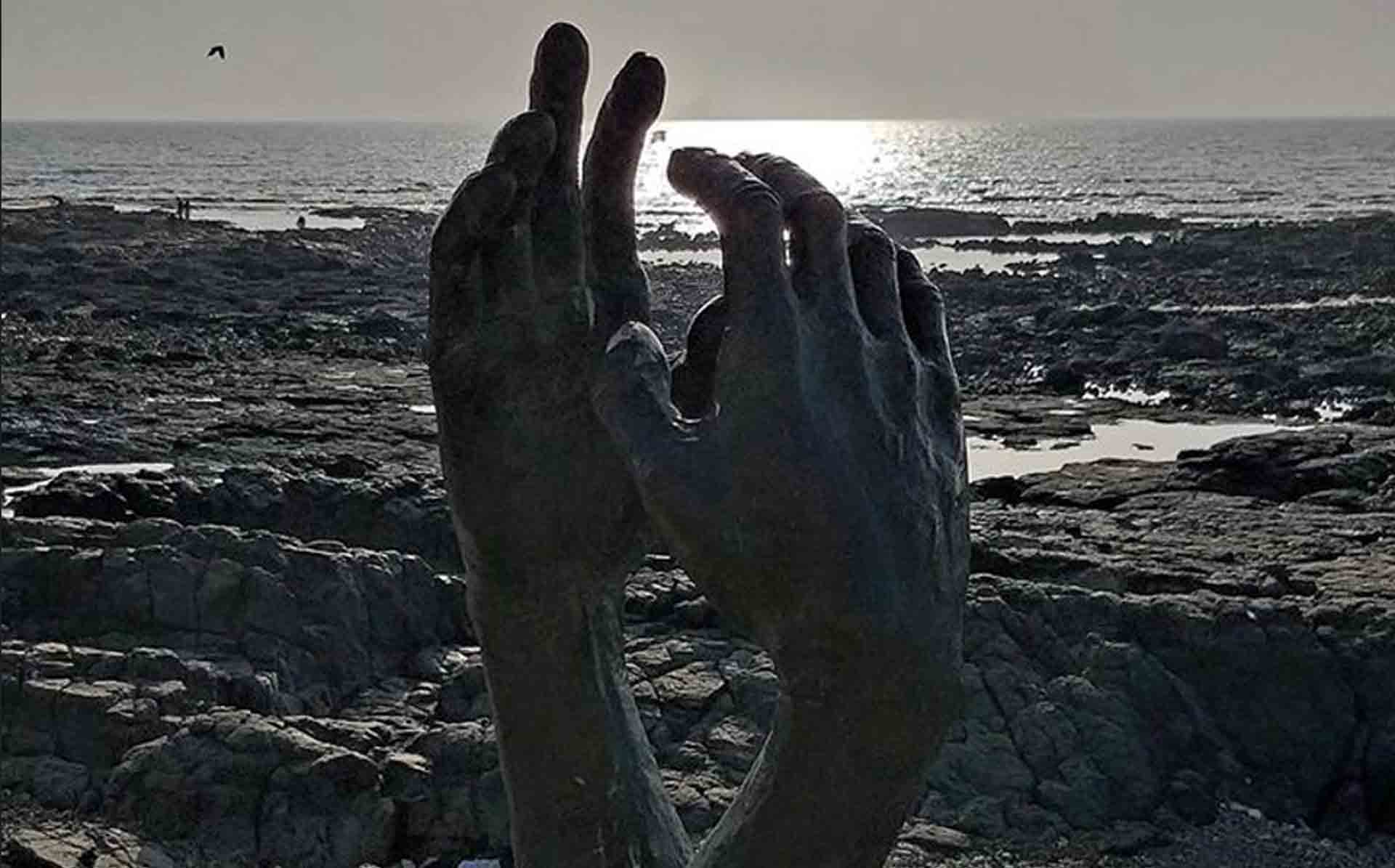
    In retrospect I think Ma was orchestrating the whole event because everything fell into place seamlessly to make it near perfect. [highlight background=”#f79126″ color=”#ffffff”]Ma was a free soul and loved nature.[/highlight] And she loved Bandra too. What could be a more fitting tribute than a piece of sculpture by the sea on the Bandra Promenade? I named the sculpture REQUIEM and my heart swells in gratitude every time I catch sight of it. It will outlive me and my siblings but Ma’s name etched on the site, will be seen by future generations and live on forever.


    Requiem is a sculpture erected at Bandra on April 28, 2017.
    In memory of Late Manobina Roy, a pioneer woman photographer in India,
    and the spouse of legendary filmmaker Bimal Roy.
    
    Ms. Manobina Roy's photographs were finally exhibited. Recently.
    They are presently the talk of the art world.


  • The Bimal Roy Path

    The Bimal Roy Path

    I wasn’t the one who proposed a road in Baba’s name. It was my eldest sister. But she handed me the responsibility to see the project through sometime in the beginning of 2016. Without any warning she thrust a letter in Marathi into my hand and said imperiously : ‘Take this and complete the job. I am fed up of following it up’. My sister is a bit like Bertie Wooster’s Aunt Agatha. One doesn’t mess around with her if one knows what is good for one. The letter turned out to be from the BMC, granting permission to name a road Bimal Roy Path after Baba, but there was no mention of any location or time frame. My only link with this proposal so far had been with a friend of my sister. He told me that she had asked the BMC to rename the extremely dirty and sinister path leading from Bandstand to Mount Mary Church, alongside the wall of Shahrukh’s property as Bimal Roy Path.

    I remember saying to him it was better not to have a road named after Baba, rather than have this hell hole in his name. I never heard anything further after this so I presumed the project was shelved. Then out of the blue, sometime around July or August 2016, my young neighbour Aakif Habib called and said: ‘I believe you have permission to name a road after your dad. May I follow up on it? I am close to all the local biggies. I am confident I can push it through’. I was overjoyed and told him to go ahead. But this was a bit like putting the cart before the horse because there was no road to name as yet.

    Sometimes one can’t see the wood for the trees. The answer lay just outside our gate but till Aakif pointed out the possibility it had never occurred to me. Aakif had struck bulls eye. The present Bimal Roy Path was actually part of Mount Mary Road originally, but physically it was a cul de sac with just a few buildings on it leading to a dead end. But the wonderful thing was that the sign would be just opposite our bungalow. The site was the perfect choice. And the perfect date for the inauguration was Baba’s death anniversary on 8th January 2017. It seemed sufficiently far away to allow us enough time to complete the job.

    Now that the road and inauguration date had been identified we needed to decide what kind of sign should be put up. My two conditions were a) it should be aesthetic b) it should be timeless. Aakif came to the rescue once again. He produced architect Alan Abraham, John Abraham’s brother just the way a magician pulls a rabbit out of a hat. He said: Meet Alan, my classmate from school. He is well suited to the job, but you are free to choose someone else. But I took to Alan instantly and instinctively and I startled him by approving the very first design he showed me. He said don’t you want to see the other two? I said only if he insisted but my mind was made up. His wife Anca paid me a back handed compliment by saying she wished he had more clients like me. By this time it was the end of October and I was leaving for the US on 2nd November so I told Alan to go ahead and fabricate the sign while I was away. He nodded happily but when I returned I realized nothing had moved in my absence.

    That was when twinges of anxiety began to occur. These escalated as time went by because by now Alan had decided to create a garden around the sign and that created a lot of extra work because the space for the garden had to be created too. There was a lot of creativity in the air but not enough activity. By now it was mid December so I gently reminded Alan about the date of inauguration. He gave a yelp and said don’t be silly, it can’t be. That is when I realized he was working to a completely different timeline. After that there was a sudden flurry of activity, but I was completely thrown when I found gardeners still adding plants and finishing touches to the garden at 3.30 pm when the inauguration was scheduled at 4 pm. I was close to having a cardiac. I am a perfectionist so I couldn’t leave the site till it met with my approval. As a result the Chief Guest Priya Dutt arrived before I could change from my work clothes to the formal ones to make an appearance.

    But all’s well that ends well. By a stroke of synchronicity Aakif had invited Samina Naz, the Consul General of Bangladesh for the ceremony. Baba was born and grew up in Bangladesh so her presence seemed most appropriate. I requested her to say a few words and she graciously obliged. And then it turned into a garden party because the sign is actually part of a public garden in which we had laid out tables and chairs and an authentic Bengali high tea. Only when people left and the sign lights came on that the significance of the moment sank in. Bimal Roy Path was a reality at last. Isn’t it wonderful that both Ma and Baba have become a tangible part of Bandra’s history?


    The Bimal Roy Path was inaugurated on Jan 8, 2017,
    the 51st death anniversary of the legendary filmmaker.