We are a family, and the loyalty of the family must come before anything and everyone else. For if we honour that commitment, we will never be vanquished – but if we falter in that loyalty we will all be condemned.
–Mario Puzo, The Family
If a body catch a body coming through the rye.” “I keep picturing all these little kids playing in this big field of rye and all. And nobody’s around—nobody big, I mean—except me. What I have to do, I have to catch everybody …. I mean … I have to come out from somewhere and catch them. That’s all I do all day. I’d just be the catcher in the rye and all. I know it’s crazy, but that’s the only thing I’d really like to be. I know it’s crazy.
–J D Salinger, The Catcher in the Rye
The above passage from Salinger’s eponymous classic could very well aptly apply to Malayalam film director Don Palathara’s Sony–the Man Friday, the Eternal Do-Gooder, the Rainmaker–of his Christian commune, the family. Sheathed in sheep’s skin, stealthily hiding the stalking traits of a predator behind the camouflage he so cleverly wears, he wins the confidence, trust and goodwill of his unsuspecting community.
Salinger’s Holden Caulfield is a hunter, hunting innocence—not to ravish or pulverise it, but to save it, to nurture it, and give it space. Sony, on the other hand, behind the naïve, chameleon façade he fronts, is a noxious and nefarious satyromaniac despoiling innocents led unto his satanic acre in implicit faith he would deliver good education to them.
After all, this jobless, all errands man, is most sought after to tutor (he had been running a tutorial centre now shut down) those that are poor of poetry or weak in maths what have you.
Aided, abetted and assisted, of course, by the Family that constitutes the universe around him. Blinkered and ignorant of the blighted existence their benign hearted Sony lives, freely prowling and preying upon the Holy Innocents with impunity thrusted unto his lair.
In fact, one could say Sony is Palathara’s hideous Holden, unlike Salinger’s, habituated to satiate his lustful hunger preying on right before the righteous eyes of the Family that Sony comes from.
Through Sony’s “instinctual, insatiable, pedophiliac disposition” to “prey on pubescent children” Don Palathara starkly spotlights on the harsh realities of physical violence, sexual abuse, and societal corruption, in his latest directorial visitation in The Family.
With the church, and the community he comes from, blissfully brushing aside his felonies going against all Catholic precepts, taken in by his geniality, Sony scours, stalks and satiates his inner demon with wanton abandon.
Brushing aside any aspersions being cast on dear Sony says the man’s aunt, a nun, “Sony is bit over friendly with children” assertively dismissive of sister Rani’s misgivings about Sony’s trespasses stating “you had your share of silliness” vainly observing “everybody makes mistakes.”
In fact, akin to Pope Alexander VI in Mario Puzo’s The Family, belief that “God will ultimately forgive his many sins simply because, as pope, he is infallible and divine,” Sony’s nun-aunt too is convinced that he will be forgiven of all his transgressions, the Lord Jesus “who purifies sinners” would “wash away the sins of brothers and sisters,” as goes the priest’s litany in the wake of the suicide of a member in Family.
With the powers that be turning a blind eye to Sony’s treacherous trysts be it with Subi seeking to know to write poetry, or Stephy wanting to better in maths or the much older Aleema who is abused even as the family prays for the departed soul, the demonic man has a free run with the young ones around.
As if that was won’t enough you have Sony being asked to teach the students of the community schools thereby opening the field for exploitation even more widen open the Family or the Commune ensures the lascivious leopard has enough meat to feast upon for a lifetime.
For, after all, “it all begins with the family, that’s where all the vocations come from. Priests, sisters, brothers, deacons, we do not come flying down from heaven. We come from families.” (Eduardo Nevares, Roman Catholic bishop 1954)
Indeed, Sony and his saviours too form part of this ubiquitous assemblage that provide him the convenience, the comfort, and canvas to go about his business of charm offensive violations gleefully.
It may be posited that Palathara’s Family, coincidentally comes at a time when exalted Christian institutions the world over have been on the global scanner for all the embarrassing and wrong reasons.
From the hallowed, holiest of holy cities of The Vatican to God’s Own Country – Kerala – nearer home, paedophiles and sexual predators of the faithful having had a home run now in the public glare being tried for their infractions.
So much so, The Pope Francis himself, in the now famous documentary – Amen: The Pope Answers has had to face a barrage of disquieting questions from the young faithfuls, accepting “there is something rotten in the hallowed institutions of the Christian faith.”
That the misdeeds of several wearing the cloak and habit have come to fore and faithfuls are seeking affirmative answers from the Vatican’s Holy See speaks of the sordid state of affairs.
To a question by a victim that there is a lot of hypocrisy within the church, with its tendency to siding with the predator, the Pope concedes the problem is serious. More so, “cases involving the churches worse because people are destroyed exactly where they should be care for. The abuser destroys the child. If you are a church person hypocrisy and double living are horrible,” laments the Pope, unable to provide an assuring answer to the young man.
True. Rightly taking a cue from recent incidents that have rocked the hallowed institutions, director Don Palathara has sought to shed spotlight on the malfeasance in Family.
However, despite his exalted intentions, where Palathara’s Family falls short, while disclosing the despicable duplicity of adults and irreparable loss of innocence of children, is he turns Family more into an “architectural design construct” rather than haunting human drama with facile Deus ex Machinafinish.
Palathara sadly sacrifices humanistic, socialistic, and accessible approach to the narrative,spicing Family with his panoply of trademark and recurrent Christian imagery, motifs, symbols he draws sustenance from.
His overt preoccupation with niceties of minimalismand sparseness of form, preconceived set piece design constructions and highly nuanced aesthetics turn Family is more of a cinematographic experimentation.
Palathara who showed promise and provenance in his very first cinematic sojourn with the 2015, black and white Savam: The Corpse, through the fluent cinematography, stark visual imageries and his preoccupation with the workings of Christian institutions has once again sought to spotlight on the hallowed seminary in Family and the shepherded folk that follow the faith.
In the process Family comes across a complex film about the insidiousness of a community’s self-preservation conveniently brushing aside the quotidian conspiracy under the umbrella of virtuousness and righteousness and hoping St Thomas would “protect them (the children) keenly, as they “roam” the wilderness in carefree abandon, as also with “showers of mercy” on the culpable wrong-doers.
The Malayalam filmmaker Don Palathara’s first three films – Shavam: The Corpse (2015), Vith: Seed (2017) and 1956, Travancore (2019) – are marked by the Syrian Catholic setting and the style of slow cinema movement in which they’re shot. Shavam is about a sudden death of a young man in a family. Vith revolves around a farmer and his son who returns to his native place for good. 1956, Travancore is a period film set before the days of land reform. This FFSI award winner for the best film of 2020 deals with the lives of early migrants to the mountainous area of Idukki where Family has also been shot.Everything is Cinema (2021), is a first-person narrative of a filmmaker about his marital relationship. Santhoshathinte Onnam Rahasyam: The First Secret of Happiness (2021) is a single shot film about a couple who are living together and stressed that they may have a baby for which they are not yet ready. While Palathara’s films are not directed towards the popular audience, they are not issue-oriented films either. All his films are based on original scripts written by Palathara either alone or in collaboration. The compelling script of Family was written by him along with Sherin Catherine. Family is his best film which goes back to the Syrian Catholic setting and makes a deeper study of it.
SYNOPSIS
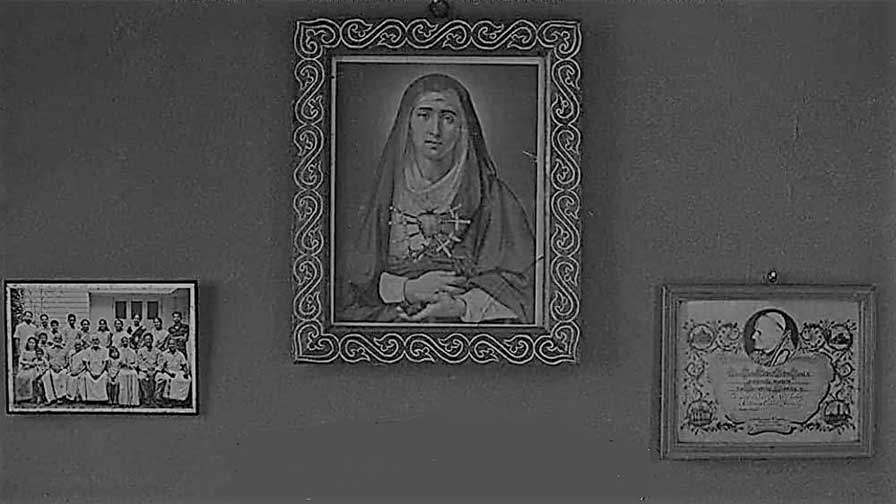
The title of the film is ironic as it refers to not just a family but the closely-knit community in the small village which follows religious rituals. In the early part of the film the entire village has turned up to attend a wedding. A barber addresses the gathering there, requesting permission from the ‘family’ for beautifying the groom! The shaving in public is followed by a dance performance by teenage girls. Some of the lines of the song for which they dance are about protecting children: “On your children who roam – Protect them keenly – With your showers of mercy, St. Thomas”. Later it’ll be known why it’s relevant to Family.
Sony, a young man has a good standing in this community. He is a math tutor for a young girl and a poetry teacher for a young boy. Sony takes initiative in rescuing a cow, laying a road and fundraising for a burial. He attends youth league meetings and helps the women and the elderly. But there is something amiss about him. Under the veneer of a do-gooder, his acts are disturbing and impact others. How will the ‘family’ address it?
THE POWER OF ELLIPSIS
The scene in which Sony tutors a young girl in her house is shot creatively. Normally such a scene will show Sony and the girl in the foreground with an insignificant and unobtrusive background so that we can understand the foreground action clearly. This scene makes an entirely opposite approach. After showing the girl in a medium shot in her room, there is a cut to the living room. In the foreground we can see the girl’s father sitting in a cane chair and watching TV oblivious to what is happening in the room nearby. In the background the audience can see Sony sitting at a desk through the entrance of the room but the girl can’t be seen. At some point Sony gets up and goes to the other side of the desk so the audience can’t even see what’s going on. The significant action by Sony in the background is left to our imagination. It’s all the more disturbing as Sony takes advantage of the trusting father of the girl in the foreground. The gravity of the scene is deeper by withholding the main part of background action.
Warning: This article contains spoilers
LEOPARD ON THE PROWL
Family opens with the conversation on the leopard between Sony riding a bike and Subin sitting behind him, announcing the recurrent leopard theme. A leopard from the adjoining forest is on the prowl. There are evidences of its presence as it preys on a calf and a chicken. But the film doesn’t show the leopard until the penultimate scene. Traps have been dug up to catch the predator but it’s a cow which gets caught in the trap and rescued. At some point we realize the connection between the leopard and the protagonist Sony. Unlike the animal which the villagers try to catch by setting up traps, Sony is “cured” and even rewarded. Finally, when we see the leopard in full view, we realize the enormity of the danger caused by the animal as well as the human beast.
STRUCTURE
The parallel with the leopard structures Family, conveying the predatory nature of the film’s protagonist. Just as we only see the signs of the leopard’s preying, Sony’s sinister actions aren’t shown but their effects on his victims can be seen. The effort made to catch the animal contrasts with the virtual license given to Sony in the end.
The film is replete with Christian imagery. Don Palathara knows his setting in his native Idukki district in Kerala well so the film looks authentic. The detached static shots with long takes have a built-in ambiguity. In a film in which the background music is minimal, the prayers and hymns in Malayalam form a recurring background on the sound track. While it’s a comment on the hold of religion on the community, there is also a spiritual aspect to these scenes.
THE GOOD SAMARITAN
Although the film has an understated satirical tone, it is largely in the nature of presenting a phenomenon and letting any conclusion emerge out of it rather than spell it out. It’s significant that the protagonist Sony is not portrayed as a villain although his good deeds come under scrutiny. He has to be a helpful person so that he can control people to his advantage. In a well-conceived scene, Sony removes his shirt and lies down next to Subin in the bed. He admonishes Subin for his misbehaviour in the school. This scene shows how Sony has an exterior persona of somebody who is concerned about Subin’s welfare but in fact he exploits Subin’s weakness for approval in order to get physically close to him. The sensitive Subin feels bad for displeasing Sony and runs away from home for a while. In yet another notable scene, Sony goes by his father’s words and conveys to Neethu that he’s putting an end to their relationship. Sony is shown as a master manipulator who is able to derive sympathy from Neethu. She even tells him that she feels sorry for him! One person Sony can’t control is Subin’s elder brother Noby who has perhaps seen through him.
Sony may be aware of what he is doing and perhaps he looks upon religion to reform him. He listens to the advice of the nun and attends the retreat. The role of Sony is played by Vinay Forrt who comes up with an excellent performance, bringing out the complex character. Sony’s condition may be hebephilia “in which people display a sexual preference for children at the cusp of puberty, between the ages of, roughly, 11 to 14 years of age.” [1] As per this article, Humbert Humbert from Vladimir Nabokov’s masterpiece “Lolita” falls in the category of hebephile and not pedophile as this fictitious character is known. Following is a summary of some of the findings about hebephilia in [2]: Prenatal factors contribute to hebephilia. Non-righthandedness, lower IQ, lesser educational performance and short height have been found. Neurocognitive functioning is another important aspect. Suffering a head injury before the age of 13 could be a contributing factor. Disconnection in the brain network that recognizes and respond to sexual cues may cause a deviant sexual preference. Experiencing sexual abuse as a child or young adolescent increases the chance of committing sexual offence against minors in the future.
THE RETREAT
In one of the best scenes in the film, Sony’s aunt, who is a nun, silences Rani, yet another aunt of Sony, who had reason to suspect Sony of committing a grave act. In an earlier scene Rani shares her suspicion about Sony with Subin’s mother Jaya. Determined to whitewash Sony’s acts, the nun admonishes Rani, the lone sane voice. The nun has come with an alliance for him as well as a job as requested by Sony’s father in the early part of the film. In yet another remarkable scene, she advises Sony in the car to put an end to his “silliness” and takes the approach of “reforming” him by sending him to a retreat which, she claims, can cure even the incurable ones. She assures him that if he sincerely repents and prays, the lord will forgive him.
The retreat scenes with charismatic high energy preaching full of shouting hallelujah by the group followed by one-on-one counselling are also among the best in the film. Sony is being saved just like the cow which was rescued. But Sony is in fact a leopard masquerading as a cow. However, the film treats the characters with complexity. This helps in evoking empathy for them.
THE ENDING
In the school assembly, Sony is introduced as a new teacher. The students are asked to applaud and welcome him. Halfway through the singing of the prayer song it starts raining so the students run towards the school building. The piety of the welcome for the teacher is subverted. It’s shocking that the predator is offered his prey on a platter. We realize that this is in fact a horror story. In the following scene the leopard which has only been talked about is shown in full view. It is a couple of children who happen to witness the leopard. Likewise, it’s the children who’ll come to know the leopard in Sony. He has an entire school at his disposal. The last freeze frame shows Sony with school children around, sending chills up our spines.
CINEMATOGRAPHY
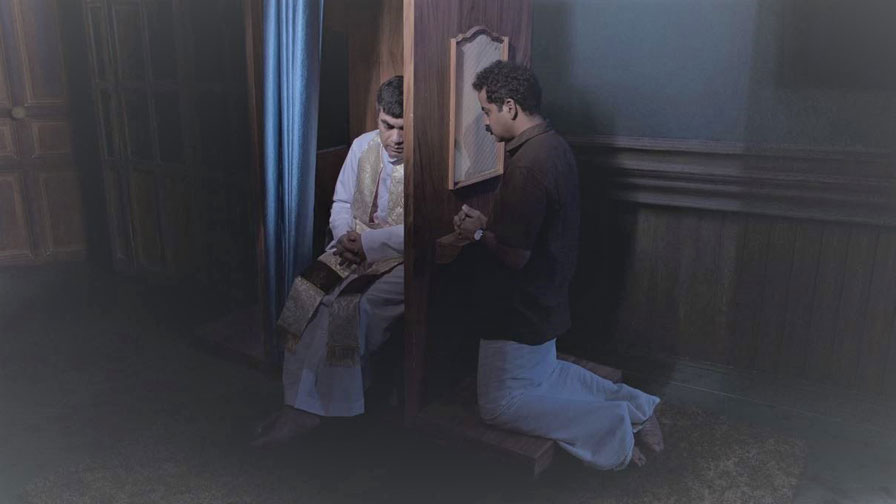
Jaleel Badusha’s camera follows a rigorous scheme of static shots with long takes which has paid off. The high angle shots in a number of scenes help in depicting the vulnerability of the characters. There is an unusual composition in which a young boy is seen sleeping in a sofa in the foreground while a mass is being performed in the background. Such a scene will usually focus only on the mass which will appear to be too carefully composed. In real life, if a child is sleepy, it’ll be put to sleep and the rest of the group will continue with its activity. This is the way it’s done in this scene in Family which makes it contrapuntal. On the other hand, the house prayer scene is carefully composed but, even in this scene, Sony is looking at the camera. Perhaps the fourth wall is broken to sensitize the audience to the presence of the wolf among the sheep which offsets the piety. The confession scene is somewhat like how employees in a company state something innocuous when they are asked to come up with their weaknesses as part of self-assessment.
The long takes demand competent acting skills. Don Palathara has made sure that the acting is uniformly good in the film. Apart from Vinay Forrt who excels in the role of the protagonist Sony, Divya Prabha as Rani, Nilja K. Baby as Neethu and K.K. Indira as the nun – called sister aunty in the film – have given very good performances. Dialogues are perhaps improvised as they sound natural.
Of late, it has become very difficult to make films which are even remotely critical of any community. Kudos to Don Palathara, Sherin Catherine and Anto A Chittilappilly & Co of Newton Cinema for coming up with a perceptive film like Family on a sensitive subject in these times. While the film is set in a milieu in which Palathara grew up, the film may be taken to be depicting in general how traditional societies look upon religion as a panacea. Family was among the best films of Bengaluru International Film Festival (BIFFES) 2023. It’s also one of the best in Indian cinema in recent times.
When Adoor Gopalakrishnan, one of the internationally acclaimed Indian filmmakers, launched his first feature film Swayamvaram five decades ago, it was after many years of sustained effort. After passing out of FTII, Pune in 1965, he found it difficult to get a producer who would back him. Hence, he took the initiative of forming a cooperative for film production along with his friends. There was not much awareness of international cinema in his state of Kerala at that time. Realizing the need for establishing a film culture, he took yet another initiative of setting up a film society along with his associates and brought out literature on cinema. Adoor himself penned articles in Malayalam to spread awareness about the medium.
The establishing of the cooperative helped Adoor in launching his first film Swayamvaram which was jointly financed by the erstwhile Film Finance Corporation and his Chitralekha Film Cooperative. It is based on a story and script by Adoor Gopalakrishnan who was assisted by K. P. Kumaran. The film won National Awards for Best Film, Best Director (Adoor Gopalakrishnan), Best Actress (Sharada) and Best Cinematography (Mankada Ravi Varma). The golden jubilee is an occasion to look at the film now, analyze it and place it in Adoor’s oeuvre.
Exposition
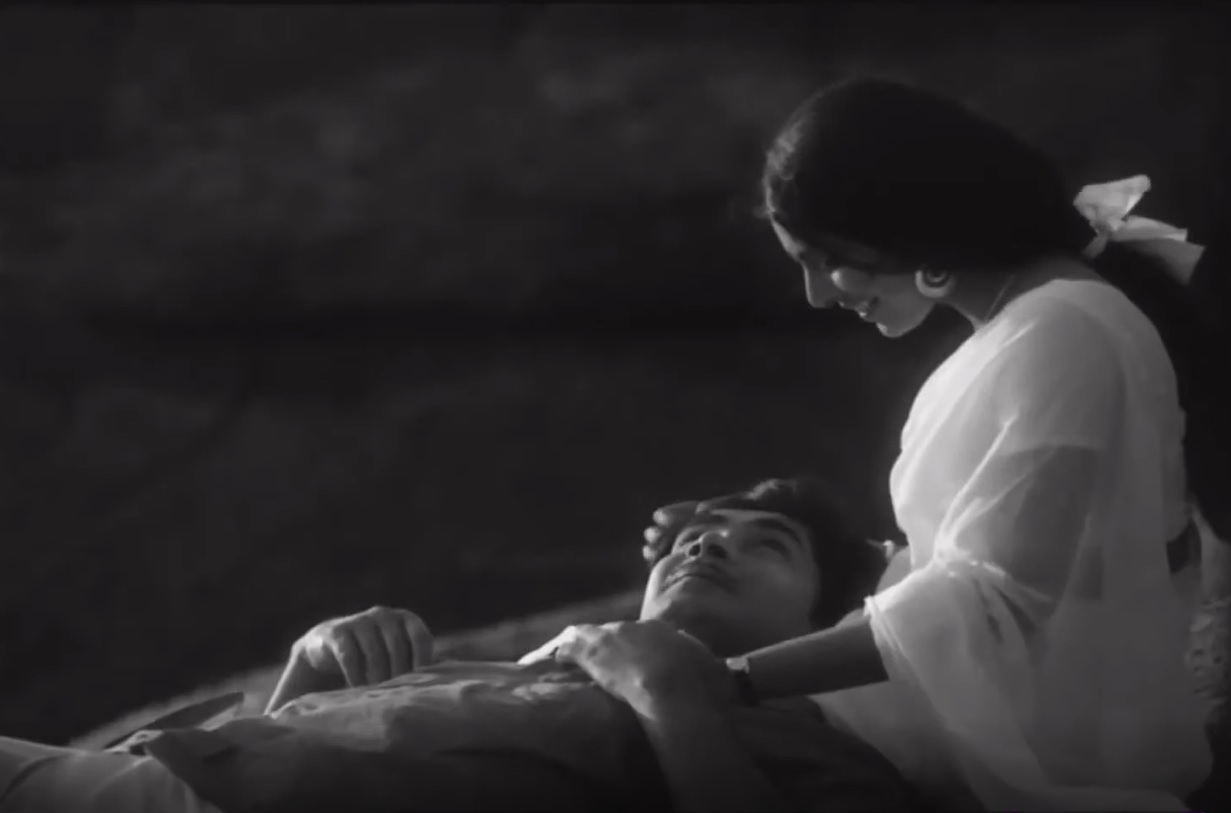
The film’s opening title sequence is shot inside a bus with a variety of passengers, some of whom are dozing off. Among them is a young couple with their faces animated. They exchange glances. The bus comes to a halt and we see them checking into a hotel room. The man asks his lover whether she regrets it. He wonders whether they gave enough thought to it. We realize that they might have eloped. A group of devotees pass by on the road in a procession chanting bhajan. It may appear odd to see the film showing the couple making love with the background of the bhajan on the soundtrack. The director’s intention here is revealed in Adoor’s interview in which he has said that he paired bhakti (devotion) with sex in that scene. [1] The essence of bhajan is bhakti. By being paired with bhakti, sex gets associated with devotion as another aspect of it. Separated from their families, they are mutually dependent on each other which leads to devotion as well as the fear of losing the loved one as seen in the dream sequences which follow.
Synopsis
Madhu and Sharada in Swayamvaram
In Swayamvaram, a young couple, Sita (Sharada) and Vishwam (Madhu) fall in love perhaps against the wishes of their parents and leave their village to live together in the city. They face the challenge of surviving on their own in a climate of acute unemployment. As Vishwam’s literary aspirations are crushed, he takes up a teaching job but loses it. Later he gets only a low paying job of a clerk in a sawmill that too by replacing a dismissed employee who worked for twelve years there. Now that the couple have a child, Vishwam has to bear with the insinuation of the previous employee who stalks him. Vishwam is haunted by the hounding but his job is important to him. When he falls sick the situation becomes grave.
Structure
Swayamvaram (1972) starts with the journey to the city of the young couple with their illusions followed by the hard reality they experience there. What Sita goes through has some parallel with the female protagonist Sita in the epic “Ramayana” which gives a resonance to the film. The title refers to the swayamvaram (meaning one’s own choice) of Sita who wedded Rama out of many princes in the epic. There is the picture depicting it that hangs on the wall of the house of Vishwam and Sita. Vishwam is her own choice for Sita in the film and not that of her family so it is a swayamvaram for her too. But Sita in the film is not exactly in the mould of Sita in the epic. She elopes with her lover to live together with him, making the subject daring for its time.
In the Forests of the Plight
Just as Sita in the epic had to undergo hardships by having to go to forest, in the film also Sita has to go through adversities. The dream sequences in the early part of the film portend Sita losing Vishwam. He climbs down the rocks towards the sea as she keeps gesturing to him to come back. In another dream sequence Vishwam lies down keeping his head on the railway track with the approaching train’s sound on the soundtrack. She runs upto him and forces him to get up. In yet another sequence she chases him in the woods and loses him. It has memorable tracking shots of her running in the forest looking out for him. Sita being renounced by Rama in the last part of the epic (Uttarakandam) has its echo in Sita losing Vishwam in the end.
Illusion & Reality
Sita and Vishwam are shown acting like lovers in commercial cinema in the dream sequences. The theme of illusion is taken up in a dream sequence showing posters of hero and heroine in love from Malayalam commercial cinema in which love is romanticized. Sita and Vishwam would have grown up watching such films and imagined that life will be rosy as it is depicted in films. Later in Swayamvaram it turns out very hard to survive as job is very difficult to get for both of them. Without any support system Sita and Vishwam are dependent on each other. Reality dawns on Sita when Vishwam falls ill.
Retrenchment Theme
Vishwam happens to see briefly a leftist party meeting in which the speaker talks about how the working class is misled by various parties. He adds that all of them obstruct the struggle of workers and their liberation. Much later in Swayamvaram after losing his job, there is a scene which shows a political march in protest against retrenching workers. Vishwam quietly watches it passing by. It seems the film was not given an award at the Moscow International Film Festival in which it was nominated. Adoor has said that the jury was surprised that Vishwam didn’t join the march of the workers which costed the film an award. Vishwam himself has been retrenched from his job. Yet he doesn’t join the march. Adoor has said that the reason is “he doesn’t see himself as part of this. This has to be understood because the other thing is simplistic that he also joins it. That’s the kind of films we used to send to Moscow.” [1] Vishwam doesn’t belong to the working class. Hence it wouldn’t have been appropriate to show him in the stock manner which would satisfy the expectation of the audience and an agenda driven jury. This is an important aspect of Swayamvaram which makes it stand apart.
The theme of retrenchment has been treated in its complexity in Swayamvaram. While the sawmill owner appears to be unfair in terminating a long-time employee, the friendly tutorial college owner with debts is forced to ask Vishwam to leave. The scene in which the owner takes Vishwam for a drinking spree is memorable.
Safety and Security of Women
Women’s safety is yet another theme in the film. Vishwam and Sita move to a second hotel which is cheaper. Sita gives away her golden bangles, perhaps the only precious jewelry she has to Vishwam. It’s for buying a mangalsutra (golden signet in a chain worn by a married woman) to let men know of her marital status and ward them off. This scene also suggests that Sita and Vishwam are living together perhaps without getting married. Sita is terrified by the way she sees a drunkard when she opens the hotel room door on hearing the knocking of the door. She is even afraid of opening the door when Vishwam arrives. Sita wearing the mangalsutra doesn’t restrain smuggler Vasu who has an eye on her. Three drunkards try to barge into her house and make unsavoury remarks about her.
The Women in the Film
K.P.A.C. Lalitha
Swayamvaram came up with very well etched characters, particularly women. Sita is a bold woman who takes the courage to leave her family to live with her lover. She is resolute and strongly willed unlike Vishwam who keeps wondering whether they made the right choice. Kalyani (K.P.A.C. Lalitha), is a prostitute living in the opposite house whose husband visits her to collect money for liquor. She is smart enough not to let him exploit her at some point. The middle-aged widow Janaki (Adoor Bhavani), the rice seller neighbour of Sita, is very helpful to her. Sita protects herself from the prying eyes of men and lives with dignity. It is impossible for the smuggler Vasu to make advances to her as Kalyani says.
Casting
Bharath Gopi
Casting of Madhu as Vishwam was right as he underplays the role unlike most of the actors of that period who were known for their dramatic style of acting. Sharada was known as a talented actress and she had already won the National Award for Best Actress for Thulabharam (1968). She was the right choice for Sita and she got her second National award for Swayamvaram. Gopi turned out to be a great discovery by giving a haunting performance as the fired employee. The rest of the cast also performed well in the film.
The Ending
In the end when Vishwam passes away, Vishwam’s colleague suggests that she can live with his family. Janaki tells Sita to return to her parents. Sita rejects both the options. Once again, she makes her own choice. Her condition can be looked at in terms of the parallel of her situation with Sita in “Ramayana” who was renounced by Rama in Uttarakandam. In the last scene there are the sounds of thunder and pouring rain as Sita feeds her child. Water leaking from the roof falls down over the picture of swayamvaram on the wall which is lit up by the lightning. The last shot is ambiguous as it shows Sita having an eye on the closed door, concerned about safety. While she is willing to face the world on her own, the future is uncertain.
Swayamvaram is one of the first Malayalam films that featured direct recording of sound (synchronized sound) and outdoor locales. It’s also considered to be the first film in Indian cinema that used sound as a leitmotif: There is the recurrent sound of wood being cut in the sawmill. This cutting sound is especially powerful when Vishwam passes away.
In an interview with C.S. Venkiteswaran, Adoor has said that the Film Finance Corporation (FFC) rejected his application for finance for a film based on a script written by C.N. Sreekandan Nair as it was a love story. FFC didn’t sanction the loan because the script didn’t take up any of the issues facing India. [2] Perhaps the issue of unemployment that Swayamvaram deals with helped in getting the finance from FFC. To compare it with Adoor’s second film onwards upto Anantaram, the approach in the latter is that of a biography of an individual. The films are very much rooted in the social landscape of Kerala but they are not issue based. Even in Swayamvaram, while the story deals with a social issue, it has other dimensions too. Its parallel with the epic “Ramayana” gives it a connotative meaning.
In retrospect the title reflects Adoor’s own choice of treading the untrodden path of art cinema with all its risks. He has been hugely successful in creating a body of work that is world class and becoming a major force in Indian cinema. A pioneer of the new Malayalam cinema movement, he inspired several other art filmmakers. Swayamvaram’s daring subject, complex treatment of the theme of retrenchment, parallel with the epic and ambiguous ending mark Adoor’s first film, revealing an original style of filmmaking which has helped the film’s longevity even after five decades.
Fire asks society a few uncomfortable questions. Is the desire to love someone beyond the periphery of the heteronormative relationship a sin? Can a woman not love another woman, or a man love another man? Even in this modern age, why do certain societies step backwards and attempt to regulate the bodily desires of individuals? From whence came this law that only a man and a woman have the right to be in a sexual relationship? Who deems what is perversion, and therefore illegal? And who gave any section of society the right to declare that sexual activity should be undertaken solely for reproduction?
The film traverses through various forms of relationships that individuals escape to, unmindful of the confined lens through which sexual desires are viewed by traditional Indian society. A sexual relationship between two women, an extramarital affair, and the denial of all forms of desire come to the fore while how bodies should behave and who determines this so-called correct behavior underlie each of them.
The family system in India is majorly a patriarchal one in which power is wielded by the eldest male member and the rest willingly or otherwise are required to obey the dictate. In Fire, the male head not only pressures his younger brother into marrying a woman and starting a family of his own but also decides how restrictively his own wife’s body should behave. This male head, though he is married, chooses the path of asceticism, but conveniently holds authority over other peoples’ bodies. In practicing austerity in the name of spirituality, the bodily needs of his wife are sacrificed too. Since she has no one to share her love and pain with, the wife ends up indirectly being a part of his penance.
Patriarchal power often brings with it repression in the form of moral policing, silencing of topics that revolve around sex, and an unspoken insistence on women to engage in the sexual act solely for the purpose of reproduction and never as a means to fulfill sexual desire. In Fire, a girl with a name symbolic of all that is pure rebels to the extent of finding sexual gratification not with a man but with another girl, and the other girl is one who engages in sex with multiple male partners purely for her sexual pleasure.
Deepa Mehta’s lead women appear to have been deliberately named, originally, after religious figures associated with purity. This was done perhaps to provoke the idea of their utmost dedication towards family values and loyalty towards their respective husbands. Initially portrayed as the typical household women burdened with taking care of other members of the family as well as the everyday household chores, they eventually disrupt the conventional ideas of societal balance by finding a companion in each other.
Sex is a private matter, yet the authority, be it the State, the male head, or a charismatic persona, seeks to know the truths of this private sphere. Such private information is used by those in power to control what they deem futile activity by passing judgement on these deemed acts of perversion. In Fire, this authoritative figure comes in the form of a priest who commands confession on the part of his subject, and classifies pleasure as a sin and female sexual bonding as abnormal, and upholds the value of chastity above all.
Fire breaks stereotypes and exhibits the different needs in a relationship. The conjugal life of the two different couples in it are the very opposite of what is usually depicted in Hindi cinema: smooth and happy. While one brother completely abstains from sex, the other embraces a relationship outside marriage purely for sexual pleasure. The film also exposes a familial hypocrisy. Though sexual pleasure from a relationship outside of marriage is often heavily reprimanded, it is sometimes conveniently ignored if the consummation in the conjugal sphere has a possibility of leading to an offspring, preferably a son, a utilitarian product displaying the legality of a relationship.
Adoor Gopalakrishnan’s Anantaram (1987), his fifth film and its three preceding films have a common approach of a biography of an individual. They get deeper and deeper as we move from his second film onwards. While Kodiyettam (1978) follows the carefree Shankaran Kutty attaining maturity, in Elippathayam (1982), Unni is like a rat in a trap, caught in his feudal ways. When Sreedharan a revolutionary communist leader makes a comeback from hiding in Mukhamukham (1984), he is a defeated man much to the dismay of the people who look up to him. Anantaram, which differs from them with its narrative strategy, is Adoor’s magnum opus. Analysing it will help in understanding its import and what Adoor achieved in it.
If one attempts to write the story in brief for Anantaram, one may end up putting down its plot instead. In place of the terms, “story” and “plot”, David Bordwell uses the terminology of Russian Formalists who call them as fabula (sometimes translated as “story”) and syuzhet (usually translated as “plot”). [1] In Anantaram the fabula has to be constructed by the viewer from the syuzhet which is presented by the film. Ajayan also known as Ajayakumar (performed exceptionally well by both Sudheesh as a boy and Ashokan as a youth), the protagonist of Anantaram, tells his story in one way and as the title goes (Anantaram means ‘and then’/‘whereupon’), he tells his story once again which doesn’t have much correspondence with the previous one. There have been films such as Akira Kurosawa’s Rashomon (1950) and Tom Tykwer’s Run Lola Run (1998) having different versions or points of view of the same events. In Anantaram the two versions are told in the first-person narrative by the same person which is rather new. The English title of the film is ‘Monologue’. It is in fact a double monologue and its structure can be called as “Double monologue/ narrative in the same first-person point of view”.
Ashokan in Anantaram
In his first version, Ajayan recounts that he was an unwanted child abandoned by his mother after his birth in a hospital. The doctor in the hospital raises him as an adopted son affectionately. His extraordinary talents alienate him from others except his foster brother Balu (played with a quiet presence by Mammootty) who is studying medicine. When he grows up and goes to college, he gets estranged from Balu– a doctor now – too when he gets strangely attracted to Balu’s newly wedded wife Sumangali called Suma (performed sensuously as well as hauntingly by Shobhana). With the feeling of guilt due to that he leaves home and he is apparently driven into suicide. Ajayan comes out quite the contrary in his second version in which he is far from being a gifted child. Suma resembles Nalini (also played by Shobhana) with whom he was in love, which torments him further.
Ajayan has been abandoned by his mother somewhat like Karna in the epic “Mahabharata”. Balu reminds us of Duryodhana who bonds with Karna, admires his great skill in archery and feels that he doesn’t get his due owing to his pedigree. Ajayan comes to know about his real parentage like Karna. While such a reference to the epic can enhance the appreciation of Anantaram, the characters in the film are not in the epic mould. The literary antecedents to the dual personality that comes through in Anantaram can be traced to several works which use the strategy of doubling identities. Of particular interest is Dostoevsky’s “The Double: A Petersburg Poem” (1846) in which Yakov Petrovich Golyadkin, a titular councilor, encounters his friendly doppelgänger. The Golyadkin Jr. though turns his bitter foe taking his place causing Golyadkin Sr. a nervous breakdown. Golyadkin Sr. is probably a schizophrenic who is driven to insanity. In Anantaram too it could be one of the interpretations as there are indications such as Balu asking Ajayan in his second version whether he has taken his medicine. Mikhail Bakhtin developed the concept of ‘polyphony’ meaning multiple voices about which he has written, “A plurality of independent and unmerged voices and consciousnesses, a genuine polyphony of fully valid voices is in fact the chief characteristic of Dostoevsky’s novels. What unfolds in his works is not a multitude of characters and fates in a single objective world, illuminated by a single authorial consciousness; rather a plurality of consciousnesses, with equal rights and each with its own world, combined but are not merged in the unity of the event”. According to Bakhtin the multiple voices haven’t become fully independent in “The Double…” unlike in Dostoevsky’s longer novels. [2] The structure of Anantaram can be viewed in this light. The two voices in Anantaram are that of the protagonist but they are quite distinct. Since they are presented in two versions, the polyphony in Anantaram could be called polyphony of the protagonist in time.
Shobhana in Anantaram
The interpretation of Ajayan driven into insanity due to schizophrenia is a denotative meaning of the film which fits up to a point. The two stories that Ajayan narrates are about the two separate realities in which he experiences to exist. While the first one is shot in the realistic style, some of the scenes in the second are expressionistic. Nalini in Ajayan’s second story could be part of his imagination. Adoor pulls off quite a coup by having Shobhana play both Suma and Nalini to indicate that Ajayan is strangely infatuated with Suma as she appears like Nalini. The other world, that is imagined by him, dominates the perception of Ajayan. But just when we create the fabula (story) based on this, we’re confused by seeing Ajayan’s roommate pick up a rose from the floor and ask Ajayan whether someone was there. We have an unreliable narrator who creates ambiguities.
The narrational gaps in Anantaram call for multiple interpretations of a higher level, bringing out its connotative meaning. Regarding how to do the interpretation, David Bordwell has written that “the procedural slogan of art-cinema narration might be: “interpret this film, and interpret it so as to maximize ambiguity””. [3] Going by that, we can discern the unintegrated personality of Ajayan who has in him mutually opposite elements. He has both extraversion and introversion. The servants appear helpful but not really so. His foster father might even be his real father. There is a hint that the yogini who is affectionate towards him could be his mother who abandoned him. He is all admiration for Balu but later he notices Balu ogling at a lady who is on her way back home after bathing. He can love Nalini but she is not real. Her look-alike Suma is a real person loving whom is forbidden. Like his counting of the steps in odd numbers and then in even numbers, he encounters things in dual form. It is very hard for him to synthesize such contradictory elements which push him to the edge. This interpretation of unintegrated personality is a view of Ajayan that is created in our mind by putting together the two versions that are narrated by the protagonist Ajayan.
Adoor’s illuminating interpretation of Anantaram is that it is about storytelling as mentioned in his “Director’s Statement” in his website. To quote a few lines from it, “[Ajayan] is drawing up on the experiences from his life basically from two stand-points – that of an introvert and an extrovert, the two positions we all keep shifting from time to time…Each story picks and chooses from those experiences from his life that go to prove its theme. The stories do not contradict themselves, instead they complement each other. The stories jell together because there is a certain built-in ambivalence in his life.” [4].
It speaks for the richness of Anantaram that the presence of the two independent voices in the film supports a dialogical discourse too. While narrating his stories, Ajayan doesn’t find the self to be coherent but alienated and fragmented. His dual voices point to a dualistic or divided self with a doubled and divided mind. Hence the two stories that his two voices narrate are like thoughts of two different minds. Applying Mikhail Bakhtin’s concept of polyphony to the film suggests a dialogical discourse.
Such an approach will lead to yet another interpretation: Unravelling the mystery of one’s psyche and searching for one’s identity may lead to one’s self-destruction. In this view, Ajayan’s search for identity starts right from when we see him crying as a child for mother’s milk. Questions on who are his mother and father haunt him. True to the meaning of his name Ajayan (the invincible one), his performance is extraordinary in studies, sports etc. but he excels in everything perhaps to make up for his lack of identity. The film makes an acute observation that super competence may end up as a failure. Yearning for a caring woman, Ajayan develops a liking for an elder girl Lata which is thwarted by a couple of senior boys. He gets attracted to his foster brother Balu’s sensuous wife Suma which ruins his studies. Curiously, the meaning of Suma’s full name, Sumangali, is “a married woman whose husband is alive”. He confesses his feeling of guilt for his forbidden feelings for Suma which apparently leads to his suicide. The second version is clearly in a different voice, making us recognize that there are in fact multiple voices in one person which may come into conflict. Perhaps the voice in the first version overstated his ability as the voice in the second one doesn’t portray him as gifted. “Ajayan” turns out to be an ironical name. The two versions view the servants differently. The three caring servants in the first are made to look iconic like the male counterparts of the three witches in Macbeth, inflicting pain on him perhaps because they know that he is the foster son of their employer. Later Ajayan comes to know that his foster father whom he has been calling as “uncle” and the yogini could be his real parents. He must have been very much disappointed that he was denied his identity. While the love for Suma is forbidden, the love for Nalini cannot be materialized. When he goes to meet her in her house, she is called Malini which is the name of a yakshi (seductive spirit). His identity as a lover is in question. Ajayan doesn’t find the world knowable. In the end he says that there are some more things that he hasn’t told us and some he has forgotten, hinting that there could be more versions. But he is nowhere near fathoming his psyche. The ending is unresolved. Ajayan’s problem is that he is very sensitive and he is aware of the futility of his search which torments him and leads him to his self-destruction.
Some of the filmmakers from Kerala ushered in a different kind of modernity to Indian art cinema. As M. K. Raghavendra has written, “Adoor Gopalakrishnan (Anantaram, 1987), G Aravindan (Esthappan, 1980) and John Abraham (Amma Ariyan, 1980) eschew the ‘critique of society’ model in Indian art cinema and reintroduce (authorial/character) subjectivity as strategies… [Kerala] appears to have arrived at its own kind of modernity without the mediation of the West.” [5]. Among them, Adoor came up with arguably an innovation in form to depict a dual human personality in Anantaram. It would figure in the top 5 all-time great Indian films that rank high internationally although it is not as widely known as it should be. For, Adoor Gopalakrishnan’s Anantaram is a monumental work in Indian cinema and has its place in world cinema as well.
References
Bordwell, David. “Narration in the Fiction Film”, New York, Routledge, 2014, pp 49-50.
Bakhtin, Mikhail. “Problems of Dostoevsky’s Poetics”, Minneapolis, University of Minnesota, 8th printing, 1999, p 6& p 220.
Bordwell, David. “Narration in the Fiction Film”, New York, Routledge, 2014, p 212.
Even before Satyajit Ray made history with his first film ‘Pather Panchali’ in 1955, he had written a script based on Rabindranath Tagore’s novel published in 1916, “Ghare Baire” (The Home and the World) [1], that was to have been directed by a friend Harisadhan Dasgupta according to the official website of Ray [2]. The Tagore novel continued to fascinate him though. In the early 80’s he revived the project, produced by NFDC, with a new script as he wasn’t happy with the earlier version. Despite suffering a heart attack and undergoing a bypass surgery, he got the film completed by his son Sandip Ray under his supervision. It was nominated for Palme d’Or at Cannes film festival 1984 although it didn’t win the award. It received positive reviews from foreign film critics such as Pauline Kael [3], Roger Ebert [4] and Vincent Canby [5]. However, ‘Ghare Baire’, in general, didn’t get the kind of acclaim that Ray’s ‘Charulata’ (1964), yet another adaptation of Tagore with a love triangle, received. In this Satyajit Ray centenary year, it is richly rewarding to have a relook at ‘Ghare Baire’ in which the master scaled new heights.
Background
Before delving into the novel and the film, there is a need to understand the effect the Swadeshi (meaning: of one’s own country and not imported) movement in the beginning of the 20th century had on Tagore which led to his writing of the novel. Lord Curzon’s partition of Bengal in 1905 drove a wedge between Hindus and Muslims and gave rise to the Swadeshi movement and boycott of British goods. But Indian made goods were much more expensive, widening the rift between them as most of the Hindus could afford the boycott unlike most of the Muslims.
In his remarkably well researched and comprehensive book, “Satyajit Ray: The Inner Eye”, Andrew Robinson has written elaborately on ‘Ghare Baire’ in the chapter “The Home and the World”. Robinson has written about Tagore and his family’s involvement during the beginning of the movement: “[Swadeshi movement’s] most enduring positive legacy is, by general agreement, the body of stirring and beautiful songs composed by Rabindranath Tagore as a Swadeshi leader, one of which is sung by Sandip in the film… Rabindranath and other members of the Tagore family had been among the earliest Bengalis to experiment with Swadeshi businesses” [6]. Tagore distanced himself from the movement when it grew violent in 1906, attracting criticism from the leaders. Robinson writes that Nikhil in the novel speaks for Tagore, quoting Satyajit Ray[6].
“Ghare Baire” the Novel
Set in the turbulent period that witnessed the Swadeshi movement in Bengal, the novel deals with the lives of an aristocratic couple Nikhil and Bimala who have been shaped by the ideals of Bengal renaissance. Nikhil’s friend Sandip, an anti-British nationalist with extremist views enters their household. A truly modern Nikhil encourages Bimala to come out of her quarters (zenana). He convinces her that only by meeting and recognizing each other in the real world there will be true love. Enticed by Sandip, she is willing to help his Swadeshi cause even at the cost of betraying her husband. But, as the events unfold, she comes to know of the violence unleashed by his rhetoric.
The title of the novel (“The Home and the World” in English) has multiple meanings. The obvious one is the aristocratic household and the outside world in turmoil that has an impact on the former. To look at yet another meaning, the prominent theorist Partha Chatterjee has written insightfully in his book “The Nation and Its Fragments” [7] that the nationalist discourse condensed material/spiritual distinction into outer/inner dichotomy. He has elaborated that the inner/outer distinction divided the social space into home (ghar) and the world (bahir). Chatterjee has come up with how they were represented: The world is the domain of the male open to the influence of the coloniser and the home is the domain of the woman which cannot be colonized. This dichotomy explains the way upper class women were confined, in continuation from an earlier period onwards, to the zenana, also called andaramahala. The progressive Nikhil wants Bimala to come out of the zenana, which is the home, to the outer apartment in their palace – the world to meet other men such as Sandip and continue to love her husband if he is worthy of it.
The names of the three main characters coined by Tagore fit their personalities. Nikhil means “whole’ which suits the aristocrat who is for universal brotherhood. Sandip means “kindling, arousing or exciting” which denotes the Swadeshi leader. Bimala means “pure” which befits Nikhil’s wife who attains purity in her love after undergoing a tortuous test at a heavy price. Their full names come through in the film: Nikhilesh Choudhury, Sandip Mukherjee and Bimala Choudhury. Perhaps it is as per the novel in the original Bengali as the English translation doesn’t give the full names.
The novel’s structure is that of the first-person accounts of the three main characters Bimala, Nikhil and Sandip who take turns to come up with their stories. Each one is given a few chapters then the novel moves to the other and so on in a round robin sequence. We get an insight into their minds and also the character progression of Bimala. The novel starts with Bimala’s story and ends with it, for she is the one who is most impacted by the events.
Apart from the main themes reflected in its title, there are several recurring themes in the novel such as Bande maataram (meaning “Hail Mother”, the opening words of a song, that extols India as the Mother, written by Bankim Chandra Chatterjee, the famous Bengali novelist), Bimala as Goddess, and characters misinterpreting the Bhagavad Gita. On Bande maataram Nikhil makes a case for universal brotherhood as against narrow nationalism. Sandip calls Bimala as goddess the very first time he meets her. His repeated addressing of her as goddess instils the self-image of the Shakthi of womanhood in Bimala. As she says in her story, Sandip subtly interweaves his worship of the country with his worship of Bimala making her “blood dance, indeed, and the barriers of my hesitation totter”. In this way Sandip manipulates her to look upon herself as the deity that will give boon to the worshipper by giving away money. Both Sandip and the young revolutionary Amulya misinterpret the Bhagavad Gita in their own way to justify their actions.
Tagore’s novel was praised by the playwright Bertolt Brecht (“a fine, powerful piece of work”), misread and panned by the Marxist critic György Lukács, and criticized as well as appreciated by the novelist EM Forster [6]. Forster came up with an observation that “the characters have to be accepted as vehicles for Tagore’s always interesting philosophy and not be required to function as individuals with a life of their own, which they are not” although Tagore appears to have based some of the characters in the novel on real people including himself. In “Ghare Baire” Tagore took up a couple of subjects of importance for him – emancipation of women and Swadeshi – and weaved a story around them in his poetic style. Because of its preoccupation with ideas, the novel appears to deal with types. It is essentially a novel of ideas where the clash of the personal and the political is handled with such intensity thanks to the force of conviction Tagore must have attained from his own experience during the Swadeshi movement.
Gopa Aich and Swatilekha Sengupta (nee, Chatterjee) in ‘Ghare Baire’
“Ghare Baire” the Film
Satyajit Ray made the film dramatic by changing the structure in his adaptation of the novel. Ray’s ‘Ghare Baire’ begins with the end: Bimala (Swatilekha Chatterjee (Sengupta)) is in tears after the tragic death of Nikhil (Victor Banerjee). There is the sense of foreboding doom accentuated by the theme music. The novel is preoccupied with the minds of the three characters so it is told as a series of first-person narration of them. Ray also brought in these voices but he simplified the structure for the film by having just two sections for Bimala and one section each for Sandip (Soumitra Chatterjee) and Nikhil. Bimala’s first story, lasting for 57 minutes, starts with about 2 minutes of her narration in which she recounts how she got married and entered Nikhil’s palace (reminding us of yet another outstanding Ray film ‘Jalsaghar’ (1958) which had a palace in ruins but the palace in ‘Ghare Baire’ is lived-in and very much in use). The rest of the section is in her point of view. There is her voice-over during the crossing of the passage with stained-glass windows by her for the first time. Sandip’s section, Nikhil’s section and Bimala’s second section start with a very brief monologue after which the rest of the sections are in their points of view. The durations for these sections are 15 minutes (Sandip’s), 15 minutes (Bimala’s second) and 12 minutes (Nikhil’s) respectively. The remaining part of the film running for about 50 minutes is in the third person omniscient point of view.
Analysing the structure of the film helps in understanding how it works. Although it is Nikhil who encourages Bimala to come out of the zenana, once she does it, it is mainly Bimala and Sandip who drive the events. Nikhil is a passive participant. In his section, Nikhil takes stock of the turbulence caused by Sandip but he doesn’t want to force himself on Sandip and Bimala. The last section shows the trouble sparked off by Swadeshis leading to communal violence, Nikhil asserting himself, Sandip’s leaving and the tragic end of Nikhil. Ray has invented several scenes of his own and enlarged the scenes, which are not in detail in the novel such as the speech delivered by Sandip for the benefit of the public. The Nikhil household has been created with all its period detail. The dialogue is almost entirely written by Ray using bare minimum lines from the novel. The conversations among Nikhil, Bimala and Sandip are invested with Ray’s touch of humour.
Satyajit Ray displayed his mastery of filmmaking right from his early films reaching a highpoint in ‘Charulata’. In ‘Ghare Baire’ he goes even beyond that peak to a higher level. The film is a masterclass which makes it worthwhile to see some of the scenes in detail. The title scene opens with the Swadeshi bonfire in the background accompanied by the ominous theme music on the sound track which ends with the cries of Bande maataram. Fire is a recurrent motif in the film. From the fire of the title scene, it cuts to the opening scene which shows fire raging in the estate at a distance, ignited by the communal violence. Then the camera pans left to the close-up of the teary eyed Bimala narrating her story saying “What was impure in me has been burnt to ashes”. No wonder she is named Bimala (pure). The camera then tracks closer to her as she says “What remains in me I dedicate to him who received all my failings in the depths of his stricken heart. Now I know there is not one like him”. Then there is a cut to a much bigger close-up of Nikhil with his wedding headgear as we hear Bimala saying on the sound track “It was ten years ago that I first met him”. The camera zooms out and cuts to a younger Bimala bedecked in bridal finery, perhaps being carried to Nikhil’s palace. On the soundtrack we hear Bimala saying, “He was the son of a noble family and I was his bride.” It cuts to her face in the huge picture of the couple – sepia tinted – and then zooms out to show both of them.
Then there is a cut to Nikhil’s sister-in-law (Gopa Aich) in white and we learn from Bimala’s commentary that she was already a widow when Bimala entered the household. The camera pans right to show Bimala as a servant plaits her hair. The camera tracks back to show both of them and the maids sitting in the corridor of the aristocratic mansion. The sister-in-law is clapping and swaying to the song played on the gramophone. This is an excellent opening which gives an introduction with economy and style.
Swatilekha Sengupta and Jennifer Kapoor
The scene in which the progressive Nikhil tries to convince his wife Bimala to come out of the zenana and meet his friend could have easily become heavy handed but Ray pulls it off with his deft touch! Bimala tries on various blouses made of imported cloth and designed by her to the appreciation of the sister-in-law who also comments on her foreign clothes and perfumes. Nikhil enters the scene, admires her dress and the couple sing a few lines of a Bengali song together. Is there a better way of capturing marital bliss? Ray infuses humour in the intelligent conversation which goes on as Bimala keeps trying on the clothes received from the tailor. Nikhil would like his beautifully dressed wife to be seen by his friends. Confining women to the house was not a Hindu custom in the past he says. He thinks that the Muslims introduced the custom. Towards the end Bimala hums the English song (Tell me the tales that to me were so dear, Long long ago, long long ago) she has learnt from her British governess Miss Gilby (Jennifer Kendal). Perhaps Ray suggests here that by now she is exposed to new ideas and she is open to them. This is the time when Nikhil tells her that he’ll be proud to persuade her to meet his friends. Bimala asks him whether he means the one in a photo on the table. It is that of Sandip whom Nikhil calls a genius. Ray manages to include a brief introduction to the Swadeshi movement when Nikhil is surprised that his wife knows about the movement and quizzes her about it. Bimala comes to know from her husband that so many articles in her room are imported: the thread with which her saree is woven, the brush, the mirror, the comb, the hairpins, the perfumes, the bottles made of cut glass, the table and the furniture. The marital bliss evoked in this scene is going to be ironically ruined once Bimala comes out of her confinement. It is an example of how set design, costumes, lighting, camera work, dialogue, competent acting and music (although very little in this scene) work together under Ray’s direction to make a memorable scene.
The meeting with Miss Gilby – who has a head injury after a schoolboy, influenced by Swadeshi, hit her head with a stone – conveys the hatred for the British that endangers innocent people. Miss Gilby leaves putting an end to all the learning of Bimala: singing, piano, English and etiquette. This scene is done in just one shot with the three of them in a triangular composition.
Soumitra Chatterjee
It is followed by the arrival of the demagogue Sandip at Nikhil’s estate to deliver a speech that fascinates Bimala. She sees him carried by Swadeshis on their shoulders through the grille from the first floor of the palace. As a leader of the Swadeshi movement Sandip captures the imagination of the public. Bimala too falls for his speech lasting for 4 minutes – written and shot so well by Satyajit Ray creating an impact. Sandip’s oration starts with a long shot of him, shot from behind the audience after which there is a medium shot of him which zooms into a close-up. The camera pans to show the first floor of the building from where Bimala is watching him from behind the screen. Cuts to Bimala’s profile and zooms into her. Cuts to her point of view shot of Sandip through the grille. Close-up of Sandip from the front, shot in low angle. Cuts to her profile shot and the camera zooms into her. Cuts to her point of view shot of Sandip through the grille and the camera zooms into him. Long shot of Sandip from behind the audience. Close-up of Sandip shot in low angle. Bigger close-up of Sandip in low angle. Cuts to Bimala’s profile and zooms into her. Cuts to close-up of Sandip. Long shot of Sandip from behind the audience from an elevation. Camera comes down the crane and zooms into him as his speech reaches a crescendo. He ends his speech with the slogan Bande maataram – “sacred mantra” as he calls it – which is repeated by the audience in which we can see his followers in their uniform. This scene shows how Bimala is bowled over by Sandip’s speech and it leads to her taking up the cause of Swadeshi. But his call for boycott of cheap foreign goods wouldn’t have gone well with the minority community which was relatively poor. The religious references in this scene such as the saffron uniform and the “sacred mantra” Bande maataram which hails the nation symbolised as mother goddess would have distanced it further.
A scene which can be called pure cinema is the one in which Bimala, accompanied by Nikhil, crosses the passage and enters the outer apartment. The novel simply says that Nikhil called Bimala to introduce the guest. For the film medium, capturing the moment of crossing is important and Ray has done it with his touch of mastery accompanied by a Tagore tune that celebrates the moment albeit with a touch of pathos. This scene lasts for about a minute. It starts with the long shot of the inner corridor with the door leading to Bimala’s quarters at the end closed. There is the voice-over of Bimala which says “On November 15, 1907, the young mistress of the Choudhury house defied all convention and stepped into the passage leading to the outer apartments.”. The door opens and Bimala and Nikhil come out. It cuts to the close-up of their feet as they set foot in the inner corridor. Music starts. Cuts to long shot of the corridor as they walk slowly and gracefully towards the camera. As they reach the end, it cuts to the long shot of the outer corridor with Bimala and Nikhil at the entrance at the other end. Camera slowly tracks to the right and moves towards them as they are walking forward. When they go out of the left of the frame, there is a cut to the shot of them framed by two pillars and the camera tracks to the left as they continue to walk forward gracefully. They go out to the left of the frame. Cuts to the medium shot of Sandip in the hall who turns and looks surprised. Music ends. Cuts to the two entering the hall and Bimala folding her hands greeting Sandip with “namashkar”.
Soumitra Chatterjee, Swatilekha Sengupta and Victor Banerjee
In this first meeting with Bimala, Sandip realizing that she is interested in the Swadeshi movement, attracts her to his cause by singing a song “Bidhir Badhon Kaatbe Tumi” written by Rabindranath Tagore when he supported the movement. Tagore’s song asserts that the weak will rise up, however mighty the British are. Bimala agrees to join Sandip’s cause. The scene ends with the shot of the ashtray in which the smoke emanates from the cigarette stub left by Sandip, indicating the stirring passion in her. Nikhil has been shown to be passionate about Bimala but it looks like there is no physical intimacy between them except Nikhil keeping his head on her shoulder and holding her hand. In a film which has kissing scenes to show physical intimacy, the only time they kiss each other is towards the end of the film. The couple are childless and their lack of a child is not touched upon by both the novel and the film. This is particularly striking in the film as Ray has added so much detail. Perhaps it is not an issue that will be raised openly in an upper-class household. The childlessness and the lack of physical intimacy between Nikhil and Bimala might have driven Bimala to the charismatic Sandip who woos her.
In their second meeting Bimala goes to see Sandip without Nikhil accompanying her. As asked by Sandip, Bimala sits next to him in the sofa. Sandip has decided to keep their estate as his base with him as a bee working for Bimala the Queen Bee. Sandip finds a hairpin in the sofa and keeps it in his pocket. This is reminiscent of Satyajit Ray’s ‘Apur Sansar’ (1959) in which there is the use of the hairpin that Apu takes out from the bed to suggest the physical intimacy between Apu and his wife. Here the relationship developing between Sandip and Bimala is captured by this device of hairpin which Sandip says is the only foreign item he’ll keep with him. He convinces her to ask Nikhil not to let foreign goods sold in his market. Later she talks to Nikhil about banning foreign goods in his market. Nikhil cannot stop the poor Muslim traders from selling the much cheaper foreign goods as nobody will buy the costlier Indian goods which were of inferior quality at that time. He also tells Bimala that he doesn’t share the feeling of Swadeshis for an abstract idea of the country as the mother.
Sandip’s story starts with his close-up – his face lit by the raging bonfire nearby – as he comes up with a brief monologue in which he says, “OnIy what I can snatch away by force is mine”. This story is all about Sandip’s activities so Bimala is kept out entirely. Sandip happens to meet Nikhil and the school headmaster (Manoj Mitra) who voice their disapproval of what Sandip has been doing in the estate. Sandip gives a speech at Nikhil’s market which fails to persuade the traders. A boat can be seen in the river in the background. There is a brief monologue of Sandip which says that he has to use other means. The traders are robbed of their goods which are set to bonfire by Swadeshis. The manager of Nikhil’s estate is surprised to see that Sandip smokes foreign cigarette. That’s the only exception he makes to Swadeshi Sandip claims. Sandip’s attraction for foreign medicine in the novel has been replaced by foreign cigarettes in the film. As they speak, we can see a boat sailing in the river in the background. They decide to put an end to the supply of foreign goods by sinking the boat of Mirjan.
Bimala’s second story starts with her monologue revealing her attraction to Sandip, followed by her third meeting with Sandip in which Bimala moves about more freely in the room. Nikhil has been kept out of this section as it is largely about her growing relationship with Sandip and not having much with Nikhil. In her first meeting with Sandip she is seen sitting along with Nikhil. In the second one she meets Sandip alone and she is nervous because Sandip makes her sit next to her. She is relieved when Sandip lets her leave. Satyajit Ray has explained the third meeting between them which helps to understand his method: “… she has all the time in the world; therefore, she doesn’t sit down. She walks, first to the window, sings, sits down at the piano, and then walks again, takes her time in front of the mirror and then there’s a conversation. And then there comes a point where she’s offended by something Sandip suggests and she wants to leave and then they really come together. It was necessary to have a point for them to come together and here was a perfectly logical reason because Sandip naturally wants to prevent her from leaving, and he comes as close as possible to an embrace, but it’s not yet time for an embrace because the relationship hasn’t got to that point yet. Anyway, he holds her hand and she has to say ‘Please let me go’. And there’s the slight suggestion that he’s holding her hand so tight it’s actually hurting her. And then she goes… Psychology dictates her movement and therefore the movement of the scene is dependent on the relationship between the two characters” [6].
Nikhil in his story starts with a monologue, wondering whether he has the strength to bear what is going on. Both Bimala and Sandip have been kept out of this scene except for a fleeting glimpse of Bimala that Nikhil has of her standing in the corridor and staring outside. This section is about what Nikhil is going through. The school headmaster is worried about the worsening situation. Nikhil says that he has read about preachers from Dacca stirring up the locals. He also feels for the way the minority community has been treated. The headmaster tells him to ask Sandip to leave the estate. His sister-in-law too feels the same. She tells him to see the result of freeing Bimala from her moorings. Nikhil says that it was not a foolish notion. She requests him to ask Sandip to leave. Nikhil tells her that if he asks Sandip to leave, he’ll find Bimala regretting it because it wouldn’t be her decision. That would be unbearable both for her and for him. Nikhil says that he can’t do it out of his own selfishness. Ray gives Nikhil the least screen time in the film to underscore his passive approach.
The rest of the film is in the third person omniscient point of view. There is Bimala’s fourth meeting with Sandip in which she appears to come on her own without being called by him. She sees him playing the piano and singing a few lines of yet another Tagore song, “Chalre Chal Sabe Bharat Santan” (Onward, sons of India, the MotherIand calls). Bimala picks up his foreign cigarette packet and says “I gather you have won the hearts of many women both Swadeshi and foreign”. Indicating that she has fallen in love with Sandip, there is a close-up of a figurine of lovers on the table she walks up to. Sandip breaks into singing the song “Bujhte nari naree ki chay” (Who can ever fathom a woman’s ways?) written by Akshay Kumar Borai. The playback singer for all the three songs sung by Sandip in the film was Kishore Kumar, one of the most popular singers of Hindi film songs. Bimala is shocked to know that Sandip may leave their estate. After Sandip says he needs five thousand rupees, Bimala pleads with him whether he’ll stay if she gives him the money. She says “I did it all for you”. She doesn’t realise that all the talk of him as a bee working for the Queen bee was to flatter her. She is so emotionally attached to him that she can’t think of him leaving the palace. This brings both of them together and Sandip kisses her. It was perhaps the first time there was a kiss in a Ray film.
Nikhil goes out on horseback in his riding attire inspecting the ghost village. There is absolute quiet as everybody has gone to the mosque. As Nikhil approaches the mosque, he starts hearing the speech of the preacher who stirs up the peasants. This scene is not there in the novel although it is alluded to. Back in his palace the headmaster rushes to him when a shot is heard. Nikhil assures him that he’ll tell Sandip to leave. The fifth meeting between Bimala and Sandip starts with a kiss. She gives him the money. But things take a turn as Nikhil comes to the room and tells Sandip firmly that he doesn’t want him to stay there any longer as in Tagore’s novel. Nikhil says that he is aware of what Sandip has caused: setting fire to peasants’ barns and sinking Mirjan’s boat. For the first time, Bimala comes to know of the violence unleashed by Sandip. She turns her back to him. Sandip asks her whether she wants him to stay or not. This part is not in the novel. She doesn’t answer his question but asks him to inform Amulya (Indrapramit Roy), his deputy, to meet her. From Amulya, Bimala comes to know that Sandip asked her for more money than needed and that Sandip is a big spender who always travels first class. The sixth meeting shows a clear break between Bimala and Sandip. Now Bimala cares only for Nikhil’s safety and no one else matters for her. In the seventh meeting Sandip returns the jewellery box, takes the money and bids goodbye. Now that the riot has erupted, he has to do his proverbial escape. Despite his charisma and commitment to Swadeshi, Sandip comes across as an opportunist. In contrast the young Swadeshi Amulya is more committed as he would rather stay in the village and face the situation. Thus, over these seven meetings Satyajit Ray has developed the growing and changing relationship between Bimala and Sandip with great skill.
This is an unusual love story in which we feel sympathetic to Bimala who is unfortunate. By the time she sees through Sandip and truly loves Nikhil, he kisses her and leaves on horseback to quell the riot. There is a shot of raging fire at a distance seen from the balcony of his palace and the camera zooms in. The next morning from the same balcony the camera shows the headmaster and others coming slowly in a procession towards the palace to beating of drums and mournful music. They are followed by a palanquin and Nikhil’s horse without a rider. This is a departure from the novel which is open ended. The doctor in the novel can’t say yet on Nikhil’s condition. The wound in the head is a serious one. In the film he is dead. While it makes the film dramatic and gives a circular structure, Tagore’s open ending left some hope however faint it was. The camera moves to the left to show the grief stricken Bimala standing against the wall and moves towards her for a bigger close-up. There is a dissolve which shows her without the bindi in her forehead. In yet another dissolve it shows her in white saree worn by widows. Then the camera tracks back a little showing her in a medium shot.
Criticism on ‘Ghare Baire’ the film
One of the criticisms on the film was whether it faithfully depicted the Swadeshi movement. After the advent of Gandhi, the movement got revived by him as a non-violent movement but the film covers the earlier period as in the novel. Tagore wrote it in 1912 based on his experience in the movement from 1905 to 1906. So, the film must be seen confined to that period.
Madhabi Mukherjee and Soumitra Chatterjee in ‘Charulata’
‘Ghare Baire’ is usually compared with Ray’s highly acclaimed ‘Charulata’ the Golden Bear award winner at Berlin. It is as though people wanted yet another ‘Charulata’ from Ray. A common criticism made in comparison with Ray’s earlier masterpiece is that ‘Ghare Baire’ is too ‘talkative’ [6]. ‘Charulata’ is a very good example of a Ray film that narrates the story of individuals in their naturalistic setting with acute observation of details and less talk. In his book “The Cinema of Satyajit Ray”, the highly respected film critic Chidananda Das Gupta wrote about the film: “Ray’s analytical method, his ability to reveal the mental event with exactness and with few words reaches its height in ‘Charulata’ “ [8]. In his novel “Ghare Baire”, Tagore had based Nikhil on himself and he appears to have modelled Sandip after Swadeshi leaders he came across. Satyajit Ray added all the details and portrayed the characters in flesh and blood. Yet, because of the strong ideas behind the story, the characters may appear as types. While ‘Charulata’, a chamber film like ‘Ghare Baire’, has some scenes which are great examples of visual narration, ‘Ghare Baire’ deals with a couple of subjects, viz. women’s emancipation and Swadeshi, involving conversations but Ray makes them intelligent and witty. Comparatively ‘Ghare Baire’ has more outdoor scenes than ‘Charulata’, setting its domestic drama against the disturbances happening in the outside world which are of relevance even today. Vincent Canby has rightly called ‘Ghare Baire’ a “sweeping chamber-epic” [4].
The characterization of Nikhil and Sandip in the film has been criticized. Nikhil comes out self-critical in the following passage in the novel: “I could only preach and preach, so I mused, and get my effigy burnt for my pains. I had not yet been able to bring back a single soul from the path of death. They who have the power can do by a mere sign. My words have not that ineffable meaning. I am not a flame, only a black coal, which has gone out. I can light no lamp. That is what the story of my life shows, my row of lamps has remained unlit” [1]. Andrew Robinson, in his book on Ray, wonders whether Ray didn’t find fault with Nikhil as he looked upon Nikhil as Tagore [6]. But this self-critical passage which fits the poetic style of the novel might have looked out of place in the film. Not that Nikhil in the film is faultless. As Vincent Canby [5] has pointed out, Nikhil comes out egocentric as one of the reasons he wants Bimala to come out of her zenana is that he wants her to evaluate him in comparison with other men. He wants to be found to fare better than others and loved by Bimala. Also, for his selfish reason, as he says, he does not force himself on Bimala and Sandip (till the riot breaks out). As Roger Ebert has written “all the time her husband stands by, his detachment becoming one of the fascinations of the movie” [4]. Pauline Kael has likened the core situation in the film to that in James Joyce’s play “Exiles” [3].
Ironically, Nikhil’s extreme idealism leads to pushing Bimala in Sandip’s embrace. Andrew Robinson has written that “the Tagores went in for such a behaviour, according to Ray” citing an actual example in which Tagore’s eldest brother Satyendranath Tagore pushed his friend to sit on his wife’s bed under a mosquito net and left them to get acquainted [6]. A more common sensical man in Nikhil’s place would have kept Bimala away from a philanderer like Sandip. Nikhil’s idealism also makes him politically naive. Somebody who understands the politics wouldn’t have let Sandip stay in his house, arouse the Swadeshis against the poor traders, use Nikhil’s manager to get Mirjan’s boat sunk and cause a riot in his estate. Nikhil’s heroic rising to the occasion to quell the riot only results in riding to his death. However, as Roger Ebert has written, Nikhil’s detachment is a fascination in the movie. It elevates the film to a visionary level. Victor Banerjee excels in the role of Nikhil with his superlative performance. It’ll go down as one of the all-time great performances in Indian cinema.
Tagore has poetic lines for Sandip too. Bimala says the following about Sandip in the novel: “There is much in Sandip that is coarse, that is sensuous, that is false, much that is overlaid with layer after layer of fleshly covering. Yet, yet it is best to confess that there is a great deal in the depths of him which we do not, cannot understand, much in ourselves too. A wonderful thing is man” [1]. This passage has no place in Ray’s film perhaps for the same reason why Ray didn’t have the poetic monologue of Nikhil. But Ray cast Soumitra Chatterjee, who played Apu in ‘Apur Sansar’ and Amal in ‘Charulata’ in the role of Sandip. As Andrew Robinson has written, Soumitra Chatterjee was fiftyish when ‘Ghare Baire’ was made and he lacked a little in elan [6]. However, Soumitra Chatterjee’s image that we hold in our mind – especially that of Amal to whom Charulata is drawn to in Ray’s ‘Charulata’ – a somewhat similar film with a love triangle – makes him charming although he plays an antihero here. Thanks to his image, Satyajit Ray’s casting of Soumitra Chatterjee as Sandip lends some positive aspects to the character. As played competently by Chatterjee – although his age was not on his side for the role – Sandip’s oratorical skills, his singing and his revolutionary posture appeal to Bimala and she falls for him. Ray’s master stroke is to let us see Sandip through Bimala’s point of view in the first 57 minutes. Like Bimala, we too fall for him. It is only after that we come to know of his designs from his story. As Nikhil describes Sandip, “despite all his gifts, he hasn’t really accomplished anything” and Sandip comes out as an opportunist. This attracted criticism that unlike ‘Charulata’ the characters in ‘Ghare Baire’ are in black and white. But in ‘Charulata’ there is the character of Charulata’s elder brother, Umapada, who swindles Charulata’s husband Bhupati of his money, destroying his newspaper. Since Umapada is a peripheral character unlike Sandip, a main character in ‘Ghare Baire’ who does the damage, ‘Charulata’ may appear more nuanced.
Yet another criticism on the film was the casting of Bimala. Perhaps people wanted to see yet another beautiful and talented actor like Madhabi Mukherjee to play the role. But in Tagore’s novel, Sandip talks about Bimala in his story in the following way: “Her tall, slim figure these boors would call “lanky”. Her complexion is dark, but it is the lustrous darkness of a sword-blade, keen and scintillating” [1]. Madhabi Mukherjee didn’t fit the description of Bimala in the novel. It would have been very difficult to find an actor who could perform well as well as meet with Tagore’s description. Perhaps Ray might have still cast a great actor like her but she was older for this part in the early 80s. Swatilekha Chatterjee (Sengupta) didn’t fit the description either. It seems she was “a stage actress he [Satyajit Ray] saw in 1981, had both personality, command of Bengali, and ‘the intellect to understand what she was doing’” [6]. Swatilekha Chatterjee (Sengupta) has the maximum screen time in the film among the three main actors. It’s one of the most difficult female roles in Indian cinema which she enacted admirably for a newcomer. To quote Pauline Kael, “Bimala is girlish and coquettish in the early scenes in the women’s quarters, and part of the fascination of the movie is that Swatilekha Chatterjee grows with her role, and becomes more absorbing the longer you see her. She is not a mere ingénue; she’s a full-bodied, rounded beauty, and her Bimala has an earthy, sensual presence” [3]. Unlike in ‘Charulata’ in which the protagonist’s blossoming of a writer alone is hurried though with a montage, ‘Ghare Baire’ brings out Bimala’s character development in all its detail.
‘Ghare Baire’ has some similarities with Ray’s ‘Shatranj Ke Khilari’ (1977), based on a Munshi Premchand short story, in that both are based on literary works that cover a period of upheaval in Indian history. ‘Shatranj Ke Khilari’ is more in the nature of a historical and the best Indian film in that category. ‘Ghare Baire’ is essentially a love story – however unusual – impacted by a turmoil, the politics of which the film brings out acutely. Like ‘Shatranj Ke Khilari’, the period has been captured in great detail in ‘Ghare Baire’ too. The production design by Ashoke Bose recreates the period exquisitely and Soumendu Roy’s cinematography lights up the film with the right ambience. Satyajit Ray started operating the camera himself from 1964 onwards and in ‘Ghare Baire’ too he would have wielded the camera perhaps not fully as he had a heart attack towards the end of making the film. His son Sandip completed it with Ray’s supervision. Those who were critical of the film attributed the “failure” of the film to his illness [6]. On the contrary, the film belies the fact that Ray was unwell as he can be seen touching the pinnacle of his filmmaking in ‘Ghare Baire’ with his screenplay, music and direction – signified by the masterly one-minute sequence of crossing the passage which is pure cinema.
References
[1] “The Home and the World”, Rabindranath Tagore, translated [from Bengali to English] by Surendranath Tagore, London: Macmillan, 1919 [published in India, 1915, 1916]. Link: https://www.gutenberg.org/cache/epub/7166/pg7166.html
[2] The Script Writer page in the official website of Satyajit Ray. Link: https://satyajitrayworld.org/script_writer.html
[3] Pauline Kael’s review of ‘The Home and the World’, New yorker July 1, 1985. Reprinted in her collection of reviews titled “State of the Art”, Published by Plume, 1985, pp 380 -382, ISBN 0-7145-2869-2.
[4] Roger Ebert’s review of ‘The Home and the World’, Chicago Sun-Times, January, 1, 1984. Reproduced in the Reviews page of the rogerebert dot com website. Link: https://www.rogerebert.com/reviews/the-home-and-the-world-1984
[5] Vincent Canby’s review of ‘The Home and the World’ in New York Times, June 21, 1985. Link: https://www.nytimes.com/1985/06/21/movies/film-by-satyajit-ray.html
[6] “Satyajit Ray: The Inner Eye”, Andrew Robinson, Published by I. B. Tauris; New edition (21 February 2004), pp 263-273, ISBN-10: 1860649653
[7] The Nation and Its Fragments – Colonial and Postcolonial Histories, Published by Princeton University Press, 1993, p 20, ISBN-10: 0691019436
[8] “The Cinema of Satyajit Ray”, Chidananda Das Gupta, Published by Vikas Publishing House Pvt Ltd., 1980, p 36, ISBN-10: 0706910354
ArtistWarning: this analysis of The Disciple contains spoilers. Artist
The protagonist of The Disciple, Sharad Nerulkar, above all is a seeker, and is deeply in love with music, aspiring for absolute union with his art; thus making this a love story, albeit, not a conventional one. The conflict in its external form is society and survival, and in its internal form is the inherent talent of the protagonist. The film belongs to the realist mode of filmmaking, and the authentic real settings and non-actors as characters in the film go a long way to achieve that goal. The protagonist is portrayed by Aditya Modak a real-life musician himself, who transforms effortlessly in the film from the age of 24 to 46, meeting the physical and internal challenges of the character quite effectively.
The film begins with the protagonist seated on the stage completely in love and reverence of, and in the shadow of, his guru rendering raag Jaunpuri at a Hindustani Classical Music concert. The filmmakers are not shy of the fact that Indian classical music is the universe of the film as there are various occasions besides this for multiple musical concert recitals. They believe that the audience who will want to experience the film authentically would also like to experience first-hand the flavour of a musical live performance. As a viewer, I was keenly aware that film is an artform and music is an independent artform. Since the film’s subject tackles Indian classical music, I was sensitive to the interplay or conversation between the two artforms as a total experience. Probing further on this interplay, I spoke to Aneesh Pradhan, the Music Director.
Although Hindustani Classical Music is nonrepresentational in that the musical elaboration does not represent specific events and situations, in the context of the film, music performances form an integral part of the narrative and Chaitanya Tamhane’s directorial vision has revealed many stories while taking the audience on a musical journey through these performances. The highly nuanced and subtle treatment of the film mirrors similar treatment experienced in khayal. Typically, a Hindustani Classical Music vocal concert can last for as long as three hours and more, but we had to restrict the duration in keeping with the requirements of the film. I took inspiration from the 78 rpm records that were published in the early part of the 20th century and that have some of the most brilliantly tailored 3–4-minute performances. (Aneesh Pradhan)
Questioned on whether the structure of Indian classical music played any role in that of The Disciple, Tamhane’s views brought an interesting dimension to the forefront.
I would say yes and no. When I wrote the script, I wrote it like I would write any other screenplay. But they say that a film is written thrice — first, during the scripting stage, the second, when you shoot it, and then during the editing. (The same, incidentally, is true when you are doing the sound for a film.) In both, the production and the postproduction stages, the rhythm of the film and individual scenes became very important to me. This would be the case even if I am directing a film that has nothing to do with music.
By virtue of the fact that they were performing music, I decided that the tanpura would be the bed of sound that is guiding the scene or guiding the rhythm of the scene. I had to do justice and be respectful to the structure of Indian classical music, or rather, to the structure, to the mode, and to the rhythm of Indian classical music. And all that seeped into the final mix, the sound design, the edit, the rhythm of the scene, the length of the scene, and the transitions of the scene. It would be pretentious of me to say that I deliberately structured the film on the structure of Indian classical music. But to some extent, yes, the rhythm and structure of the film is definitely inspired and influenced by the music in the film and by the choices we have made in sound design. It’s a two-way process of the music influencing the film and the film influencing the music. (Chaitanya Tamhane)
Thus, I feel that the film with its subject and treatment is also an interesting opportunity for the audience to view in context of Indian classical aesthetics. The aim of the classical Indian artist with a work of art is to evoke a particular rasa (heightened emotional state) and make the audience experience something beyond mundane raw emotions. If I look at the film in this context of the exploration of a central emotion from the 8 basic rasas — Sorrow, Fear, Laughter, Anger, Wonder, Disgust, Love, Heroism — then personally Karuna (Sorrow) is the feeling that I am left with after experiencing the film. It feels like a melancholic mood that is all pervasive in the film; however, it is not one of dejection or hopelessness but rather of struggle and yearning. In fact, Indian art aesthetics exploring the psychological state of Sorrow includes the journey of other transient feelings and shades that make up a complex layered experience of that emotion. It may be interesting too to point out that the highest form of Sorrow in the Natyashastra (ancient Indian treatise on drama/art) is Compassion.
Technically speaking, in Indian classical music, the choices made in relation to the choice of notes and the arrangement of notes and rhythm create a mood in a raag. In the case of The Disciple, though, there is no overall raag scheme set in a particular mood exploration, as I was informed by the filmmaker and his team. I feel that the vilambit (the overriding slow rhythm) went a long way in helping the film explore a particular psychological state. However, this is my personal take on the film and its mood in context with ancient Indian aesthetics and a particular conscious emotional state. Tamhane’s view differs radically.
It wasn’t any one particular psychological state that I was trying to explore, if anything. I had wanted to show the transition or change in the psychological /emotional state of the character, which starts with a whirlpool of possibilities until slowly that dream starts fading away, that colour starts fading away, and maybe in some ways, he becomes more insecure. And that reflects in the music as well. Then he reaches a certain phase where he is trying to reach some kind of transcendence. And then there is a certain calm state of mind that he reaches in the end. At the level of the story, the film is about an artist struggling to find his inner voice, pursuing excellence, and negotiating his artistic expression in a fast-changing city like Mumbai. (Chaitanya Tamhane)
So, the film is about a hero on a quest and the goal set out for him appears to the forefront when we hear the wise words and advise from the recordings of Mai, his father’s guru, evocatively voiced by late Sumitra Bhave.
Saints and ascetics have attained this music after thousands of years of rigorous spiritual pursuit. It cannot be learnt so easily. Even ten lifetimes are not enough. The sacred texts don’t merely prescribe, “This raag uses the Pancham or that raag skips the Dhaivat.” Through this music, we are shown the path to the divine. There is a reason why Indian classical music is considered an eternal quest. And to embark on that quest you will have to surrender and sacrifice. If you want to earn money, raise a family, then perform love songs, or film songs. Don’t tread this path. If you want to tread this path, learn to be lonely and hungry.
These recurring passages in the film reenforce the kind of high standards that the goal embodies for our protagonist and brings to light the true spiritual nature of Indian classical music, making the other scenes and their treatment like a parallel universe of the real mundane world where the protagonist is failing and struggling to meet his goal, faced with the human conflict between his need for survival and his passion for experiencing the divine.
I would like to go on a slight tangent here. What makes these scenes with the spiritual guru come to life is the drowning hypnotic music that suspends reality, created by the tanpura. The filmmaker and his team have made a brilliant choice with this as the key instrument in the film instead of, say, a sitar or a flute. This is an Indian drone instrument that is usually played in the background and sustains the melody in a performance by providing a sustained harmonic drone; in The Disciple, though, the tanpura takes centerstage. The presence of the drone also embodies the concept of om, the elemental and eternal sound from which all other sounds flow.
The tanpuras that you hear constantly when Sharad is on his bike were tuned or detuned consciously to represent the mood of the protagonist or to add a dimension to the brooding, oppressive, or introspective tenor that was being experienced on screen. (Aneesh Pradhan)
The visual treatment by cinematographer Michal Sobocinski adds another dimension of poetic grace with its slow speed and gentle movements that further suspends us in this bubble that appears to be floating towards or away from the protagonist. It is interesting to observe that the background and space of this unfolding are the streets of Mumbai — the city as a character in the film literally juxtaposed to all that Mai speaks about as ideal demonstrates the corrupting influence of modernism.
Further exploring the story, the climax of the film evocatively embodies one of the significant overarching themes of the film — the struggle between the ancient and modern. I would like to discuss the sequence of scenes that lead to the resolution of the film, starting with a film song and ending with a folk song, but including a raag at its central core.
Starting from about 15 minutes towards the closing of the film, we are presented with the song of a reality show that represents the corrupting influence of modernism and commercialism — a humble participant at a talent show who had auditioned with a classical Indian music piece is later reduced to a dark seductress vamp; through this sequence, perhaps, the filmmakers are demonstrating how the sacredness of the classical form is eventually being replaced with cheap entertainment.
This above scene is followed by one in which the protagonist as a member of the audience witnesses a performance. And with the soundtrack of a J cut (that is, the audio of the next cut appears before the visual), we are soon drowned in the sonic womb of the tanpura. This then visually transitions to the last concert performance by the protagonist in which Tamhane and Pradhan have deliberately chosen to use a particular raag, Mia ki Malhar.
We did not follow any rasa or mood when it came to the selection of repertoire. But Sharad’s last concert scene is very poignant as he tries to find his voice or musical identity in the presence of an audience. For this scene, we tried unconventional melodic phrasing while using Mia ki Malhar, a raag prescribed for the monsoon. (Aneesh Pradhan)
Complimenting the soundtrack is the evocative camerawork (Polish cinematographer Michal Sobocinski) and actor staging, which begins with the camera capturing the protagonist from behind — the staging itself speaks volumes — before gently gliding through the air and coming bang frontal.
We did not want the film to be composed of only static shots, yet concepts like having the camera moving with the music seemed too music video-ish. Ultimately, we chose to sync the camera with Sharad’s emotional state — the way he thinks and perceives the world. I took inspiration from the likes of Tarkovsky’s Stalker (1979; cinematographed by Alexander Knyazhinsky) where the camera movement is unobtrusive and creates a sensation that something is going on that we are yet to understand. (Michal Sobocinski)[1]
Throughout the scene the audience experiences the inner conflict of the protagonist, and is held captive by the probing camera and the nature of the raag, which has a strong sense of seeking and pathos. The effective use of an evocative classical rendering in a film reminds me of Bade Ghulam Ali Khan’s rendering in the iconic lovemaking scene with the song ‘Prem jogan ban ke’ in Mughal-e-azam (1960). Except that, in The Disciple, the protagonist is trying to reach his beloved in vain. Midway through the raag the protagonist loses himself and walks out of the hall, and we are left with murmurs from the audience. That sudden walk out and interruption in the raag helps the audience of the film feel the chaos within the protagonist and effectively conveys his inner state of being.
The scene then cuts to black and silence. A long while later, we hear the reassuring rhythm of a train and the sweet giggles of a child; sounds that appear to emerge from the dak night of the soul. The image that fades in from black shows us that the protagonist has made his choice — he has accepted his mediocrity as an artist and stepped down from the high goal that he had set out for, encouraged by Mai. He has instead accepted the mundane bliss of married life. We are then led to a scene of a small gathering and stage quite like a concert hall but a bit smaller. This time, though, the occasion is the protagonist’s book launch, rather than his music concert. We enter this scene with the audience clapping on the soundtrack. This helps to subconsciously make the audience feel a sense of victory and acceptance for the protagonist.
Immediately following this, however, we have the last scene in which the film concludes with our protagonist back in the train, this time with his family sitting opposite him and him witnessing a singing folk street singer begging for alms. If I were to analyze the visual dimension of the scene and compare it with the first shot and scene of the film, it strikes me that now the protagonist does not have the symbolic object of his beloved (music), which was the tanpura, but is empty handed and instead observing a street player who now has the musical instrument. So, for me it is a story of lost love, there is still a longing for the beloved but the reality of life stares at him and he is coming to terms with it. The protagonist has not achieved the goal he set out to achieve as a traditional performing artist, but inspired by the lofty ideals of his guru, Mai, he stands at a distance and admires the beloved (music) knowing that he will never be one with her. So, there is a longing and pain but not a defeat. And instead of self-destruction there is acceptance.
The film ends on a poetic note. Decoding the lyrics of the folk song sung by the musician in the train might yet again open another dimension to the theme of the film.
Oh, Seeker! Artist
At the edge of a well, oh seeker I sowed a tamarind seed
The tree sprouts fish Artist
And casts a fine shade Artist
At the edge of a well, oh seeker
A deer was wed Artist
At the edge of a well, oh seeker, oh seeker
She gave birth to five fawns Artist
At the edge of a well, oh seeker Artist
The beauty of the film I feel lies in the fact that it juxtaposes the old and the new and in that it questions their values and principles and asks the audience to introspect. I think it helps discuss many dimensions of the ancient and modern. For one it helps put a spotlight on how art is taught and received. And it’s nice to spare a thought to the film’s title — The Disciple. The film revolves around five generations of the guru shishya parampara (student-teacher tradition) shown in the four relationships — one being the protagonist and his students, second being the protagonist and his guru, third being the protagonist and his father (revealed in flashback and showing the unsuccessful attempts of his father at attaining excellence), and the fourth being the father and his guru Mai, who in turn is also the protagonist’s guru as he listens to her recorded speeches and is inspired by them (Mai is presented as a powerful force in the film and is the most enlightened).
The Disciple introduces us for the most part to the practice in Indian classical music of the guru being not just a teacher for a few hours providing a service in exchange for money but as an imparter of knowledge gained through personal experience and handed down from one generation to the next (This comes to a full stop with the protagonist, who is instead a teacher in a music-school setup). The student in turn looks up to the guru as a father figure and feels obliged to care and look after him. Of course, this kind of dependence traditionally could lead to the guru taking undue advantage of the student and could lead to exploitation. However, the main narrative of the film deals with the relationship of the protagonist and his guruji, played brilliantly by Arun Dravid, a respected classical Indian musician himself, and the film draws a delicate balance in this equation. The guru in this case is not exploitative but vulnerable and old, and there is a bond of genuine concern and respect. Personally, for me, the film besides mirroring the journey of an artist could also be an opportunity for the audience to examine a dying tradition of the guru shishya parampara and question the new environment and approach to teaching in contemporary India.
That such a film was made free from the constraints of commerce and entertainment goes a long way in favour of art and the artist (Tamhane). Kudos too to the Producer (Vivek Gomber) and Executive Producer (Alfonso Cuaron) for being a rock support to such sincere subjects. The subject, its treatment and it coming to life is inspiring for artists like me to continue treading on the path and discovering for ourselves the delicate balance between our material self and the higher self, and completing our own unique love story.
[1]Kuzma, Darek. Interview of Michal Sobocinski. Cinematography World. January 2021. Artist
Joji — a comparative study of four Macbeth inspirations
Literary works provide off-the-shelf fast food in the pecking order for film makers to ply their trade when writers’ block bite them. However, a majority of these “inspired” adaptations by filmmakers have always been a tricky and tacky proposition. Only a very few stay true to the text to the ‘T’ and covet the author’s as well as the audiences’ appreciation. The rest simply revel in making suitable — often-times, obnoxious — departures, retaining just a sliver of the original, and invoking disdain and depreciation; the individuals behind such are primarily motived to stamp their individuality on the “inspired” version rather than do due justice to the original and its larger thematic trajectory.
One may well argue that it is the filmmaker’s prerogative on how to interpret the text in a manner that they feel is best to trigger its visual retelling in the film form. True. One certainly has to concede a person’s artistic freedom in giving vision to the text and theme at hand. However, simply retaining the kernel of an otherwise classical literary work, glibly garnishing the film to suit the maker’s febrile interpretation is not a done thing nor can one condone such an attempt; nothing can be more insulting and demeaning than that to the author, dead or alive, as also the audiences who place implicit trust on the director to come up with an honest and decent job. That unfortunately, and woefully, has been the case with the Bard of Avon William Shakespeare’s very many plays. Not that the revered Indian epics The Ramayan and The Mahabharat have not fallen prey to puerile, pitiable and pathetic renditions primarily pandering to the baser instincts of mass audiences to have cash registers clinking.
Shakespeare must have turned in his grave every time there was an Indian version of his play, Macbeth in this case. Until of course, director Dileesh Pothan and screenwriter Syam Pushkaran’s “inspired” and inventive Joji joined the scroll of filmmakers by interpreting the bard’s play to a delectable and ensemble effect. The film’s producer and lead actor, Fahad Faazil, who says it is “not a direct version of Macbeth, but one inspired by its theme,”[1] puts up a bravura performance, making Joji a pleasurable, engaging experience.
On the international scene, there have been at least six international adaptations /inspirations of the nearly 415 years old play by various directors in the last five years itself — Macbeth (2015 and 2018), Lady Macbeth (2016), Ghost Light(2018), and Stained (2019). The latest is one in the making by one of the Cohen brothers, titled The Tragedy of Macbeth. Additionally, auteurs such as Orson Welles, Akira Kurosawa and Roman Polanski too have brought out their own versions.
In India in the near past, Vishal Bharadwaj foisted Maqbool (Hindi), Jayaraj made the grandiloquent martial art epic Veeram (Malayalam), and Abhaya Simha came out with a modern day rendition, Paddayi (Kannada). But the “tragedy” of gargantuan proportions is that none of these three versions flatter to deceive. The emphasis by these three directors on overtly sexual, explicit body show and lust play with overzealous pursuit of the sex quotient rather than on a subtle, serious and sober look at how overarching avarice, ambition, and guilt, leading to penitence spell doom for the murderous person and his co-conspirator makes one roil at the respective director’s audaciousness to alter the text to their whimsy fancies.
In fact, a cursory revisit of Shakespeare’s Macbeth would reveal that the playwright has never overtly or covertly dwelt upon lust or sexual trysts as a trigger. The text only bespeaks of the prophesy of three witches — an opportunistic, over-zealous wife girding the protagonist to a greedy, ambitious action that brings about the doom, and death, of both once their conscience is stricken with guilt and remorse at their deed. This essentially is what the play is all about.
These three Indian filmic adaptations /inspirations have done away with witches per se but not the occult or oracle portions that are perfunctory to the pursued plotline. Bhardwaj transposes the witches as corrupt, gun-toting, trigger happy buffoonery horoscope-reading cops. Jayaraj conveniently supplants them with exploitative, naked, nubile virginal lasses. And Simha invokes the local Bootha Kola spirit to tastefully deliver the prophesy, in keeping with the local cultural and folklore traditions.
Since Pothan-Pushkaran’s version is a modern day one that speaks of a family’s expectation of ancestral property, the witches and oracle bit has not been included. Instead the film concentrates on the scheming persona and inner psyche of people populating the household, and shows how greed could stir up even the most lethargic male into affirmative, destructive action.
Though Simha says “it is not necessary to be honest to the text, but be honest to the life being represented,”[2] his version too, like those of Bharadwaj and Jayaraj have conveniently not included the non-sellable parts of Macbeth.Instead, the trio sex up their respective films with sultriness, and the sensual play is of eyeball-popping proportions, and have stooped to tasteless vulgarity, besmirching the film’s rendition of the tragic play.
Bhardwaj dresses up Maqbool with an illicit comeuppance cupid-play between the protagonist and a girl married to an aged man. Jayaraj has two nymphets pleasuring and goading his protagonist to avaricious action that could pass off as semi-porn. Simha, on his part, while faithfully retaining the original kinship of a newlywed couple, conveniently spices things up with their sensuous love play and body show in addition to bawdy dialogues, to supplant the film’s amorous quotient. He further embellishes it with needless eroticism — the wife enamoured by a Dubai scent that sends her into ecstatic, esoteric imaginations as an allegorical afterthought.
Contrast this with the manner in which Pothan has constructed a subtle, understated, unwritten, undercurrent sexual frisson between the protagonist and his sister-in-law sans indulgent physicality. The duo’s matter-of-fact encounters, predominantly in the kitchen, with the man gorging on her cooked meals in no way vitiates the viewer’s aesthetic experience.
While the trio have taken to a highly stylised, violent and bloody narrative structure in keeping with the general ambience that their respective films have been set in, Pothan has eschewed such overt, visual exhibitionism and has in a minimalist manner rendered his version in a more relatable and realistic sedate tale of destructive greed, which is what Shakespeare’s Macbeth is essentially about.
The films of the trio, unlike that of Pothan, have over-the-top situations. Bharadwaj locates his version in the familiar corruptive Mumbai underworld with its scheming dons, their lieutenants, rivalries, and bloody gang war, and two cops as convenient cogs to oil and grease the gangland warfare. Jayaraj is set in13th Century Kerala to the backdrop of Kalaripayattu (traditional martial warfare) warrior characters drawn from Kerala folklore. Simha sets his version in the high tide sea-washed shores of Mangaluru and the fishing community, the fishing trawlers, and shows the business rivalry between contended traditionalists and the money-minded mechanized owners.
Pothan has situated Joji in the familiar everyday setting of a joint family in which the disciplinarian and doughty patriarch is robust as ever and still building his biceps. Despite his failing health, he defies death, and stands rock solid between the expectations of some of his offspring and the inheritance that would change their lives for the better.
In terms of subtlety, Joji scores high; the characters convey their emotions through nuanced body language as they go about their daily chores in a mundane manner. Bharadwaj, Jayaraj and Simha, on the other hand, take recourse to embellishing their respective versions with seduction, incest, salaciousness, and needless bloodletting; none of which in any way justifies Shakespeare’s play of royal subterfuge of vaulting ambition and calamitous downfall.
Therein lies the triumph of Pothan’s pure, fluid and fascinating Joji over the other three lavish productions whose directors concentrated more on vacuous atmospherics, wanton theatrics and audacious adult play than on getting into the pith of Shakespearean’s tragic, political and moralistic royal drama, whose primary import is that greed and vaulting ambition can bring upon one’s ruin and downfall.