Category: Criticism

  • Why do you need a film critic?

    Why do you need a film critic?

    Why do you need a film critic?
    Christian Metz, the French scholar once so famously opined “A film is difficult to explain because it is easy to understand.” Metz was trying to draw Freud and Lacan into cinema and its aesthetics. No doubt, he required to formulate theories to save his money. And like all theoreticians, worldwide at every nook and corner of time, he made sure that we all understand film and accept how difficult it is to explain. But holy Christ, why on earth do we need explanation from pundits with grueling persona who have died under the weight of their own theories?

    In India when we can produce thousands of films per year, do we really need the Foucaults and Lacans of the Western world? An Indian mainstream filmmaker once told me “Aah, I know all those western concepts. End of the day I need to think of the common man on the street who comes to cinema to be entertained.” Had it been 30 years back or even 40 or 50 I would have taken the filmmaker up in my arms for this breath-taking discovery. A la, my Vasco da Gama. But not anymore.

    The man on the street, about whom Indian filmmakers have no idea and hence respect has been entertained today outside of their films. The filmmaker hence can go on celebrating nostos and in the process consolidate his tragic position and face a complete lack of identity. Identity is however a problematic term. More so in cinema. Who does the film identify with? The filmmaker or the audience?

    This is where the film critic has always consolidated his stature. The middle-man. One who always mediates but seldom meditates himself. So, as everywhere, he is half-cooked, not to be trusted but oft-quoted. More and more the critic took shelter in theory, his readers wandered off like the drunken sailor, to play videogames or to watch television. To hell with creepy intellectuals inhabiting university verandahs and gloomy classrooms. Dry and tasteless.

    The filmmaker doesn’t love the critic. Ever. From the rays of halcyon hopes to the lust of seasonal pantomimes all have despised the critic. Univocally. Categorically. Without fail. “Do it yourself, man” the critic is told, always without fail. To be a critic you have to be a creator first! All alkalis are bases but not all bases are alkalis — secondary science stuff. That simple. That basic. So, there floats the film critic, unattended.

    In Plato’s allegory of the cave, the philosopher enlightens the prisoners. In today’s world the critic doesn’t enlighten, ever. He plays the Shakespearean fool to perfection. The fool is a mere parasite. To have the parasite survive, the host needs to thrive. The host, the king, the filmmaker has already lived his nine lives without even knowing that.

    [highlight background=”#f79126″ color=”#ffffff”]With the death of the intellectual critic, the leftovers writing on cinema are the cheaper call-writers providing plot summaries with stars. They are, mostly, good enough to write paragraphs you had practised in school.[/highlight] We all have. Film review has been fun since then. So democratic. Empowering. ‘Your favourite movie that you watched during your vacation’, what nostalgia. More than two world-cup finals combined, a dozen porn stars, sweet, juicy, dream-like.

    In every sphere of life as we hanker for experts and specialists, in the glorious sunshine of film writings mediocrity is celebratory, the whole idea is great fun. To top it with Facebook Likes and Twitter Sentiments why pay the writer if the crowd itself pays for its own ‘enlightenment’? The icing on the pie is the always-healthy star rating of films in these channels. If all films are above average when did the average-line hid below the Atlantic or the Bay of Bengal? Our high-school essayist is probably hand-cuffed anyway. A poor rating may grieve the producer of the film who may be an advertiser of the channel as well. More importantly everyone associated with the film will ensure the film looks healthy in their starred skies anyway. A poor rating by the poor essayist will make the review less popular. Google God will not pick our essayist up if he doesn’t have sufficient tickles and love. And if he repeats this crime over and over again, he will surely be back to selling lollipops to kinder garden mommies.

    As the entire culture of film discussion is put on life-support the unrealized-but-dead filmmaker raises a toast in memory of the critic. The shadow of the critic merges with the crowd. The crowd still needs him and resuscitates him, just to bind him to the post and wait for shooting orders.

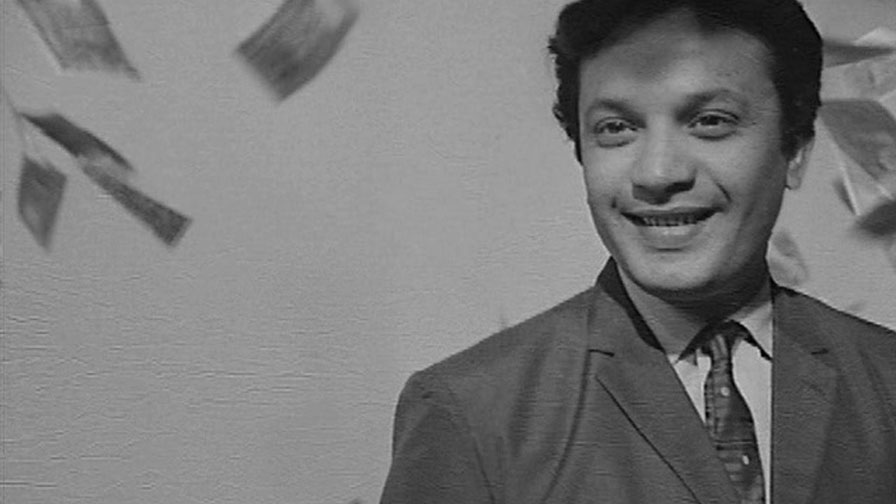
    This is the same crowd that funds the film. The same crowd that reigns the rains. The same crowd whom Satyajit Ray’s hero (in the film Hero) can say “Bullshit, public. Steamroll them.”

    The same crowd who is mad, crazy, passionate and forgetful.

    The crowd has now become the film.


    Photograph: Uttam Kumar as Arindam Mukherjee in Satyajit Ray’s Nayak (Hero; 1966)

    See also:

    https://filmcriticscircle.com/journal/critics-choice/

    https://filmcriticscircle.com/journal/society-cinema-and-the-critic/


  • Mysskin — Missing the forest for the trees

    Mysskin — Missing the forest for the trees

    A perspective peek at the nonet of films that have pitchforked Mysskin into the exalted realm of Kollywood’s cinematic sense


    Straddling the Kollywood movie marquee in the last dozen plus years like a lodestar among his peers, Tamil film director Mysskin, nee Shanmugha Raja, since his trailblazing debut in 2006 with Chithiram Pesuthadi, has been the toast of elitist and eclectic film critics, especially in Tamil Nadu. So much so, he has been [highlight background=”#f79126″ color=”#ffffff”]valorised as a shrewd filmmaker whose films carry a certain idiom of visual expression to his narratives, of which much has been written about in eulogising terms. Given that they take an academic approach to film criticism glossing over the film’s otherwise mundane and banal reality.[/highlight]

    Sure enough, basking in this newfound fame of critics’ fascination with his films, you have had the director unabashedly flaunting his erudition and education on cinema, from its aesthetics to its functionality, and naming the choicest celebrated auteurs who have influenced his appreciation and understanding of the craft, which “finds visual expression” in his own films.

    Born Shanmugha Raja, he went on to baptise himself professionally as Mysskin—much inspired by Prince Myshkin, the protagonist in Russian novelist Fyodor Dostoevsky’s celebrated classic novel The Idiot.

    His low budget directorial debut Chithiram Pesudhadi coveted critical appreciation for his unique narrative style and mise en scene, while Anjathey, his sophomore essay, catapulted him into the big league of the Kollywood film industry, making him a name to watch out for with awe. His subsequent forays have brought him much appreciation and accolades for his visual style and directorial acumen. Additionally, [highlight background=”#f79126″ color=”#ffffff”]Mysskin has been hailed as one of the trendsetters of contemporary Tamil cinema, changing its otherwise accepted staid image of rolling out familiar flicks in an assembly line fashion.[/highlight]

    Given his favourite subjects—his protagonists, caught on the wrong side of the law, are violent and bloody thirsty in nature—his films have also been termed as dark, dismal and dreary.

    In a Masterclass on Film Appreciation with film critic Baradwaj Rangan, you have Mysskin profoundly stating, “Cinema acts as a therapy when any good story is properly told. It also acts as a metaphor.”  Citing Robert Bresson’s A Man Escaped and Akira Kurosawa’s Seven Samurai, among the films that have greatly influenced him, Mysskin eulogises, “Simplicity is the hallmark of a classic.” He goes on to say, “ If Leo Tolstoy and Fyodor Dostoevsky were alive today, they would be making films.”

    In another interview, justifying the excessive, and graphic, violence in his latest film, Psycho, Mysskin says, “All sincere stories have death. All sincere stories have murders. All sincere stories are full of evil.”  Further, the director has no qualms about blatantly justifying stalking as a means of expressing one’s love to another. “I like my protagonists to be like lightening. Their unpredictability creates an interest in my audience.”

    If only one could fulsomely agree with Mysskin’s idea of cinema and appreciate his approach to film making, which is quite the contrarian to the classics and the masters of cinema and their influences that he so effusively cites in interview after interview!

    Of the nine films in his repertoire so far, nearly four of them virtually run on the time-tested template of most violent and virulent bloodletting, be it his very first foray, Chithiram Pesuthadi, wherein you have the protagonist turn hit man to stave off his debtors, or Anjathey, where you have the reckless hero indulging in violent tiffs, before turning into a new leaf to wear khaki. Thereafter, in Yuddam Sei you have a trail of bloody bodies as a CID officer embarks on a mission to trace his missing sister. Mugamoodi, inspired by various comic book heroes, has the hero chasing criminals who leave a trail of dead bodies.

    And not to discount his latest and most obnoxious, Psycho, whose serial killer hero systematically severs heads of females leaving their decapitated bodies in the open for the police to find.

    However, his Nandalala, incidentally inspired by Takeshi Kitano’s Kikujiro, is surprisingly sublime and sedate, marking a clear departure from his violent preoccupation. Other equally enterprising ensembles that provide a saner, subtler and much appreciable side of Mysskin are Onaayum Aattukkuttiyum, Pisasu and Thupparivaalan—the last being an ode to Sherlock Holmes and his Baker Street irregulars.

    If Onaayum Aattukkuttiyum provides a comedic but realistic portrayal of how good Samaritans end up being culprits for having done a good deed of saving a dying man on the street, Pisasu with its ghost thriller angle spotlights on various social issues.

    Otherwise, you have Mysskin faithfully following in the footsteps of Asian directors such as Takeshi Kitano, Kim Ki Duk, Park Chan-wook, and Miike Takashi known for their bloody, gut-wrenching violent portrayals, and American director Quentin Tarantino known for his macabre violent films full of blood, guts, and gore.

    It is understandable and somewhat acceptable that film directors such as Mysskin resort to stark depiction of visual violence as mise en scène acting as a crucible for social commentary on marginal lives ostracised by social opprobrium and driven by circumstances. However, one is unable to digest the fact that where subtlety and nuanced narration and suggestive visuals could effectively convey the angst and anxiety of these fringe people, Mysskin prefers distasteful and disgusting visualisation of violence to evoke empathy towards the victims. According to him, these persons, who come across as violent, if showered with affection, love and care, which job is conveniently left to female protagonists, change, and are otherwise benign souls but for mitigating circumstances.

    It is at this juncture, one would hazard to state, that [highlight background=”#f79126″ color=”#ffffff”]cinema, given its overarching influence on susceptible and impressionable minds, needs certain modicum of sanctity. A certain ethical sense of sensitivity. An iota of sanitation. A dose of subtlety and sensitisation. Above all, certain aesthetics whose narrative does not cross the Rubicon of excessiveness to achieve its larger social and moralistic purpose.[/highlight]

    For, cinema is a collective experience. The visual images received and assimilated in the receptacle of the darkened theatre is subconsciously internalised into an individual’s own moral and ethical dispositions and the cultural moorings that they have evolved from. The majority of these audiences are unable to differentiate between reel depictions and the harsh reality of their own everyday existence.

    That being the case, it indeed becomes incumbent and imperative upon a film maker to realise his immense responsibility and ethical duty towards civil society and the disparate audiences that come to watch his films drawn by the media-created halo, and to ensure that his films do not corrupt the gullible or vitiate the discerning and more cinema literate viewers’ sensibilities.

    Given that each person carries his/her own individual experience and understanding from the visual narrative they have been relentless bombarded with for the nearly three-hour-plus running time of the film—most of Mysskin’s films are that long—it becomes imperative that the film does not leave a bitter aftertaste.

    Mysskin on the setsMysskin may argue that his foregrounding of gut-wrenching violence is to specifically critique the social inequalities and the disenchantment that his protagonists find themselves in, in the world around them, and speak of the trauma of societal alienation, and therefore, in response, brutally lash out. But it is a given fact that, unlike in a majority of narrative cinema, the characters’ violent actions do not necessarily lead to “empathetic” resolution.

    Instead, as researchers note, violence only creates a recursive loop, as is evidenced in the brutal killings, rapes and other forms of real-life violent incidents that one sees in real society today.

    Instead of being a cathartic experience, the brutal cinemas of directors who push the representation of violence to its point of acme, repeatedly, using it as a justified means to legitimate ends, has only triggered a wave of such formulaic films to cash in on its success.

    By their celebration of violence in the most stylistic fashion, such as in Mysskin’s Psycho, they become counter-productive to their intended objective, leading to misplaced formulations of masculinity, driven by the viewer’s sense of self-esteem and personal identity injured and defeated by social injustices.

    Violent depictions of this sort only catalyse and instigate the minds of susceptible and vulnerable audiences to mimic their theatrical experience in their own real existence as a form of valorous requirement, justifying their acts that run contrary to the very ethos of normal, law abiding, socially obligatory living.

    It is here that Mysskin’s handful of films and his central motif of taming the violent brute in the form of an understanding, all-sacrificing female principle is contrarian to his own assimilated views on cinema, given his exhaustive reading and learnings about films and film making and cinema as an art form.

    One would like to suggest that Mysskin works on the rather indulgent self-belief that the majority of the audiences who grace his films seeking “entertainment” would also be erudite enough to read the metaphors, symbolisms and allegories and appreciate the fine craft of cinematic excellence that he is trying to bring from his own knowledge and education.

    [highlight background=”#f79126″ color=”#ffffff”]Unfortunately, these “cinema illiterate” as well as “poorly literate” masses who indulge in such “escapist entertainment” to rid themselves of their diurnal worries and problems, wistfully cheer at the goings on, being lost in the world of make-believe, unlike erudite critics who seek to gloss over the film’s inherent dangers at the peripheral level and its construct of images[/highlight], perforce, mandatorily mimic it in real life, being overawed by its enticing allurement to uplift themselves from their own station in society and living conditions.

    The larger and purposefully intended motif and metaphors of Mysskin’s films are simply lost in the high decibel volatile action and explicit execution, and thereby, fails the very idea of cinema that Mysskin venerates and espouses but himself shirks to take up. His mind weighed heavily by the commercial dynamics of a film’s destiny at the box office and the purse strings of the producers rather than aesthete aspects, Mysskin’s films end up striking a discordant, disquieting note.

    Gainsay, one could accede to a more pedantic and popular academic /theoretical approach that each of the actions has been specifically designed to convey a certain metaphor or to allegorise on the state of mind to the spectator. As to how much of these are meaningfully assimilated by the viewers who come primarily for “time-pass” and “entertainment” and become inured so as to eschew it themselves in their own real life, though, is rather moot.

    For, instances have been cited by police and investigative agencies of crimes committed in real life wherein culprits have confessed to being inspired by depictions of brutal graphic mutilations, including severed heads, in mainstream films such as Mysskin’s Psycho.

    Mysskin’s arguments, as he depicts through his heroines, who, invariably, fall in love or are forced to fall in love and be empathetic with the troubled protagonists, and through their love, care, affection and understanding will reform, is just a fallacious one, as social realistic bespeak otherwise, much as directors may try to dismiss them as being a result of their cinemas.

    While [highlight background=”#f79126″ color=”#ffffff”]films of the genre of Mysskin’s may make handsome material for contemporary critical discourses on flawed individuals and society at large, raising false hopes of acceptance of judiciously unpardonable crimes committed by the protagonist who in real life has to pay the price for such heinous acts, in reality they cannot be so easily dismissed and one needs to take a very strong stand against such films, the nature of their on-screen violence, and the absurd play of narratives that they bring into their equally trite and mundane tales.[/highlight]

    It is an undeniable fact that films with violence have come to sadly represent a growing trend in the booming film industry of India. Take the case of Anurag Kashyap and his ilk whose every second film turn out to be a celebration of violence and machismo in its most depressing regularity. Such stylised superficiality only give audiences an adrenaline rush as they watch the proceedings in the darkened recess of film theatres when in actuality in real life things may not work the same with no time for rationale thought whatsoever.

    With filmmakers’ sense of commitment to mirror social reality hardly remaining untarnished by strong market force influences, despite cinema being described as an art form to creatively portray social reality, the drive to link the success of a film to box office returns with attendant commercial claptraps puts to shade the real intent of directors, much as critics may sing paeans about their products in esoteric terms.

    Profit prioritisation overpowering their films’ social and developmental goals, [highlight background=”#f79126″ color=”#ffffff”]obscenity, lewdness, and violence have emerged as an integral feature of Indian cinema and a sure-fire success[/highlight] to their own popularity and pulling power.

    Finally, there are two schools of thought on this issue. One line of thinking being that films can never affect or reform the social body or events taking place within it. The other believing that the medium does have a direct or indirect impact on social streams, even though it may not be immediately perceptible. As usual, the ball is in the spectator’s court even as censor and certification boards lock horns with filmmakers on what is the done thing and what is not.

    For now, fired by the patronising criticism of his films more from the perspective of film form and technique and their metaphors and allegories rather than the quality of content and the crass way it is treated and purveyed to gleeful audiences with wet, hanging tongues, Mysskin is enjoying a great gambol run with his kind of cinema.


    Editor’s note: Earlier in the year, Super Deluxe, a film co-scripted by Mysskin had won the Film Critics Circle of India Award for the Best Indian Film of 2019

    https://filmcriticscircle.com/journal/super-deluxe/


    [divider top=”yes” anchor=”#” style=”default” divider_color=”#999999″ link_color=”#999999″ size=”2″ margin=”0″]

    IMDB link — Mysskin

    [youtube_advanced url=”https://www.youtube.com/watch?v=dInk9M6kKns” width=”300″ height=”200″ responsive=”no” controls=”yes” autohide=”alt” autoplay=”no” mute=”no” loop=”no” rel=”yes” fs=”yes” modestbranding=”no” theme=”dark” playsinline=”no”]
  • Ideology matters: film criticism in new Malayalam cinema

    Ideology matters: film criticism in new Malayalam cinema

    Throughout the history of cinema, the dominant ideology determined the content. It is predominantly capitalistic, male and heterosexual. Likewise, film criticism too established its territory. Malayalam cinema

    Film critic Chintha Raveendran

    Tracing back to the fifties, film criticism popularised by the trio Cinic, Kozhikodan, and Nadhirsha was mostly engaged with the text, rarely exploring the sub-text, inner dynamics, or political unconscious. In the early eighties, film critics like Dr. T. K. Ramachandran and Chintha Raveendran initiated the ideological film criticism, exposing the nexus of money invested in the films and the content generated. I myself was attracted to this line, which probably evolved as a part of the active film society movement of the period. To have legendary filmmaker John Abraham in the movement fanned the flame. His radical people’s movement called Odessa was a real alternative for filmmaking, but unfortunately it found no succession.

    The arthouse films could never serve as a real parallel. It had to yield to the power play of state-run machineries, the way mainstream films were, and still are, to private production houses. Radical initiatives with variant perspectives as Dalit, feministic or queer was almost impossible to be materialized. Malayalam cinema could not evade censorship

    of capital and power that is devastating.

    Old or new, commercial or arthouse, all shared the same ideological fallacy due to this dual censorship. The celebrated “new” is not new enough for me. Though seemingly new at the outset, they are mere modified versions of the old. Illustratively, look at the way it is continuing with explicit anti-women, anti-Dalit content.

    Book by film critic Dr. TK Ramachandran

    In recent times, a new path seems to be evolving; one that utilizes amazingly low budget productions. Independent cinema, as they are being termed, with hardly any support from the mainstream, are but travelling across boundaries. Dr. Biju, Sanal Kumar Sasidharan, Dr. J. Geetha, Jeeva, the Babu Senan brothers, Pratap Joseph, Sudevan, and Jayan Cherian are a few at the forefront of this movement. Even popular film director Jayaraj falls in this line. These filmmakers have marked their presence in the international film circuit, expanding the horizon of the medium through thematic brilliance and depth.

    This is where I find the “new” Malayalam cinema—the real radical, parallel, experimental alternative.

    Back to my area of film criticism. In the last 35 years in this career, I have dealt with criticism in many forms, being in charge of the film page of a leading daily newspaper, and later editing the film journal of our publishing house. In my journey, I have noticed a fundamental difference in film criticism since 1991. Globalization marked the change. Earlier it was relatively possible to criticize films. Post-1991, the threat of advertisement ban has made criticism near impossible—ads being a major source of revenue. Capital is becoming more arrogant and intolerant towards criticism in any form.

    Film criticism has given way to film promos today. You can see that almost all mainstream media has stopped film criticism per say. Smaller, independently-run magazines attempted a parallel stream, but social media with a bang has taken over. Blogs, Facebook, and Twitter are much ahead with film analysis compared to the print and visual media.

    I conclude with the observation that I can spot the New Malayalam cinema in independent filmmakers and social media film critics—of course, not the paid online PR agents. Hopes lie in those who can transcend the challenges enforced by capital and the dominant ideology. This could mark the history of New Malayalam cinema and New Malayalam criticism.


  • Irrfan Khan—the journey towards an ‘actor’s film’

    Irrfan Khan—the journey towards an ‘actor’s film’

    ‘I would never say such an unfeeling, rude thing such as that all actors are cattle. What I probably said was that all actors should be treated like cattle.’ actor

    -Alfred Hitchcock, on the Dick Cavett show


    ‘Most enjoyable screen performances have been produced by nothing more than a typage, and it is commonplace to see dogs, babies, and rank amateurs who seem as interesting as trained thespians.’

    -James Naremore, from Acting in the Cinema


    With these two conscious teasing statements, I would like to begin my discourse on Irrfan Khan’s artistic persona, which is a supreme example of creating an actor’s definitive mark in this chaotic business of filmmaking. Quite self-consciously, I have quoted two sentences that are used to undermine, if not humiliate, an actor’s role in a film-text. Although James Naremore’s statement should not be judged by its face value, Hitchcock’s infamous words are out and out scandalous given the fact of his repeated dependency on great actor-stars, from Ingrid Bergman to James Stewart. Rather than judging these statements and starting a war of opposing opinions, I want to argue about a specific type of cinematic form that allows Hitchcock the right to make a seemingly crass statement. Furthermore, needless to say, cinema as a medium is highly different from an actor-oriented medium such as theatre, so my propositions and arguments will be centred on the questions related to cinematic medium and film form; no discussion on the art of film-acting can bypass either of these. The making of Irrfan’s gradually important persona is highly related to the forms of films in which he acted.

    Before moving to any particular discussion on Irrfan’s own oeuvre, I want to discuss a few things about film acting in general. As I have mentioned earlier, it is quite well known that acting in cinema depends directly on many things that are absolutely uncontrollable for an actor. A slight change of light direction in a frame can create a major change of overall emotional or intellectual effect of a particular scene. The same is true for shot scale—an extreme long shot literally reduces an actor’s artistry into the overwhelming landscape and other components of the mise-en-scène. [highlight background=”#f79126″ color=”#ffffff”]Editing, of all things, can create a range of nuances even without an actor’s awareness[/highlight]—take, for instance, Kuleshov’s famous experiment with a single static face with three different elements that can create three different emotions out of the single expressive face. An actor’s work in a film is by nature fragmentary, and in no circumstances can they be fully aware of what the ‘meaning’ of their little gestures carry to the audience. Between the shooting of raw footage and the final output on the big screen, innumerable works are produced in which acting resides in one of the preliminary stages of the process. Here, an example of the famous scene from Casablanca (1942) can be illustrative. ‘It is rumoured that during the making of Casablanca, director Michael Curtiz positioned Bogart in close-up, telling him to look offscreen, to his left and nod. Bogart did so, having no idea what the action was supposed to signify. Later, when Bogart saw the completed picture, he realized his nod has been a turning point for the character he was playing: Rick’s signal to the band in the Café Americain to strike up the Marseillaise.’[1]

    Ingrid Bergman

    Cinema, at least in its mainstream expressive form, does not create space for an actor —a space that is dedicated and controlled by an actor’s own presence. Of course, the question of stardom arises here quite effectively: mainstream cinema does create space for stars to flourish. Like stock footages, the star system creates stock gestures and behavioural patterns that get repeated in film after film and thus creates a persona that is beyond the control of a particular film-text. We can discuss about Humphrey Bogart or [highlight background=”#f79126″ color=”#ffffff”]Ingrid Bergman’s famous smile or Shahrukh Khan’s stretched hands[/highlight], which are comparable to the iconography of a generic imagination—like the mountain valleys of the Westerns or the dimly-lighted cityscapes of the Film-Noirs. These specific iconographies are an important part of cinematic imagination, especially when we concentrate on stardom and its relation to audiences. Many of us love the Westerns for their expanded landscapes and wide-angle shots, and many of us love Ingrid Bergman for her beautiful, subtle smile—both are signatures.

    But stardom is not necessarily depended wholly on acting. Although stars can surpass the oppressive cinematic apparatus by their repetitive use of same gestures, seldom can they control the definitive ‘meaning’ of their actions. As I have proposed earlier, this is related to the question of both the cinematic medium and film form. In cases where the cinematic medium is not friendly to the actors, I would like to know if there exists a film-form that, within the limitations of the medium, can create more space for actors that is not related to the question of stardom. In other words, I want to find if there is a possibility of film form that is dependent on the actor’s performances and which in turn can be dominated by their presence. And of course, the major question remains—is it possible that an actor, who is not necessarily a star, can wield command over the film form and compel the eyes of the spectator towards their performance? Is it possible for an actor to do that, even passively?

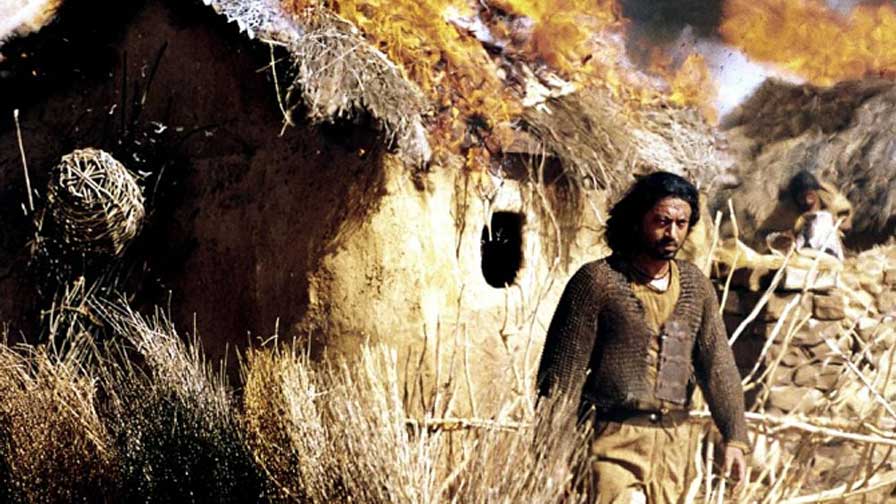
    It can be said that with The Warrior (2001), Irrfan Khan marked his presence as a lead performer in cinema. Stylistically, the film locates itself in the arena of international art-house cinema, where the presence of actors is historically more important than the typical mainstream films. If classical Hollywood cinema (and its later mainstream formal manifestations) tend to limit actors’ performances with a systematic film form (dominated by editing), art cinema, on the other hand, tends to rely more on mise-en-scène  and long takes. Irrfan did complete justice to this demand—starting from extreme close-ups of his expressive eyes to close-ups of his face in long, meditative takes. Nasiruddin Shah, albeit modestly, noted the rare quality of Irrfan’s performance in The Warrior, the kind of which, he claims, he himself hadn’t mastered at that young age.[2] Irrfan had managed to capture both the ruthless and helpless quality of the warrior with a fine touch of authenticity that he henceforth maintained. Standing firmly in the realm of realism, his acting matured from Maqbool (2003) and Road to Ladakh (2004) to The Namesake (2006). Still, he did not limit himself to a particular style of acting—as proven in his performances in Life in a … Metro (2007), Haider (2014) and Puzzle(2018). In these particular films, his performances are slightly stylized in order to be in sync with specific film forms. Irrfan’s capability to produce the same skill in altogether different styles of acting demonstrates his rare quality as an actor. Irrfan was as competent in the role of an apparently simple stranger in Road to Ladakh as the highly enigmatic Roohdaar in Haider. Another significant aspect is his casting as the rebel common man in the social thriller Madaari (2016); his common-man brand persona is reminiscent of Nasiruddin Shah in A Wednesday (2008).

    But I do not want to summarize Irrfan’s oeuvre here. I have some specific questions in mind that I have already stated earlier. Almost all the films mentioned in the above paragraph are illustrative of basic questions of acting in the cinematic medium discussed earlier. We do not know the authorship of any of his subtle gestures; we do not know if they belong to Irrfan or the respective film directors. I have already stated that it is almost impossible to separate acting from the other elements of film—actors, at least in wholesome entertainers, do not have that much space. But I have also raised a few questions about a different film form, and here, André Bazin’s ideas will be highly important for us.

    We remember Bazin for his proposition of a theory of realism in cinema that is different from the standard classical Hollywood realism. Bazin was in favour of a cinematic form in which the scenes had a documentary-like realistic look. He was against the fragmenting of shots and the incorporation of artificial meaning through editing. He vigorously opposed montage where the ‘meaning’ depends on the joining or collision of two images; where meaning is not there in either of the images. He called it trickery or deceiving. Long takes, which can meditate in front of reality and are dedicated to the materials being shown, were important to him.

    The Red Balloon (1956)

    Although Bazin did not incorporate the ideas of actors within this theoretical realm, we can extend his argument and bring in the idea of a cinematic form that, in order to meditate and capture the reality, by default meditates to the actor’s performances. When ‘Bazanian’ realism is opposed to the oppressive cinematic apparatus that disallows documentary-like reality to flourish with its own dignity, by default we can argue that with this cinematic form an actor’s performances becomes more important and meaningful in itself than the imposition of meaning chiefly through editing. Bazin praised the short fantasy film The Red Balloon precisely for this reason—it did not use the trickery of editing; the film allowed a balloon to follow a child in long takes and ‘show’ the reality, instead of suggesting a feel of reality by the use of cuts. Bazin wrote about this film: ‘Ballon Rouge is a pure creation of the mind, but the important thing about it is that this story owes everything to the cinema precisely because, essentially, it owes nothing.’[3] Here, he praised the relative absence of the cinematic apparatus, that is, editing, and championed a different idea of ‘cinematic,’ which is true and authentic to reality (in our argument, to actors) itself.

    I want to argue that, in some cases, a cinematic form is possible that can create relative spaces for actors to perform, and that this creation of the space is tangentially related to the performer. And sometimes, it is possible for an actor to command the cinematic form for creating spaces for their performance. Here, the focus of the apparatus is to look at the performers (at reality; as Bazin said) and let the situation unfold through their performance (without resorting to the star’s iconographies). Irrfan Khan is a rare performer who did this in some of his films, one of  the supreme examples of which is The Lunchbox (2013). Although it is true that the director’s intentions are important for creating these spaces, it is equally important for an actor to have that rare quality that can compel directors to look at their performance and allow reality to be embodied through it.

    It is important to note that Irrfan did an ‘anti-Bazanian’ film in the year prior to the shooting of The LunchboxPaan Sing Tomar (2012). Here, throughout the protagonist’s running sequences—it is the camera and the editor who run—the spectator does not get to see a long take that shows a running sequence in its entirety. Now, I am not criticising the film for doing this, of course—this is just a different paradigm of filmmaking; one where most of the mainstream cinema resides (for instance, superhero films would have been impossible without these trickeries). But it is important to take note of The Lunchbox, in which such trickeries was not resorted to. Irrfan had to embody the sad and lonely bachelor life of an elderly government employee. The nuances of his character was not shown through montage. Instead, the camera was focussed on him to create meaning. Although The Lunchbox is not a ‘Bazanian’ film in a direct sense—it does not employ the two notable features of this school of thinking, namely, the long take, and deep focus photography—the essence of Bazin’s theory is palpable here. The film is dedicated not to the style, but to the reality. And according to my argument, such is dependent solely on the actors; sans an excellence of ‘realistic’, ‘authentic’ performance by the main performers (Nimrat Kaur and Nawazuddin Siddiqui too deserve mention here along with Irrfan), it can never meditate on the reality.

    Juliette Binoche in Certified Copy, & Robert De Niro in Taxi Driver

    Now we can understand that it was the question of cinematic form that allowed Hitchcock the right to pronounce such a savage remark—in Hitchcock’s idea of film form, the apparatus is more important that the reality/actors. We are talking about a liberated film form that is in a way dominated by the actors’ presence in order to capture the reality. Although a film-maker’s decisions about the paradigm of a particular film is primary, it still requires actors such as Robert De Niro and Juliette Binoche to envision films like Taxi Driver (1976) and Certified Copy (2010), respectively; in both cases, the characters were written specifically with the said respective actors in mind. Like them, Irrfan too succeeded in commanding a space for acting without resorting to star iconographies. I wouldn’t really know if the idea of  an ‘auteur’ can encompass this crucial aspect of acting, but, for me, such a signature truly is the hallmark of a great actor.


    [divider top=”yes” style=”default” divider_color=”#999999″ link_color=”#999999″ size=”2″ margin=”0″]


    [1] Naremore, James. Acting in the Cinema.

    [2] Shah, Naseeruddin. Indian Express. May 3, 2020. ‘Irrfan’s legacy is like a constellation of stars for every actor to take inspiration from’. Retrieved: May 13, 2020.

    [3] Bazin, André, What is Cinema. V-1, pp 46.


  • Ek Betuke Aadmi Ki Aafrah Ratein: Photographed theatre or cinematography?

    Ek Betuke Aadmi Ki Aafrah Ratein: Photographed theatre or cinematography?

    In A Thousand Plateaus, Gilles Deleuze and Felix Guattari (D&G) define the machinic assemblage as having different speeds, slownesses and intensities on the Body without Organs. They go on to deconstruct the machinic assemblage: a machine is anything that can be plugged into, whereas the assemblage is that which “deterritorializes” the becoming (flows). The point is that D&G are providing us with a toolbox for thought, which is then broken into its components that do not resemble one another.

    For us, the fundamental question in Sharad Raj’s debut Ek Betuke Aadmi Ki Aafrah Ratein is whether photographed theatre is different from “a writing with images and sounds” (Bresson) or cinematography. Like D&G we will break the assemblage “photographed theatre” into two parts photography and theatre. Photography is about capturing a section of time on film or digital bits, whereas theatre is the un-covering (altheia) of the truth of the actor. As Rajneesh and Krishnamurthi point out we must stay with the question; or the Deleuzean problem whose construction is more important than its solution: the solution is how the question is constructed. (In this regard, Jean-Luc Godard’s posing of the question is extremely profound. For Godard, things are not “good” or “bad” but instead: “How are things?” (Comment ca va, 1978)).

    Instead of comparing Raj’s work with that of Robert Bresson, I will instead argue that Raj’s work is a commentary on Alain Resnais’ first three films: Hiroshima Mon Amour, Last Year at Marienbad and Muriel. The object petit a or the obscure object of desire, that can no longer be recollected (like ‘Rosebud’ in Citizen Kane), is the event i.e. riots in Muzaffarnagar, that simultaneously affirmative and null event (Badiou) that find their center in the nation’s capital, Delhi and periphery in the film’s location-space, Lucknow. In other words, Raj’s version of filmed theatre occurs at the periphery of consciousness, where horizontal movements and zoom are used to decenter the film. The film is not so much a transformation of the object, as they teach in bourgeois art schools, but a transformation of image. The interior of the film is this ‘real’ image of Lucknow, whereas the projected image is Baudrillard’s “something that hides the nothing” or simulacra. The inside and the outside move according to the self-overcoming that is simultaneously overcoming and negating or Aufhebung. This Aufhebung transforms Being (space) into Becoming (time). This dialectic between Being and Becoming culminates in the shot that are a direct reference to the opening shots of Resnais’ debut.

    The points is not whether Raj’s film is a commentary on Dosteovski or Premchand, but that it creates a sound-image continuum (decoupage) that form a single succession. This succession is then filmed along the Lacanian Real, which find their triangulation in the Symbolic, stylized Kathakali procreation dance, and Imaginary, in the images of political realities that form the outside.

    Contrarily, the theatrical is the filming/recording of Bresson’s dictum of a “profound in a posture”, that materializes itself in the recitations of Tagore that confirm Proust’s dictum of being written in another language: an Othering of the Self. Most significantly, Raj’s cinema is one in which the territorial motifs: the advertisements or shop fronts, find their territorial counterpoints in the fixed distance shots that signal the un-Becoming of the Becoming; until the poetic utterances create pre-empted and delayed images (chhanda) that redefine film as a body in a state of tension.

  • Critic’s Choice

    Critic’s Choice

    I wrote my first film review in 1968 in the leftist political weekly Century (founded by VK Krishna Menon) while I was in college. Since then I have reviewed films on and off in various newspapers and magazines. In spite of spending over 5 decades in films and other media I am still hesitant to call myself a film critic. Today there are hundreds of film critics in India. I dare say that except for the writings of a handful of these hacks (they don’t deserve to be regarded otherwise), what passes on as film criticism is opinionated, patronising writing. One of the main reasons is that many film critics have their knowledge of cinema manufactured in the Film Appreciation Course at the Film & TV Institute of India. Watching films at various film festivals, reading foreign reviews and now listening to social media chatter gives them ‘legitimacy’ to pontificate on good cinema. Interestingly many of these film critics are well intentioned, amiable people, some of whom I am fond of. I only wish they heal the chip on their shoulders.

    Arguably the first film review appeared in New York Times in 1896 in the earliest years of motion pictures. It was less about the film but more about the medium. Henry Miller writing in The Guardian on January 12, 2012, observes,

    “The early film critics, wrote Alistair Cooke in 1937, were presented with a new art form, unencumbered by tradition, and free ‘to define the movies with no more misgivings than Aristotle defined tragedy’. Or at least they would have been, but the press lost interest once the novelty wore off, and so ‘through a trick of snobbery the simple Aristotelian lost his chance. This lapse did not pass without comment. While ‘every theatre play is accorded the honour of a press notice’, complained the trade paper Kinematograph Weekly as late as 1918, the ‘perfunctory sort of acknowledgement’ given the likes of The birth of a Nation and  Intolerance was ‘obviously written by people who bring to the kinema the prejudiced mind of dear old Granny from the country on her first visit to the play’. There were a handful of exceptions, and the not entirely reliable consensus had it that WG Faulkner, of the London Evening News, was author of the ‘first regular criticisms of films in any British newspaper’”.

    However there are two landmarks in film criticism. The first is Sight and Sound—the magazine started by the British Film Institute in 1932. For generations it remained an authoritative publication on the art of cinema. In 1951 a second watershed moment came with the publication of Cahiers du Cinéma. This journal which became the fountainhead of New Wave Cinema in Europe and later in other countries including India was started by Andre Bazin, Jacques Doniol-Valcroze and Joseph-Marie Lo Duca with the active support of Robert Bresson, Jean Cocteau, Claude Chabrol, Jean-Luc Goddard, François Truffaut and Andrew Sarris. These were people who understood the grammar of cinema and many of them went on to become great film makers themselves. In the mid fifties there was a divide when these young film makers started reviewing popular American cinema by film makers like Alfred Hitchcock, Howard Hawks, Billy Wilder and David Lean along with European greats like Ingmar Bergman and Federico Fellini and Asian film makers like Kurosawa, Ozu, and Ray. These left of centre intellectuals obviously inspired Indian films critics of the 50s and 60s in India. However there was an apparent delta between these high priests and their Indian disciples. Unfortunately an inherent disdain for anything popular still lingers on as a rather self-acquired legacy. India has always lacked someone like Pauline Kael, Robin Wood or Richard Corliss who could critique avante garde cinema and blockbusters with equal aplomb and without prejudice.

    Somewhere in the post World War II era of print were created two distinct approaches: first and more popular was the film reviewer and the other the film critic. By and large film reviews are what appear in newspapers and magazines, radio and TV and of course now online. A recent phenomenon is social media reviews, some even typed from inside a cinema while the reviewer is still watching the film. Reviewers generally follow a set pattern—Give a gist of the plot (nowadays with spoiler alerts), talk broadly about the main players’ performance, make broad comments about the screenplay, cinematography, music, production design, etc. There is usually a reference to direction. Often the reputation of the creative professionals and artistes colour the review. A trend started by American publications in the late 1940s of awarding stars based on some arbitrary methodology caught on in India as well. Even now the so called ‘serious’ film critics dispense stars as some sort of personal dole.

    Any criticism of artistic work is subjective and there will always be personal biases. A peculiar hang up of Indian critics of all arts is that they become all knowing arbiters of aesthetics, form and content even when their knowledge is based on a casual read of a few books and articles. Merely watching films in film festivals or week after week in cinemas and cosying up to a select group in the art circuit in media does not give anyone the authority to pass unqualified judgement on all creative efforts. Interestingly most of these purveyors of good cinema gladly land up at a star’s house for an exclusive interview (stars sell, or so say their bosses) and do puff pieces on successful film makers while lamenting about how their favourite film did not get a proper release. I don’t remember ever reading in Sight and Sound, Cahiers du Cinema or even the Guardian or New York Times about the lack of screen time or the improper release of a film. Self-styled modern masters (mavericks in disguise more often) and their cheerleaders in media would like us to believe that every genius is a victim of some box office chicanery. By the way most in this [highlight background=”#f79126″ color=”#ffffff”]“guild of film critics”[/highlight] author books on popular stars, film makers and films while decrying the same week after week in print, television and online.

    I have often said that mediocrity rules in every walk of life but on a good day even the most ordinary artiste is capable of a stroke of excellence.

    -A true critic


    [divider size=”1″ margin=”0″]


    Editor’s note:

    Clarification. To correct a slight error that has been in circulation in the leading English dailies since the last one year. FCCI was officially registered way back in Feb 2013 under the Travancore Cochin Literary Scientific and Charitable Societies Registration Act XII of 1955.

    In the pic above: Subhash Ghai quotes from the Oscar rules for its jury, at the first AGM of the FCCI following its official registration, “You have the responsibility to look into the growth of civilisation and of the next generation. We filmmakers look upon you as God. So guide us in your reviews, tell us where we lack, and how we can improve.”