In Geeta Dutt’s warbling voice, subdued smile and shy glances we find the nymph and the muse being fused together and nothing comes as close to her life and art as does [highlight background=”#f79126″ color=”#ffffff”]the immortal bird of Keats’ famous ode. [/highlight]Hers is a tale of extreme experiences that life can offer to an individual. While destiny endowed her with the rarest ability to conjure up a gush of fresh air and a soothing shower to a parched land and a thirsty clime, the same destiny took away all her powers and left her feeble and lonely, as if administered by some unalterable nemesis. Geeta Dutt’s life was tarnished as much by love and deceit as by despair and longing. But her timeless voice makes her the immortal Dryad of the evergreen bower in which the short-lived summer is celebrated with ‘sunburnt mirth’.
Geeta Dutt with Talat Mahmood, Mohd Rafi, Kishore Kumar, Mukesh, GM Durrani, Meena Kapoor, Kamal Barot, Mubarak Begum, et al.
Geeta Dutt’s oeuvre of playback singing remains an inseparable part of the golden days of Hindi cinema and from sad musings to playful jingling, everywhere she was at the best of her full-throated ease. Coincidentally, it so happened that her songs were neither purely romantic, nor tragic, nor seductive. Her forte lies in those songs that were half jesting and half sceptic, with a detached, quizzical vision of love and life; of an accultured, neo-urbanized neo-hybridized society imbibing the cultural milieu of the early phase of a globalized culture. For someone with a very conventional upbringing, being born and having spent her childhood in rural East Bengal, it is a wonder how she instilled such a lively spirit to that ethos as far back as the early 1950s. How Geeta Dutt succeeded in finely attuning her voice to the beats and rhythm of those songs will always remain a mystery. In ‘Tadbir se bigdi huyee’, the stop and go movement of e he he he, he he/ ehe he, he he throws us into a thrill of anticipation, and being true to itself, the song does make us tap, clap, sway and move all the way.
She pitched her feet firmly in that arena, usually discreetly avoided by mainstream singers, and [highlight background=”#f79126″ color=”#ffffff”]created a genre all by herself and trod a solitary path with nobody to look up to and none to walk behind. It wouldn’t be wrong to say that this genre began and ended with Geeta Dutt.[/highlight] All attempts to revive her joie de vivre merely ended with sloppy songs spilling all over.
Even in her plaintive numbers, Geeta Dutt portrays that stoic indifference and is not swamped by sorrows. In ‘Waqt ne kiya’, she is overladen with sighs, but she negotiates with them, without veering off on the verge of sentiment. And when she is not detached or in a mood to negotiate, she is the most spontaneous. ‘Mujhe jaa na kaho, meri jaan’ and ‘Na jo saiya’ are songs of starkly different moods—her voice is choked with laughter and ecstasy in one, and trails off with desperation in the other. This combination of spontaneity, detachment, playful coyness and joyful quirkiness makes Geeta Dutt the artiste extraordinaire, and, arguably, one of the most inimitable singers of the erstwhile Bombay Talkies.
In her enduring songs, [highlight background=”#f79126″ color=”#ffffff”]Geeta Dutt is no less than the “hammered gold and gold enamelling” nightingale of W.B. Yeats’s celebrated poem ‘Sailing to Byzantium’ seated on a golden bough and singing of “what is past or passing, or to come”.[/highlight] Geeta Dutt has been long gone, engulfed by the perplexities of life. But her songs have become ever more resonating. In them, we inhale the whiff of the first rain in the days of cultural draught.
“The fact that I’ve lived this long is not really an achievement, Time passes; we age… it’s natural. This is why it annoys me when a person watches a movie and tell me that it was ‘time pass’. Would time not have passed if he hadn’t watched the film?”
-Kamal Haasan
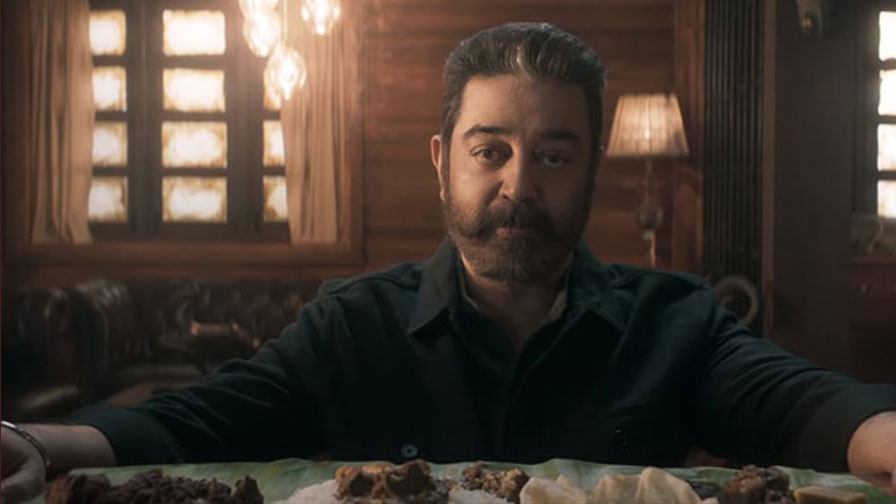
All of 65 and fit as a fiddle. 232 films strong with that eternal spring in his steps. Three marriages and two darling and dainty daughters in Akshara and Shruthi — that’s Paarthale Paravasam Kamal Haasan for you. Versatile, method actor. Dancer. Singer. Aesthete scripter-director. Tamil Cinema’s iconic thespian. Shaped and striven by an innate philosophy to “lust and hunger for the audience,” and “to do my duty of being better than my predecessor and to see that my successor is better than me.”
Hailed by Hollywood’s Barrie M Osburne for his intense knowledge of literature, history and films as “encyclopaedic” and Ang Lee for his brilliance and knowledge of films, Indian Cinema’s, more precisely, Tamil Cinema’s “Mr Perfectionist’s” has a simple modus operandi towards incessant success. He says, “I would like to keep updating myself. That is the only way to make life interesting. And because I am a performer, I would like to do it deliberately and with purpose.”
It is no wonder then that this very sense of purpose and life’s mission saw Kamal Haasan draw blood in the very first film he forayed into when a physician friend of his mother visited AV Meiyappan (AVM) to treat his wife, with a young child tagging along. That innocuous stripling and Destiny’s Child would catch the keen and perceptive eye of AVM’s son M Saravanan to be recommended for their production Kalathur Kannamma, in which his character, Selvam, [highlight background=”#f79126″ color=”#ffffff”]a cherubic four-year-old waif, gloriously crooned the haunting hymnal Ammavum Neeye Appavum Neeye without betraying the slightest trace of camera consciousness.[/highlight]
That his debut performance as a child artiste should have fetched him the coveted President’s Gold Medal was a presage to what followed this multifaceted, multitalented, mercurial man of the medium, admiringly and effusively proclaimed Ava (n) l Appadithan for his artistry and aesthetics. Kamal Haasan the prodigious talent would go on to rule the movie amphitheatre for 6 decades.
Born Parthasarathy, into a Tamil Iyengar family, Kamal Haasan, as he is better known by his screen name, is the youngest of four siblings. His sister Mrinalini is a classical danseuse, and his brother Charuhasan and niece Suhasini are National Film Award winning actors. He grew up in a home that was deeply steeped in performance arts; one very much like an open-air auditorium, where renowned singers of the time would enthral audiences.
Upon his father’s encouragement, he joined the repertory company (TKS Nataka Sabha) headed by T K Shanmugam even as he continued his studies at Hindu Higher Secondary School in Triplicane. The quality time with the theatre company shaping Kamal Haasan’s craft and interest in makeup.
Straddling the Kollywood cinema coliseum like a colossus, Kamal Haasan is known for his virtuosity. Among his eclectic repertoire of films as a director-actor are Raja Paarvai, Vikram, Apoorva Sagodhargal, Thevan Magan, Mahanadi, Kuruthipunal, Hey Ram, Anbe Sivam, Dasavatharam, and Virumandi, each of which explore different thematic concerns and bring to fore his wide range of acting skills, depth and intensity, and the understated manner in which he plays his parts with aplomb. He is not one who can easily be categorised in any one manner of emoting for he brings into play a variegated and nuanced rendering.
Often frowned upon for his over self-indulgence with aesthetics of film making and acting, and an unabashed pursuer of commercial dynamics, despite clinging on to his ideal idea of cinema, Kamal Haasan has never been wanting when it came to meld commerce with craft for the greater good of cinema. He is a radical experimenter always willing to take that leap of faith to sharpen audiences’ cinematic sensibilities with subtleness and complexity rather than relying on dead pot commercial cauldrons.
Kamal Haasan continues to set the bar for craftsmanship in writing, direction and acting through his constant exploration of structure and form. He educates and prepares his audiences to become better informed and to appreciate, to seek, and to solicit quality cinema from film makers. Ever exploring newer avenues of narratives, he is on a constant singular mission of re-imaging the approach to cinema beyond the mundane function of entertainment and toward a more thinking craft.
Age cannot wither her, nor custom stale her infinite variety
These lines from Antony and Cleopatra, originally woven by the Bard of Avon to sing a paean to the Egyptian queen, seem apt for Shabana Azmi. There is an unwritten norm that most celebrities much before they approach seventy opt for retirement and live the life of a recluse making only selective public appearances. On her seventieth birthday, contrarily, Shabana is still going strong and is still at the helm, experimenting with her craft, generating public opinion on social or political issues, and sitting for long, engaging interviews for both domestic and international television channels.
In her forty-six-year-long career in the film industry she has wondrously transformed herself and evolved not just as an actress but as a public speaker too. Shabana has always been articulate, but with age, a mellowed warmth has become an added feature of her personality, opening her up for more conversations. Sometimes she is playful with her fetish perfection, sometimes she is elegance and wisdom personified, and sometimes she is a grand dame in bright purple patched sarees, with a big sprig of flowers tucked in her bun.
Living up to her philosophy that the ‘political is personal’ and the ‘personal is political’, she has kept her personal and public lives in perfect harmony, something that many celebrities and otherwise successful people fail to do. For they are usually very insecure and protective about their private lives. Shabana, on the contrary, has never attempted to compartmentalize her personal, professional or social lives, for she has lived by certain core values and she wants those values to be reflected in all spheres of her life. And the more she mellows in age the more she appears to gather more energy to carry on her missions.
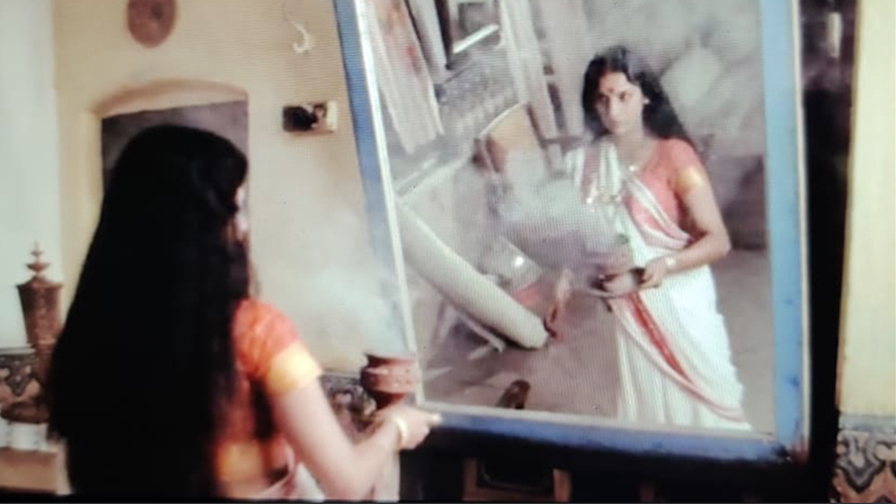
Shabana Azmi has been around for a long time as the cynosure of cinema lovers and has become an inspiration for many, yet very few have been able to emulate her way of believing in oneself, her way of suppleness in work, her multi dimensional personality and her hypnotising oratory. As I sing this paean, the unforgettable images of her as Jamini amidst the ruins in Khandhar (1984), her as Mitthu walking along the craggy contours in Namkeen (1982), and her with the blank stare of the hukka smoking Begum of Awadh in Shatranj Ke Khiladi (1977) rush past my mind; each role is unparalleled and unsurpassable, a sui generis, a class in itself—just like the real Shabana.
With five National Awards in the Best Actress category, from the startled-eyed Lakshmi in Ankur (1974) to the gun-wielding matriarch of Godmother (1999), Shabana Azmi’s celluloid journey, which spans more than four decades, is nothing short of a dream ride. But she is an artist who has never taken her awards and accolades for granted and asserts that it is more a journey of hard work and commitment than one of just talent and privileges, while modestly acknowledging that the right opportunities came to her at the right times. She is proud and grateful to be backed by two strong legacies from her parents—socialist ideologies from her father Kaifi Azmi and the gift of acting from her mother Shaukat Azmi. With age, she has brought slight squints to her big kohl laden eyes, as if to see things better and beyond and a little twist to one corner of her lips, and to show amusement and pretend detachment; but, in actuality she is hardly ever detached from the realities of her surroundings, be it social, cultural or political.
Shabana Azmi belongs to the clan of those handful of artists whose performance, even within the limited space allotted to an actor (for it is commonly believed that cinema is the director’s space), asserts the unlimited possibilities that cinema can explore—cinema as art, as philosophy, as an intellectual movement or a weapon for social change, as entertainment, or cinema as life is—unchanging and unchangeable. In Khandhar, her character accepts the utter deprivation of her situation, but at the end, her reticent, sensitive part is badly defeated as her emotions get better of her; yet it does not promise any change in her life; her image amidst the ruins that Subhash captures, symbolically shows her entrapment to that frame forever.
As an actress, Azmi’s forte is to make her part extraordinarily engaging even though hers is not the key role of the narrative or she is not the prime focus of the director’s camera. Her role as Mitthu in Namkeen is a part of that slice of life left to the doom or destiny, where human beings lack the agency to change it. Mitthu is traumatized and speechless but caring and understanding. She finds new happiness in her life as she befriends and falls in love with a stranger. She shares this newfound happiness with the rocks of the valley, but when the stranger leaves, she receives another shock, never to recover again. The seemingly simple yet nuanced narrative leaves many things unexplained. Shabana’s careless, unmeasured steps on the rocks and her grey silhouette against the craggy contours linger as some enduring images from the movie.
In Shatranj Ke Khiladi, another movie without a central character, Shabana Azmi is the purdah observing and hukkasmoking Begum of Awadh, who is ignored by her husband for the sake of a game of chess. Her blank stare and muffled entreaties are the external markers of her repressed self and they match well with the stifling, closed interiors and beautifully contrast against her husband’s indifference and obsession with chess.
In playing numerous other roles, Shabana has been continuously taking new turns and setting up standards for herself. She closely observes women’s lives and has a deep understanding of how women struggle for their own space. We see her donning as many different hats as none else has ever tried—innocent victim, corrupt powermonger, ridiculous whorehouse owner, what you will. In all these roles, she tries to capture the elusive spectrum of women’s lives, generally caught in the complex web of patriarchy and a gender insensitive society. Instead of flaunting the garb of a ‘humanist’, she calls herself a downright feminist who wishes that women become more visible everywhere.
Shabana Azmi is not an artist who believes in art for art’s sake. Her consciousness is deeply rooted in the social and cultural ethos of her time and she calls for a fine balance between rights and responsibilities that artists must build up in them. She repeatedly urges people to recognize the fine line between celebration of sensuality and commodification of sensuality.
Shabana Azmi is a film personality, a stage performer and an activist with commitment and political consciousness, not in terms of petty party politics, but in the context of larger, day-to-day social interactions. Each side of her personality enriches the other and makes her a person with introspection and high moral responsibility towards the society; however, that does not make her a somber looking matron out to silence noisy children under her ruler. Her offscreen image is one of a vivacious lady always open for dialogues, and also opening new issues for more dialogues. She switches between English and Urdu-accented Hindi with equal flair and is often heard reciting her father’s famous poem:
Uth meri jaan mere saath hi chalna hai tujhe
Tujhme sholay bhi hai, bas ashk ki nishani hi nahin
Tu haqeeqat bhi hai, dilchasp kahani hi nahin
Tere hasti bhi hai ek cheej, jawani hi nahin
Apni tariff ka mizan badalna hai tujhe
Uth meri jaan mere saath hi chalna hai tujhe
(Rise, my beloved, you’ve to walk by my side
You’ve the sparks, you’re not just a hint of tears
You’re reality too, not just an engaging story
You’ve an individuality, not youth alone
You’ve to change the scale of measuring yourself
Rise, my beloved, you’ve to walk by my side.)
Shabana has always stood by this, not for her own sake, but for all women.
Shabana Azmi made her debut as an actress in Shyam Benegal’s directorial debut, Ankur, for which she received her first of five National Film Awards. This is what Satyajit Ray had to say of her act: “Her poise and personality are never in doubt. In two high pitched scenes, she pulls out the stops to firmly establish herself as one of our finest dramatic actresses.”
Which author holds the distinction of being the most adapted writer in the cinema of India? Shakespeare? Tagore? Premchand? Or, perhaps, Dharmvir Bharati? We Indians have never demonstrated excessive love for adaptations. Thus, if one were to list the most iconic litterateurs of the subcontinent, it would be noticed that quite a few of them, such as C. Rajagopalachari, Sarojini Naidu, Ramdhari Singh Dinkar, Suryakant Tripathi, Amitav Ghosh, and Anita Desai have not a single proper film adaptation to their name. There is however [highlight background=”#f79126″ color=”#ffffff”]one Indian writer whose works have been incessantly adapted, in multiple languages, and across the country — Sarat Chandra Chattopadhyay.[/highlight]
IMDB lists 77 titles with Sarat Chandra Chattopadhyay credited as writer. It includes films in five languages, spanning 97 years and encompassing filmmakers as diverse as Bimal Roy, Mehul Kumar, Crossbelt Mani, Hrishikesh Mukherjee, Anurag Kashyap, Basu Chatterjee, Ajoy Kar, and Adurthi Subba Rao. In fact, in just two years’ time, Sarat Chandra adaptations would have completed a whole century in the film industry.
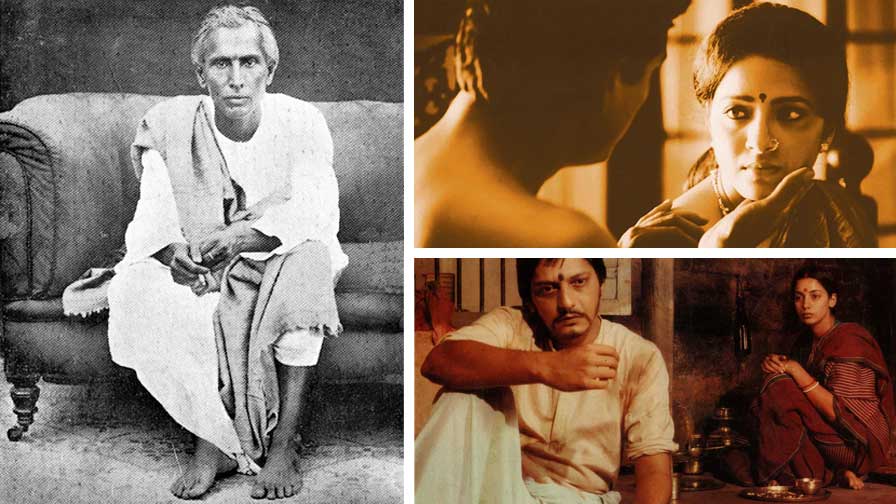
Sarat Chandra Chattopadhyay
Sarat himself led a spectacularly fascinating life. During his early days at Bhagalpur, he was so enamoured by the writings of English authors like Charles Dickens, Henry Wood and Marie Corelli, that he himself adopted the pseudonym “St. C. Lara”. Apparently, the St. and C referred to his first name Sarat and middle name Chandra. His mother Bubanmohini Debi passed away when he was only 19. By then, the bug of writing had bit him hard, and he started penning stories in Bengali for local magazines. His father Motilal Chattopadhyay, of extremely humble means, managed to get him a job at the local zamindar’s estate. But Sarat wasn’t at all happy with the work, and following an argument with his father, the former left home.
Sometime later, [highlight background=”#f79126″ color=”#ffffff”]Sarat Chandra Chattopadhyay was discovered in the guise of a sanyasi, standing in the Muzaffarpur office of a popular magazine those days, called Bharatvarsha. In flawless Hindi, he requested to be furnished with writing materials. He was out of pen and paper.[/highlight] He was carrying a notebook, and the pages of that notebook were filled with countless stories. He was shipped back to his hometown.
Around this time, certain accounts mention a lover, a young widow who had captured his imagination. He kept alluding to her in various letters, without explicitly revealing who she was. Apparently, at the behest of this lady love, Sarat sailed for Rangoon in search of a livelihood. According to Radharani Devi, a close confidante of Sarat Chandra and a fiery feminist (back in the early 20th century, she wrote pieces on whether the “dignity” of a woman could be tied to her being a virgin), this mystery woman in Sarat’s live was probably Nirupama Devi, who was widowed as a child and spent a lifetime of rituals and strict rules that were painfully inflicted on Brahmin widows of the time. In his own writings, notably, Charitraheen and Srikanto, Sarat portrayed the state of young widows in Bengal but always fell short of getting them married. It has been hinted that this was because the woman he was in love with never got a chance at such liberation.
Sarat Chandra remained in Rangoon till 1916, and it was during this phase that he got married to Shanti Devi. They were blessed with their first child, a son. But within a year, Shanti Devi and her infant child were claimed by the great plague of 1908. Two years later, Sarat got married again, this time to a widow. They were childless and stayed married till the end of his days. [highlight background=”#f79126″ color=”#ffffff”]It was after his second marriage that Sarat truly flourished as a literary genius. His new bride, Hironmoyee, was an illiterate but provided the fuel for his creative output.[/highlight] Saratchandra was in his late 30s. In an incredible burst of prolificity, Sarat Chandra Chattopadhyay produced some of his best works in the next 25 years. Even while in Rangoon, in just the first two years he wrote works like Ramer Shumoti, Bindur Chhele, Naarir Mulyo and Charitraheen. Almost all of these books had formidable women characters, and the male characters seemed to pale in comparison. This remained a hallmark of Sarat’s writing throughout his oeuvre.
Sarat was back in Bengal and within a few years, the stage adaptations began. It was the golden age of Bengali theatre, and the great theatrical genius Sisir Kumar Bhaduri was prancing about on the stages of Calcutta. Sisir Kumar adapted his story Shoroshi for the theatre and it was a raging hit. Sarat later wrote about it to his soul-sister Radharani Devi, speaking about Sisir in glowing terms. The first film adaptation of his work—Andhare Alo (1922)—was also directed by Sisir Kumar Bhaduri. The silent film was co-directed by Naresh Mitra, who within six years made the first adaptation of Devdas (1928). This was followed by Dhirendranath Ganguly’s adaptation of Charitraheen (1931).
This was the time when a young filmmaker from Assam, Pramathesh Chandra Barua, was experimenting with the new technology of “talkie” films, in Calcutta, and for the first time there was the question of which language to make films in. Barua made the first “talkie” adaptation of Devdas (1935) in Bengali, with him playing the eponymous character. It was an instant sensation. In the following year, Barua directed the Hindi version, with singer-actor Kundan Lal Saigal playing the hero. The Hindi version was an even bigger hit. A Tamil version was made in the year after that. Danseuse and filmmaker Vedantam Raghavaiah made a Telugu/ Tamil bilingual in 1953. It had Telugu superstar Akkineni Nageswara Rao reprising the iconic role. The film became a milestone. Devdas Mukherjee, a jolted, ill-fated lover with a penchant for self-harm, had become the darling of the masses.
But Sarat himself did not think too highly of this work. While he was in Rangoon, his friend Pramathanath Bhattacharya tried to coax him into publishing Devdas, which he had written way back in 1901. Sarat responded, “Don’t even think of it. It was written in a drunken state. I am ashamed of the book now. It is immoral…” But Pramathanath convinced him and eventually it was published in the former’s magazine, Bharatvarsha, in 1917.
[highlight background=”#f79126″ color=”#ffffff”]It has been more than a hundred years, but Indian cinema’s obsession with the character hasn’t dissipated.[/highlight] The cinematographer of P.C. Barua’s Devdas, a young cameraman called Bimal Roy, adapted his version of the story in 1955. It still remains the most iconic of the lot, and stars Dilip Kumar, Vyjayanthimala and Suchitra Sen. Devdas has been made in Bengali (India and Bangladesh), Telugu, Tamil, Assamese and Malayalam. There was even an Urdu version made in Pakistan, a film that was supposedly a “tribute to Sarat Chandra Chattopadhyay, Bimal Roy and The Great Dilip Kumar”, but the lead actor Nadeem Shah kept aping Shah Rukh Khan, who himself featured in a much-maligned-but-loved adaptation by Sanjay Leela Bhansali in 2002. Even Anurag Kashyap, who, much like Sarat himself, disliked the story, filmed a re-imagination called Dev D in 2009. Bimal Roy’s protege Gulzar planned an adaptation with Dharmendra, Hema Malini and Sharmila Tagore but it never did come to fruition.
Gulzar with his Devdas cast. Photo: https://twitter.com/FilmHistoryPic
Gulzar did however adapt Sarat Chandra’s Pondit Moshai as Khushboo (1975). Basu Chatterjee filmed three adaptations—Swami (1977), Apne Paraye (1980) and Zevar (1987). Bimal Roy directed as many as three adaptations, including Parineeta (1953) and Biraj Bahu (1954). Hrishikesh Mukherjee made Majhli Didi (1950). There were too a number of Telugu superhits starring Akkineni Nageswara Rao, and Tamil films like Manamalai (1958), Maalaiyitta Mangai (1958), and Kaanal Neer (1961).
Sarat Chandra stands tall in the Indian literary pantheon. He wrote only in Bengali, but [highlight background=”#f79126″ color=”#ffffff”]his translated works are so native to North India that many of his works are considered a part of Hindi literature.[/highlight] Hindi writer Vishnu Prabhakar wrote a biography called Awara Maseeha, which is a veritable classic. Malayali poet Dr. Ottaplakkal Neelakandan Velu Kurup a.k.a. O.N.V. Kurup once said, “Sarat Chandra’s name is cherished as dearly as the names of eminent Malayalam novelists. His name has been a household word.” In a similar vein, his Marathi translations became native to Maharashtra.
Almost all his works are marked by complex and layered female characters and flawed heroes. His almost-autobiographical Srikanto, in its original unedited version, begins with the protagonist writing while in an opium-intoxicated stupor. The portion had to be excised later. Since he showed an upper-class Brahmin widow fall in love in Charitraheen copies of his books were burned in front of his house. His novel Pother Dabi was banned by the British Raj for the depiction of armed revolutionaries.
But while Devdas, admittedly Sarat’s weakest work, has been adapted with great fanfare, [highlight background=”#f79126″ color=”#ffffff”]his magnum opus Srikanto, which displays fascinating glimpses of his personal life and includes some awe-inspiring women, is yet to be adapted in its entirety.[/highlight] Some portions of the latter have been brought to the screen in Bengali, and there was, in the 80s, a television serial featuring Farooq Sheikh as Shrikant. One would think that there is scope for a delightfully complex and layered adaptation of this book, now that we are in the middle of The Great Streaming Wars.
When I was completing the edit of my film ‘Remembering Bimal Roy‘ on my father, my editor asked me who would do the final sound design. This was the first time I heard the term sound design and realised that my documentary would need one. Shajith
By sheer serendipity a dear friend Meena Pillai mentioned that Shajith Koyeri, a friend of hers, had just won a National Award for Sound Design. This could not be a coincidence. I told Meena to fix an appointment for me to meet him, which she did instantly. When I was shown in to the mixing room to meet Shajith I gave an involuntary start as I set eyes on him for the first time. Shajith was seated on a chair which seemed so large in comparison to him that it seemed to swallow him up in its recesses. That was because he was tiny in size and painfully thin, and [highlight background=”#f79126″ color=”#ffffff”]severe arthritis had turned his fingers into claws. I couldn’t imagine how he could handle the sound controls with those bent claws. And yet this man had won a National Ward for his skills.[/highlight] His achievement was all the more miraculous because he did not have any formal training in sound design. Whatever he had learned was by observation and practice.
I personally witnessed the magic of those bent fingers when we sat together for the sound design of my film. His keen intelligence and sensitive hearing enabled him to maximize the potential of the existing soundtrack and better it when required. The seamless and near flawless final soundtrack created by Shajith far surpassed my expectations. And his sunny disposition made it a pleasure to work with him.
Shajith’s story is a fascinating example of how destiny can play a pivotal role in one’s life.
Consider this. Shajith grew up in a small town called Punnol in Kerala. His father owned a ration shop and his mother taught Hindi in a government school. Shajith was a normal school going kid who loved football. But at age thirteen he was detected with juvenile arthritis. The local doctor gave him wrong medication for two years at the end of which Shajith’s condition had deteriorated alarmingly. The parents finally took him to a senior doctor in an adjoining town, and that medication helped to stop the deterioration. But the damage had already been done. He began to suffer from severe depression. But he finally took up a job in a local library and he became a voracious reader. His mind opened up and he became curious to know more about politics, world affairs, history and space. And he was fascinated by unexplained phenomena like the Bermuda triangle. His depression lifted and he was in a better space.
All through this time his friend Satish who lived next door was a great support and would spend time with him to cheer him up. Satish then went to the Film and Television Institute to study sound design and finally opened his own studio in Bombay. But it took Shajith several years of suffering and hardship before Satish rescued him from wasting away in a small town. His one day visit to Satish turned into 7 days. Shajith would spend the day in Satish’s studio. [highlight background=”#f79126″ color=”#ffffff”]He was fascinated by the process of mixing sound. Shajith told me that from childhood natural sounds had fascinated him… for example the difference in sound when the same person walked on sand and then on the road. He had already developed a very keen ear for sound.[/highlight] And his interest in Hindi cinema, unusual for a boy from a small town in Kerala, was because his mother taught Hindi and would take him to see Hindi films. He confessed that he had been a great fan of Amir Khan, so he would buy old copies of Filmfare from a second hand bookshop to know more about him and Bollywood. Obviously life was preparing him for a career in shaping the sound of Hindi cinema.
It has been a long and arduous journey for Shajith from Ponnul to Bollywood and from depression to jubilation. Shajith’s story is inspirational particularly for handicapped people. His life proves that one’s strength of mind and determination can make the impossible possible.
In her heydays, Sharmila Tagore was a path breaker, a sensation maker and a constant stirrer of surprises; after a long career of four decades, she now mellows with age, warmth and grace. Like Shakespeare’s Rosalind, the pert and robust heroine of As You Like It, Sharmila Tagore is certainly one of those handful of articulate, witty, strong willed and intellectually bent actresses of Bombay cinema, but sadly enough, she is also the one whose real potential went unrecognized there and despite her stardom, the promises of the brightness of a thousand stars remained a far cry. Had her brimming virtuosity been fully exploited, Bombay cinema of the sixties and seventies would have chronicled drastically different stories that would have been more enduring in art and appeal. For cinema in the sixties not only meant color images and exotic locations but also a confluence of many new waves and an emergence of a global culture with long lasting effects.
For someone like Sharmila Tagore, who started off at the age of thirteen with a master ‘seer’ like Satyajit Ray as her mentor director, was guaranteed to have a long ride, rich and eventful. The ride was long, and eventful too, but in a hurry to finish that great length, it did not come to a halt to explore the treasure that lay on the wayside or within herself. When Sharmila Tagore first appeared as Aparna in Apur Sansar the intensity reflected in her eyes and facial contours indeed promised of a new beginning. Even without much speech—she mostly spoke in monosyllables, and rarely on her own—she brought forth the whole of a young bride, stepping into an unknown world, caught between the emotions of having to leave her parents on the one hand and the joy of being with Apu, her husband, on the other.
But then, instead of finding her moorings in her own surroundings, she chose to respond to the calls from outside. And, in a twist of irony, when she was grafted into the highly commercialized and newly glamorized Bollywood, her speaking eyes became still and dumb and remained wide open all the while, forgetting to flutter and sparkle at life’s new experiences. Her face that had emoted many layered thoughts in a single moment, merely got cast into plastered masks. In Kashmir ki Kali she had no ‘role’ as such but to push around her shikara all over and lure away her lover, like the famous la belle dame sans merci, into frenzied twitching and gibbering (in pain or pleasure nobody knows). She meant to break the stereotypes all the while; but in movies such as Aradhana, Amar Prem, and Safar, for which she is mostly remembered, her directors dismally fell short of raising her above them, either in gestures or in speech delivery or a haunting consciousness of the camera gaze. In Mausam too her character set out to be unconventional, but the overall impact did not come out without the lingering question of art and artificiality.
Namkeen, directed by Gulzar, to a great extent, brought back the freshness and naturalness of Sharmila Tagore the artist as Nimki, the eldest of three sisters in a remote mountain village. Sharmila is seen in one of her spontaneous best in her free and open postures and minimalist dress and make up. Surely, the raw landscape of mud walls and thatched roofs atop a rocky hill enhances this spontaneity, bringing alive all the nuances of her difficult situation in a seemingly uneventful life.
In Shubho Mahurat, Sharmila plays the dubious Padmini Choudhury, an NRI producer who puts her money in a movie but does something diabolic. In this ‘enactment’ of an amoral character, every bit of Sharmila’s finesse as an actress comes out to the tip, even within the frame of a thriller—we certainly do not forget that it was adapted by Rituparno Ghosh from Agatha Christie’s The Mirror Crack’d from Side to Side; a cracked mirror being a metaphor for our fragmented selves or ‘schizophrenia’, a disorder in which a number of contradictory facets build up a single personality. In Padmini’s character, Sharmila brings out with her natural ease the hidden selves of a divided individual in whom success, wealth and fame are interlaced with hatred, jealousy, revenge and an inescapable sense of failure.
In spite of all the overwhelming paradoxes in the illustrious career of Sharmila Tagore, given her talent, depth of personality and range of interests, we would have been happier to see the Sharmila magic burst and sizzle more vigorously like a never-ending cracker festival. We go about rapturously to call her the brightest jewel and the fairest of all faces like Orlando did in the forest of Arden for Rosalind, but we also wistfully reflect on what a difference it would have made had she walked with a halted pace to adore the hidden jewels.
Where the bee sucks,
There suck I;
In a cowslip’s bell I lie;
There I couch when owls do cry;
On the Bat’s back I do fly
After summer merrily.
Merrily , merrily shall I live now,
Under the blossom
That hangs on the bough.
-The Tempest, Act V, Scene I
With all her vivacity and volatility, Aparna Sen can be very challenging as a subject. For it is actually difficult to catch her in a single mood, even while she sits for a discourse on a serious issue. She is always playful, always coming up with a surplus of ideas, and an endless string of ‘ands’, and almost never for any ‘either or’. If at all Aparna Sen can be perceived or defined in a single term, it has to be briskness. [highlight background=”#f79126″ color=”#ffffff”]With her fleeting gestures, twinkling glances and smiling lips, she hardly ever settles for a single mood. And by the time one tries to catch her mood, the next moment it is replaced by something else, which is constantly passing like the incessantly flowing river into which one cannot step twice.[/highlight] Or, like that eternal stream of moments ceaselessly becoming an ‘already’.
It is for this briskness that she is best embodied by the little squirrel Chorky — her companion in her first screen appearance as the mischievous teenager in Teen Kanya (1961). No wonder. It was Satyajit Ray, the master ‘seer’, who could feel the exact vibes of that swiftness; indeed, who else could have done that?
But it isn’t just in terms of its gushing, linear movement, but also in its bottomless depths that Aparna Sen is exactly like a river; it is a river that is still thirsty and has set out to quench its thirst plunging into its own profundity. This river also comes up with the idea of the beyond, that is, the unseen part of the other bank, which always enchants people. For Aparna Sen isn’t simply extraordinarily beautiful, but something way beyond such; she isn’t simply outstandingly intelligent, but something way more. In her sharp features and elegant appearance, she literally embodies a classic exquisiteness.
[highlight background=”#f79126″ color=”#ffffff”]In her multiplicity of roles as the scriptwriter, director and actor, Aparna Sen apparently resembles Prospero, the Duke of Milan, the magician, the creator and controller of events and at the same time, very much a part of those events. But, in essence, she is more akin to Ariel, the spirit of the air.[/highlight] For it is only Ariel, who sayeth ‘Before you can say “come” and “go”/ And breathe twice and cry “so so”’ in Shakespeare’s The Tempest, who can assure us of that quaintness and softness of action.
In spite of all these attributes, she never demands deification, but only simple praise and admiration. This prevents her creations from being incredible or magical. With a perfect combination of subject matter, story and cast, whatever she creates always remains credible, grounded, and all too humane, an approach adopted only by a handful of master creators.
Aparna Sen’s portraiture of two claustrophobic middle-aged housewives in Parama (1985) and ParomitarEk Din (2000), marks this humane approach. Parama’s character (played by Rahkhi Gulzar) shows that being human means frailty, desire and failure as much as it means strength, austerity and success. The sudden appearance of Rahul in her life makes her yearn to live life on her own terms, refusing to be no longer assured by the fake domestic security. The film is by no means an attack on domesticity; it is only Parama who feels like stepping out of its monotonous circularity. Unfortunately, she becomes a little too wayward to return and fit into that circle again. Meeting Rahul is like remembering her lost youth. She wistfully tries to compensate for something she could not make the most of. But it is too late for her to realize that, like Rahul, her youth too is gone forever!
In Paromitar Ek Din, Aparna Sen is in her directorial and performer’s best as Sanaka, an unhappy, deprived housewife of a middle class family. She is surrounded all the time by her big joint family, but prefers to isolate herself from its mundane demands, and finds her mental escape in the tiny images of the small frame of the television box. Her mind is always moored in a ‘somewhere else’ and this she confesses to her daughter-in-law Paromita; she confides to her that if her former lover had asked her even once, she would readily have run away with him, leaving everything behind — her husband, children, everything. Sanaka’s reaction over the news of her husband’s death and her childlike joy of kite flying are some staple moments that we go back to, over and over again. Or, can we ever forget the dejected Violet Stoneham walking home alone, or lovesick Snehamay writing letters to his beloved far away in Japan? Whether in the overt handling of the theme of communal violence, the subtle politics of everyday life, the hilarity of family drama, or the delicate nuances of female friendship, Aparna Sen is second to none.
[highlight background=”#f79126″ color=”#ffffff”]Aparna Sen is an example of how a woman can make bold statements about life and living by always remaining warm, tender and empathetic to others, preserving every feminine grace and charm and never ever being rude and aggressive.[/highlight] Her political stand is always very clear and both as a person and a professional she refuses to be presented by someone else’s vision. This is the reason why she switched over from acting to scriptwriting and directing. She has her own stories to tell and she tells them so intriguingly, leaving no loose strands to hang clumsily here and there. She is always driven by her own instincts and beliefs and never takes the audience for granted. Even as she turns seventy-five, she still remains the sprightly teenager that she had enacted sixty years before — never trying to surprise her audience with feeble twists, but always answering their pleasure exactly like ‘dainty’ Ariel, “be’t to fly, to swim, to dive into the fire, to ride on the curled clouds.”
Awards
Aparna Sen is the recipient of the Padma Shri as well as 9 National Film Awards.
Photo credits
Header pic of Aparna Sen on the sets, by Prem Prakash Modi
Aparna Sen at Kolkata by Biswarup Ganguly
Rare pic of Aparna Sen by Benu Banerjee
Aparna Sen at The Japanese Wife press meeting by Bollywood Hungama
When renowned poet Faiz Ahmed Faiz watched Gaman (1978), he was overcome by so many emotions that it was nearly impossible not to say anything about it. He wrote a letter to Muzaffar Ali, the 34 year-old adman who had directed the film. Faiz wrote, “Gaman is a poem in visuals. Its tragic lyricism and muted eloquence is deeply perceptive. It is a sensitively conceived and truthfully captured slice of reality around us, the beauty and the heartbreak of the human situation makes it a sheer delight, a veritable tour de force.”
Mumbai is the Indian version of the American Dream. The proverbial land of opportunities, where thousands converge every year in search of livelihood and a better life. By the mid-19th century, Bombay had become one of India’s most significant ports and trading hubs, which attracted a significant number of migrants from different parts of the world. In 1947, during Independence, more than 50% of Bombay’s population comprised of migrants. For those uprooting themselves from their homes in other states, it represented an erosion of their own societies. In Gaman, Ghulam Hassan (Farooq Sheikh) leaves his wife Khairun (Smita Patil) and his mother back in the village, and lands up in Bombay at the insistence of his friend Lallulal Tiwari (Jalal Agha), who was already pursuing his dreams in the city. The film chronicles the lives of migrants from Lakhimpur Kheri, Muzaffar Ali’s own backyard.
Rajah Muzaffar Ali of the Royal Muslim Rajput family of Kotwara. oocities.org
Muzaffar Ali grew up in the UP township of Lakhimpur Kheri, and the culture of Awadh, along with the age-old tradition of Ganga-Jamuni Tehzeeb deeply fascinated him. While studying at Aligrah Muslim University, this fascination only got deeper and richer. He was influenced by the poetry of revered Urdu poets like Dr. Rahi Masoom Reza, Shahryar, Ali Rahman Azmi, Makhdoom Mohiuddin, and Faiz Ahmed Faiz. These poets at the turn of the century were concerned with a breakdown of what they referred to as “Muaashra”, a construct that is representative of a way of life — the closest English equivalent is ’society’. While consuming their verbiage at an impressionable age, Muzaffar shared their worries about erosion of this way of life. But eventually when his career brought him to the bustling metropolis of Bombay, it was finally clear to him what all this was leading towards. Scores of migrant labourers flocked to the city, disillusioned by rising unemployment in their hometowns. This nudged him in the direction of his first film, Gaman, in which he chronicled the migrant experience. Muzaffar’s Ghulam Hassan finds himself trapped inside the massive belly of the all-encompassing metropolis, finally earning a living but unsure whether he’d be able to leave the city even if he wanted. The City of Dreams had devoured him whole, as evinced by these lines by Shahryar:
Seene mein jalan, aankhon mein toofan sa kyon hai
Iss shahar mein har shaks pareshaan sa kyon hai
Tanhayi ki yeh kaun si manzil hai, rafeekon
Ta-hadd-e-nazar ek bayabaan sa kyon hai
(What is this burning inside the chest…
What is this fire in the eyes…
Why is every person in this city so distressed?
How lonely is this place, friends,
That it’s wilderness as far as the eye can see?)
One film that weaves both his obsessions — poetry and the Awadhi culture — into an elegant bundle of storytelling — is Umrao Jaan, Muzaffar Ali’s magnum opus.
Mirza Hadi Ruswa, a man literally born at the cusp of history, in 1857, produced an abundance of Urdu pulp fiction, had a whirlwind affair with a Frenchwoman named Sophia Augustine, got his heart broken, and carried on amorous adventures with the courtesans of Lucknow. But the man would be known in history for a novel that he insisted was inspired from personal experience, Umrao Jaan Ada. According to Ruswa, an ageing Umrao Jaan herself narrated her life story to him. Sometime in the 70s, Muzaffar Ali, a young advertising executive and budding filmmaker, happened upon the book, which painted a picture of decadence, the last breath of Awadh’s opulence, lyricism and debauchery. Muzaffar recorded the whole book on an audiocassette and listened to it in his car every day. There were moments in the story that he seemed to have experienced in his own life. The resonance was uncanny, and he felt these ‘moments’ could be recreated on film.
Rekha in Muzaffar Ali’s Umrao Jaan
Spotting Rekha — her face and her eyes — on the cover of a magazine, sealed it for Muzaffar that she should be his Umrao. Poet Shahryar was flown in from Aligarh, and Muzaffar Ali hosted him in his own house at Juhu. Music director Khayyam too stayed just around the corner. They sat together for hours, trying to weave the poetry that became the soul of Umrao Jaan. It took them about a year and a half to compose all the songs. Khayyam himself researched extensively on the raagas and singing styles of the 19th century which the courtesans of Lucknow regaled their patrons with. Much like Ghulam Hassan, who had to leave his village to come to an alien Bombay, Amiran is forced to leave her home and end up in a city of boundless exploitation, soul-stirring poetry, exquisite beauty and a promise of love that’s never quite realised. This uprooting was just as painful and Amiran somehow finds it in herself to transform into Umrao Jaan, the queen of a thousand hearts. But unlike Ghulam Hassan from Gaman, she is able to express herself through her art. Shahryar reimagines this soulful quest through the dazzling ghazals encapsulated in the film, with Asha Bhsole breaking form to venture into a domain she had never quite tried before. Rekha completely internalised the alienation, the pain and ultimately the redemption of Umrao Jaan. It had a stellar cast of spectacular actors, all in the prime of their careers: Naseeruddin Shah, Farooq Sheikh, and Raj Babbar. Umrao Jaan swept the National Film Awards and Filmfare Awards announced next year.
After Umrao Jaan, Muzaffar Ali continued exploring themes of alienation and breaking down of communities. Aagaman (1982) is an antithesis to Gaman in the sense that one of its protagonists, Mohan (Suresh Oberoi), comes back to the village after being educated in the city, and tries to unite sugarcane farmers so their exploitation by the mill-owners can stop. The film introduced a talented young actor by the name of Anupam Kher, who played Mohan’s father Ramprasad. With Anjuman (1986), Muzaffar Ali went back to old Lucknow and the erosion of old-world values. And like migrants in Gaman, courtesans in Umrao Jaan, sugarcane farmers in Aagaman, Muzaffar Ali adopted the milieu of chikankaari artisans of Lucknow.
In the 80s, many trips to Kashmir endeared Muzaffar to the concept of Sufism and Sufi philosophy. Intrigued by the enigmatic Kashmiri poetess from the 17th century called Habba Khatun, he mounted his dream project Zooni on an epic scale. Dimple Kapadia was cast in the titular role, and Vinod Khanna in a role opposite her. Dimple and Vinod had just returned from their respective sabbaticals and their casting caused plenty of media attention. But Muzaffar’s lofty vision for the film, his perfectionism, insurgency in Kashmir, lackadaisical attitude of the government and similar logistical challenges kept stalling the project. Muzaffar Ali kept trying to revive the film till as late as 1997, but to no avail. His dream remains unfulfilled, much like his muse Umrao Jaan Ada, who lamented,
John Abraham and Ritwik Ghatak. That combination sounds blasphemous already. But it shouldn’t. Because the John I am talking about blazed a trail through Indian cinema that nobody since has had the gall to follow. This is how Jacob Levich distinguished Ghatak from Ray: “Satyajit Ray is the suitable boy of Indian film, presentable, career-oriented, and reliably tasteful. Ghatak, by contrast, is an undesirable guest: he lacks respect, has “views”, makes a mess, disdains decorum” Pick up those colourful words used for Ghatak, and use them on John Abraham. Every word fits with equal resonance.
John Abraham was the Enfant terrible of Malayalam cinema. His work, like his mentor’s, was marked with a blatant disregard for established mores, while displaying a longing for days gone by. The rebellious streak was a constant in him, till the day he breathed his last. Even during his FTII days, John had been suspended from the hallowed halls of the institute. Not once, not twice, but four times. And yet he graduated with a gold medal in direction and screenwriting. This contrast permeated through his as well as his mentor Ritwik Ghatak’s life.
Ritwik Ghatak joined FTII in the year 1965. He had already made six of his most acclaimed films, had had a brief and rather unsavoury brush with what we know as Bollywood today. It was Ritwik’s brother, Sudhish Ghatak, who had wielded the camera for the venerable Phani Majumdar’s Street Singer, was responsible for Bimal Roy getting into New Theatres Studios as a camera assistant, back in the 1930s. Later Ritwik started his stint in filmdom by assisting him in Roy’s early works like Tathapi, where Ghatak was chief assistant. After Ritwik got married to his wife Surama Ghatak, a fiery revolutionary an active IPTA member, he was looking for stability by way of gainful employment and landed up in Bombay, working for Bimal Roy Productions. Ghatak wrote Bimal Roy’s classic Madhumati as well as Hrishikesh Mukherjee’s debut venture, Musafir. But despite the box office success of these films (or maybe, because of it) he was disillusioned and left the glitter of Bombay behind and returned to the grime of Calcutta. Back to the bottle, back to the endless Sunday sessions at Coffee House with the likes of Utpal Dutta, Satyajit Ray, Tapan Sinha. Meghe Dhaka Tara brought in acclaim and recognition, but Komol Gandhar floundered at the box office.
Ghatak household was mired in financial insecurity. Ritwik and Surama were facing a bad patch in their conjugal life, and were living separately. The fact that he admitted to her of falling love with another woman, wasn’t helping. Ritwik’s life is like a series of self-destructive indulgences, punctuated by short bursts of lucidity, something which us lesser mortals will perceive as “normalcy”. During one of these phases, Ghatak decided to make things up with Surama and obtain a secured employment. That is when he took up the teaching job at FTII. There are fables about Ritwik Ghatak at the institute. One of them is about him dishing profound philosophy on life and cinema in a state of drunken stupor, to his disciples sitting under the Wisdom Tree. There were the likes of Mani Kaul, Kumar Shahani, Vidhu Vinod Chopra and Subhash Ghai. And then there was John.
Ghai and Chopra never tired of speaking about the master and his influence on their lives. Ghai says he was the one helping Ghatak to his room after the drinking binges. Chopra tells stories of how Ritwik rambled to him in Bengali, and eventually suggested the moniker “Vidhu”, permanently added to his name. Mani Kaul and Kumar Shahani built their own oeuvre, with a distinct world view. But it was John Abraham from Kerala who ultimately carried the mantle of Ritwik Ghatak. If Ghatak had a cinematic heir, it would without a doubt be John.
John Abraham wasn’t just a wide-eyed youngster who crowded into Pune Film Institute (as FTII was referred to back then) merely to make a career in the movies. He was barely 12 years younger to Ghatak, and was well in his mid-30s by the time he graduated. John was kind of wandering across disparate career opportunities when he chose to abandon everything and enrol for film school. He had been teaching in college, and worked briefly for Life Insurance Corporation as well. Which means this move must have been well thought out and extremely risky at the same time. John’s IMDB lists three diploma films he was associated with: Koyna Nagar, Priya and Hides and Strings. This is not unusual. Students have been known to work in others’ diploma films even after they had graduated. Also, Ritwik made some changes in the curriculum of the institute to emphasise on practice rather than theory.
Not only Ritwik’s pedagogy, but his politics, worldview and philosophy had a great impact on John Abraham. And John was primed for it, having had his formal education in politics and history from the Mar Thoma College at Thiruvalla. Both Ritwik and John were short story writers. And just like his mentor, John had a brief brush with Bollywood. He assisted on a Waheeda Rehman starrer called Trisandhya but unlike Ghatak, John’s film probably never saw the light of the day. But in 1969, he would get the opportunity to work on another Hindi film, Mani Kaul’s Uski Roti – which pretty much set the stage for ‘Parallel Cinema’ in India. John not only assisted his friend, but also appeared in a minor role.
John Abraham’s directorial debut was a rather conventional and tame Vidyarthikale Ithile Ithile, featuring mainstream Malayalam movie stars like Madhu aka Madhavan Nair and Jayabharathi. It was with his second film that he truly came into his own.
Agraharathil Kazhutai is about an ill-fated donkey that finds himself in a neighbourhood dominated by chaste Brahmins. Though initially some kind souls treat the beast with some affection, he faces bullying for the most part (among others, at the hands of some students who draw Nietzsche-in parallels with the “Ass”). Eventually, scared of the ill-luck brought about by the animal, the donkey is killed off by the residents. Displaying John’s almost-brutal capacity of pitch-dark humour, the donkey’s murder unleashes death and destruction in the Brahminical village. And then, miracles start manifesting themselves.
John was even more Ritwik than Ritwik, in some ways. Barring a couple of documentaries, Ghatak didn’t do any work outside of Bengali, the language and milieu he was most comfortable with. John’s breakout film Agraharathil Kazhutai was a Tamil film, though he primarily identified as a Malayali filmmaker. The film created waves. Earned a National Award, among other things. John Abraham also innovated an early example of crowdfunding in cinema. He launched the Odessa Collective in 1984, which went around campuses, small towns and villages in Kerala, staging street plays and screening old films, collecting money from people who volunteered to pay for the experience. The resultant money was utilised towards production and distribution of tightly budgeted indie films. One of them was Amma Ariyan, which has become the other definitive John Abraham film. Amma Ariyan, literally meaning a letter to mother, is about a man traveling with the dead body of a stranger, trying to take him to his mother. The lead was played by Joy Matthew who in 2012 created waves with his Malayalam film Shutter, inspiring remakes in Tamil, Telugu, Punjabi, Tulu and Marathi.
John’s persona, much like his master, attained mythical status. His quirk, his spontaneous refusal to comply, an outrageously self-destructive streak, all of this added to the allure, perhaps. Anecdotes abound to establish this. Amma Ariyan was being screened at the Flaiano film festival and John was waiting for his flight to Italy. His partners in crime, when they reached the airport, noticed John had forgotten his shoes. He right there, standing barefoot, waiting for his flight to Italy! Similarly, on another occasion, he took off his pants and gifted them to a rickshaw driver when the man complimented him on his jeans.
A 50-year-old Ritwik Ghatak died, derelict, consumed by the bottle and in the mouth of madness. Little more than a decade later, on 31 May 1987, John Abraham fell from the terrace during a party. He had been drinking copiously. He died a day later, two months short of his 50th birthday.