Author: Darshana Goswami

  • Shyam Benegal — the Affable Auteur

    Shyam Benegal — the Affable Auteur

    Shyam Benegal: the Affable Auteur

    “Weave a circle around him thrice,

    And close your eyes with holy dread,

    For he on honey-dew hath fed,

    And drunk the milk of Paradise.”

    -Samuel Taylor Coleridge, ‘Kubla Khan’


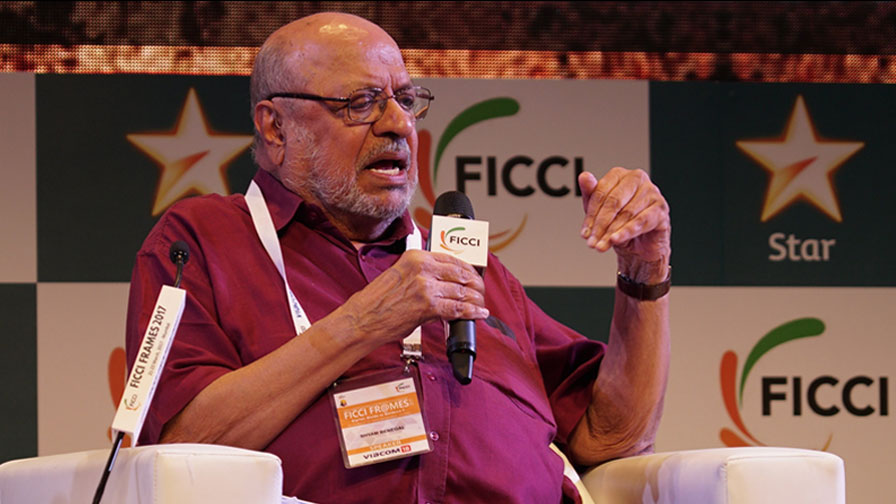
    The most endearing aspect of Shyam Benegal as an individual and a director is his unassuming demeanour. He is an ‘author’ without being authoritarian. His seemingly ordinary way of bearing himself simply belies his strength to give sustenance to the universe of stories that he carries within him. This facet of Benegal starkly contradicts the commonly perceived image of directors; that they are inseparable from their inherent authorship even while they are not all the time conscious of it.

    What makes Shyam Benegal stand out is his turning away from the author’s persona as described by Roland Barthes; an “author” who is keener on ‘seeing’ things as they happen than on ‘showing’ them from the central perspective of a manipulating agent. This ‘author’ contradicts the auteur who emerged in the 1950s new wave cinema as the sole controlling figure. To be more precise, Benegal prefers to be among the anonymous audience rather than donning the role of a puppeteer who holds the strings and fastens the story to his fingers. For Benegal, the self-effacing author, the story unfolds itself, and speaks for itself.

    In the conventional notion, an artist /author is synonymous with a creator, an inspired being—one who drinks the milk of Paradise, is guided by the “Heav’nly muse” (John Milton, Paradise Lost), sees things that others fail to, and is capable of creating life with masterstrokes. However, in the 1960s, this notion was radically replaced with the notion that the author is only a ‘translator’ and not a creator. This new incarnation or role of the “author” was ushered into the arena of critical theory by Roland Barthes in his path breaking essay ‘The Death of the Author’, in which he says that the author is merely the facilitator, the mediator or simply the ‘space’ where currents and cross currents of socio-cultural happenings cross their paths.

    No doubt it has always been that way. As soon as a fact is narrated no longer with a view to acting directly on reality, but intransitively, that is to say, finally outside of any function other than that of the very practice of the symbol itself, this disconnection occurs, the voice loses its origin, the author enters into his own death, writing begins. The sense of this phenomenon, however, has varied; in ethnographic societies the responsibility for a narrative is never assumed by a person but by a mediator, shaman or a relator whose ‘performance’—the mastery of the narrative code—may possibly be admired but never his ‘genius’. (Roland Barthes)1

    In a similar manner, John Barth takes a survey of art forms and genres such as music, painting, pop art, intermedia art, and literature, and proposes that all art is repetitive by nature and that the ‘authors’, instead of creating, merely synthesize what went past and what they see around them in the present. Benegal, in spite of possessing a widely acclaimed oeuvre, appears not to believe in this proposed ‘myth’ of originality, in which the Aristotelian conscious agent is an “aristocratic notion” of which “the democratic West seems eager to have done with, not only the “omniscient” author of older fiction, but the very idea of the controlling artist has been condemned as politically reactionary, authoritarian, even fascist.”2

    Benegal is said to have set out under the influence of Satyajit Ray, but his films are a class apart from Ray’s, for, unlike Ray, Benegal in his depiction of social realism prefers to be less suggestive and more straightforward, less dreamy and more harsh, raw and lifelike. Whether in his early films such as Ankur, Manthan, Bhumika, Mandi, and Junoon, or in his later films such as Mammo and Zubeidaa, he captures the political undercurrent that flows through all social relationships. Survival and self-fulfillment of individuals caught between the expectations of the society and their own, are the core issues that Benegal addresses in his movies that move in the domains of class/caste struggle, gender politics, psychic obsession, history and cultural anthropology.

    In real life too, as in his films, there is no attempt to mystify or romanticize reality. While reflecting on his own works, Shyam Benegal assumes the ‘role’ of anything but the director that radiates a towering, all eclipsing and an all-knowing halo. He is careful not to let the author’s self take over his common man’s way of sitting relaxedly while talking. Even while giving background details of threshold moments, Benegal appears like one recounting the most mundane, ordinary happenings in the chain of everyday incidents of which we barely take any notice. In his description there is neither any trace of anxiety of searching nor the thrill of finding. Shyam Benegal is placidity personified.


    References

    1. Barthes, Roland. “The Death of the Author.” Authorship: From Plato to the Postmodernism: A Reader”, by Sean Burke, Edinburgh University Press, Edinburgh, 1995, pp. 125-130. JSTOR, www.jstor.org/stable/10.3366/j.ctvxctrs61.21
    2. Barth, John. “The Literature of Exhaustion.” The Friday Book: Essays and Other Non-Fiction. London. Johns Hopkins University Press. 1984


  • Geeta Dutt — the Muse of Unstrained Melodies

    Geeta Dutt — the Muse of Unstrained Melodies

    Geeta Dutt

    ‘Tis not through envy of thy happy lot,

    But being too happy in thy happiness,—

    That thou, light-winged Dryad of the trees

    In some melodious plot

    Of beechen green, and shadows numberless,

    Singest of summer in full-throated ease.

    – John Keats, Ode to a Nightingale


    In Geeta Dutt’s warbling voice, subdued smile and shy glances we find the nymph and the muse being fused together and nothing comes as close to her life and art as does [highlight background=”#f79126″ color=”#ffffff”]the immortal bird of Keats’ famous ode. [/highlight]Hers is a tale of extreme experiences that life can offer to an individual. While destiny endowed her with the rarest ability to conjure up a gush of fresh air and a soothing shower to a parched land and a thirsty clime, the same destiny took away all her powers and left her feeble and lonely, as if administered by some unalterable nemesis. Geeta Dutt’s life was tarnished as much by love and deceit as by despair and longing. But her timeless voice makes her the immortal Dryad of the evergreen bower in which the short-lived summer is celebrated with ‘sunburnt mirth’.

    Geeta Dutt with Talat Mahmood, Mohd Rafi, Kishore Kumar, Mukesh, GM Durrani, Meena Kapoor, Kamal Barot, Mubarak Begum, et al.

    Geeta Dutt’s oeuvre of playback singing remains an inseparable part of the golden days of Hindi cinema and from sad musings to playful jingling, everywhere she was at the best of her full-throated ease. Coincidentally, it so happened that her songs were neither purely romantic, nor tragic, nor seductive. Her forte lies in those songs that were half jesting and half sceptic, with a detached, quizzical vision of love and life; of an accultured, neo-urbanized neo-hybridized society imbibing the cultural milieu of the early phase of a globalized culture. For someone with a very conventional upbringing, being born and having spent her childhood in rural East Bengal, it is a wonder how she instilled such a lively spirit to that ethos as far back as the early 1950s. How Geeta Dutt succeeded in finely attuning her voice to the beats and rhythm of those songs will always remain a mystery. In ‘Tadbir se bigdi huyee’, the stop and go movement of e he he he, he he/ e he he, he he throws us into a thrill of anticipation, and being true to itself, the song does make us tap, clap, sway and move all the way.

    She pitched her feet firmly in that arena, usually discreetly avoided by mainstream singers, and [highlight background=”#f79126″ color=”#ffffff”]created a genre all by herself and trod a solitary path with nobody to look up to and none to walk behind. It wouldn’t be wrong to say that this genre began and ended with Geeta Dutt.[/highlight] All attempts to revive her joie de vivre merely ended with sloppy songs spilling all over.

    Even in her plaintive numbers, Geeta Dutt portrays that stoic indifference and is not swamped by sorrows. In ‘Waqt ne kiya’, she is overladen with sighs, but she negotiates with them, without veering off on the verge of sentiment. And when she is not detached or in a mood to negotiate, she is the most spontaneous. ‘Mujhe jaa na kaho, meri jaan’ and ‘Na jo saiya’ are songs of starkly different moods—her voice is choked with laughter and ecstasy in one, and trails off with desperation in the other. This combination of spontaneity, detachment, playful coyness and joyful quirkiness makes Geeta Dutt the artiste extraordinaire, and, arguably, one of the most inimitable singers of the erstwhile Bombay Talkies.

    In her enduring songs, [highlight background=”#f79126″ color=”#ffffff”]Geeta Dutt is no less than the “hammered gold and gold enamelling” nightingale of W.B. Yeats’s celebrated poem ‘Sailing to Byzantium’ seated  on a golden bough and singing of “what is past or passing, or to come”.[/highlight] Geeta Dutt has been long gone, engulfed by the perplexities of life. But her songs have become ever more resonating. In them, we inhale the whiff of the first rain in the days of cultural draught.


  • Vivien Leigh — the Scorn that Won the World

    Vivien Leigh — the Scorn that Won the World

    Vivien Leigh — the Scorn that Won the World
    “Was this the face that launch’d a thousand ships,
    And burnt the topless towers of Ilium?
    Sweet Helen, make me immortal with a kiss.
    Her lips suck forth my soul: see, where it flies!
    Come, Helen, come, give me my soul again.
    Here will I dwell, for heaven is in these lips,
    And all is dross that is not Helena.”

    Doctor Faustus (Christopher Marlowe)

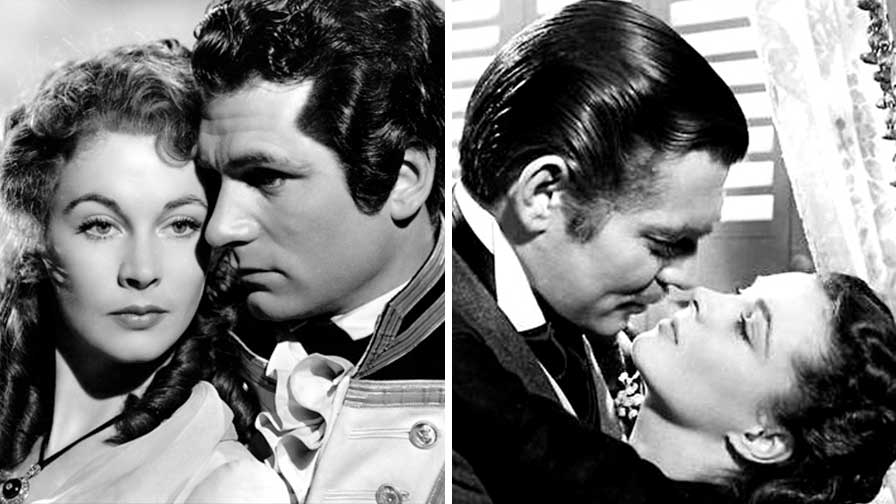
    Faustus, Christopher Marlowe’s scholar magician tragic hero, broke into a rapturous praise for Helen of Troy, for whom man and the gods together fought a battle that shook the earth and the heaven for ten long years. Vivien Leigh, the epitome of eternal feminine beauty, too, caught the world in a frenzy in the same manner in the 1940s and 50s with her alluring charm. Helen symbolizes not only divine beauty but also voluptuousness and hellfire. Her story is the story of war and violence. Likewise, there is more to Vivien’s chiseled charm, fluttering eyelashes and supple physique that conform to the norms of the archetypal female beauty. Her delicate contours are lined with fine strokes of angst and scorn, and her puffed nostrils and sideways glances hardly betray a hint of grinding teeth and clenching fists that characterize the subversive female. Her swan limbs are not only meant to be held in the arms of her lover and waltz round the ballroom but also to put up the fiercest fight for survival in the most difficult situation. Women with these traits are called the ‘monstrous other’, and always pose a challenge against conventions.

    In this regard, Vivien Leigh the person and the artist goes much ahead of being merely a combination of beauty and talent, and is a metaphor for women’s resistance against whatever patriarchy imposes upon them. For, this is the flux and paradox in which women have found themselves in, down generations. Society expects them to remain docile and dependent, but in the hours of crisis they are required to fight their own battles. Vivien enacts these complex female experiences in all her memorable roles, including Blanche Du Bois in A Streetcar Named Desire, Myra Lester in Waterloo Bridge, and Scarlet O’Hara in Gone with the Wind.

    Besides being the paragon of ethereal charm, Vivien Leigh is also the perennial split self—a place where the angel and the femme fatale reside side by side. It is this aspect of her persona that makes her suitable to play the perfect foil to unscrupulous males such as the speculating Rhett Butler and the brutish Stanley Kowalski. The sternness in Vivien’s demeanor to match Scarlett O’Hara’s strength to fight a lone battle is simply irreplaceable. And it was only an amoral Blanche Du Bois who could challenge the aggressive male in her sister’s husband. Cinematically, to highlight the striking features of the characters she play, Vivien’s roles are sometimes contrasted against good hearted but nonetheless passive women characters such as Melanie in Gone With the Windand Stella in A Streetcar Named Desire. Vivien’s rare ability to recognize and bring alive the intricacies in human situations earned her an enviously successful career that comfortably straddled the two eras before and after the Second World War and represent two distinctively different sensibilities.

    Certainly, more than her beauty, it was her gift of naturalness in role playing that made her all the more irresistible. Vivien Leigh was an artist who lived a life for art’s sake. She was the kind of artist for whom the line between art and reality was too blurred to recognize and for whom happiness meant being tucked away in the make-belief world of art and imagination. For artists like her, the light of the real world was too blinding to bear. Astonishingly, this aspect of hers uncannily brings her very close to Sybil Vane, the female protagonist in the role of an actress in Oscar Wilde’s novel The Picture of Dorian Gray.

    Like Sybil, who knew and loved the stage from childhood, Vivien too was fascinated by the stage from early girlhood and underwent formal training in acting from the Royal Academy of Dramatic Art, London. Quite many actors back then used the theatre as a stepping stone to the silver screen and had no inclination to return to their roots if they struck it big it in films. Vivien Leigh, though, quite to the contrary,  loved the theatre very much, found time for it throughout her film acting career, and brought out a number of memorable stage productions, mostly with Lawrence Olivier, her second husband and an acting legend by himself. Leigh was true to her belief that an actress is a real artist for lifetime while film stardom is flimsy and ephemeral.

    In The Picture of Dorian Gray, every evening Sybil Vane transforms herself into a Shakespearean heroine—Juliet, Perdita, Portia or Ophelia—and enthralls her audience; for her, the stage is the real world and the emotions of these characters are the real emotions that she feels. Ironically, she has no emotion of her own. Furthermore, the moment she becomes aware of the real world beyond the stage, she ceases to be the artist she has been and finally ceases to exist altogether. Vivien Leigh’s passion for role playing too is of the same vibes. She is more real as a stubborn Southern belle or as Ophelia the eternal virgin or headstrong Cleopatra or fiendish Lady Macbeth than Vivien Leigh the real woman. Once those sublime moments of exuding all possible human passions came to an end, they gave way to nauseous moments of irreconcilable depression.

    This feeling of estrangement and unease in the real life atmosphere made Vivien gradually fade away into mental and physical degeneration and finally die an untimely death at the age of fifty three. But her art endures so powerfully that even with the passage of more than eight decades, we still marvel at how Margaret Mitchell’s fictional Scarlett O’Hara became the real Scarlett O’Hara in Vivien Leigh.


  • Shabana Azmi

    Shabana Azmi

    Shabana Azmi 

    Age cannot wither her, nor custom stale her infinite variety


    These lines from Antony and Cleopatra, originally woven by the Bard of Avon to sing a paean to the Egyptian queen, seem apt for Shabana Azmi. There is an unwritten norm that most celebrities much before they approach seventy opt for retirement and live the life of a recluse making only selective public appearances. On her seventieth birthday, contrarily, Shabana is still going strong and is still at the helm, experimenting with her craft, generating public opinion on social or political issues, and sitting for long, engaging interviews for both domestic and international television channels.

    In her forty-six-year-long career in the film industry she has wondrously transformed herself and evolved not just as an actress but as a public speaker too. Shabana  has always been articulate, but with age, a mellowed warmth has become an added feature of her personality, opening her up for more conversations. Sometimes she is playful with her fetish perfection, sometimes she is elegance and wisdom personified, and sometimes she is a grand dame in bright purple patched sarees, with a big sprig of flowers tucked in her bun.

    Living up to her philosophy that the ‘political is personal’ and the ‘personal is political’, she has kept her personal and public lives in perfect harmony, something that many celebrities and otherwise successful people fail to do. For they are usually very insecure and protective about their private lives. Shabana, on the contrary, has never attempted to compartmentalize her personal, professional or social lives, for she has lived by certain core values and she wants those values to be reflected in all spheres of her life. And the more she mellows in age the more she appears to gather more energy to carry on her missions.

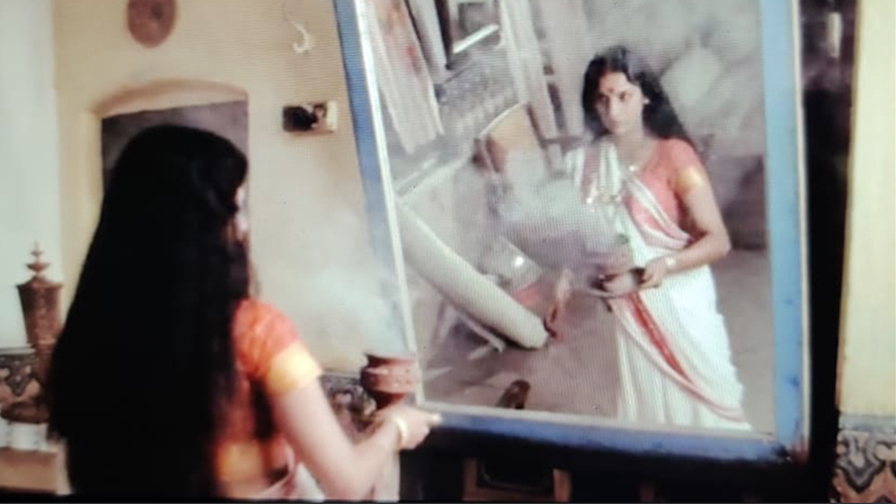
    Shabana Azmi has been around for a long time as the cynosure of cinema lovers and has become an inspiration for many, yet very few have been able to emulate her way of believing in oneself, her way of suppleness in work, her multi dimensional personality and her hypnotising oratory. As I sing this paean, the unforgettable images of her as Jamini amidst the ruins in Khandhar (1984), her as Mitthu walking along the craggy contours in Namkeen (1982), and her with the blank stare of the hukka smoking Begum of Awadh in Shatranj Ke Khiladi (1977) rush past my mind; each role is unparalleled and unsurpassable, a sui generis, a class in itself—just like the real Shabana.

    With five National Awards in the Best Actress category, from the startled-eyed Lakshmi in Ankur (1974) to the gun-wielding matriarch of Godmother (1999), Shabana Azmi’s celluloid journey, which spans more than four decades, is nothing short of a dream ride. But she is an artist who has never taken her awards and accolades for granted and asserts that it is more a journey of hard work and commitment than one of just talent and privileges, while modestly acknowledging that the right opportunities came to her at the right times. She is proud and grateful to be backed by two strong legacies from her parents—socialist ideologies from her father Kaifi Azmi and the gift of acting from her mother Shaukat Azmi. With age, she has brought slight squints to her big kohl laden eyes, as if to see things better and beyond and a little twist to one corner of her lips, and to show amusement and pretend detachment; but, in actuality she is hardly ever detached from the realities of her surroundings, be it social, cultural or political.

    Shabana Azmi belongs to the clan of those handful of artists whose performance, even within the limited space allotted to an actor (for it is commonly believed that cinema is the director’s space), asserts the unlimited possibilities that cinema can explore—cinema as art, as philosophy, as an intellectual movement or a weapon for social change, as entertainment, or cinema as life is—unchanging and unchangeable. In Khandhar, her character accepts the utter deprivation of her situation, but at the end, her reticent, sensitive part is badly defeated as her emotions get better of her; yet it does not promise any change in her life; her image amidst the ruins that Subhash captures, symbolically shows her entrapment to that frame forever.

    As an actress, Azmi’s forte is to make her part extraordinarily engaging even though hers is not the key role of the narrative or she is not the prime focus of the director’s camera. Her role as Mitthu in Namkeen is a part of that slice of life left to the doom or destiny, where human beings lack the agency to change it. Mitthu is traumatized and speechless but caring and understanding. She finds new happiness in her life as she befriends and falls in love with a stranger. She shares this newfound happiness with the rocks of the valley, but when the stranger leaves, she receives another shock, never to recover again. The seemingly simple yet nuanced narrative leaves many things unexplained. Shabana’s careless, unmeasured steps on the rocks and her grey silhouette against the craggy contours linger as some enduring images from the movie.

    In Shatranj Ke Khiladi, another movie without a central character, Shabana Azmi is the purdah observing and hukkasmoking Begum of Awadh, who is ignored by her husband for the sake of a game of chess. Her blank stare and muffled entreaties are the external markers of her repressed self and they match well with the stifling, closed interiors and beautifully contrast against her husband’s indifference and obsession with chess.

    In playing numerous other roles, Shabana has been continuously taking new turns and setting up standards for herself. She closely observes women’s lives and has a deep understanding of how women struggle for their own space. We see her donning as many different hats as none else has ever tried—innocent victim, corrupt powermonger, ridiculous whorehouse owner, what you will. In all these roles, she tries to capture the elusive spectrum of women’s lives, generally caught in the complex web of patriarchy and a gender insensitive society. Instead of flaunting the garb of a ‘humanist’, she calls herself a downright feminist who wishes that women become more visible everywhere.

    Shabana Azmi is not an artist who believes in art for art’s sake. Her consciousness is deeply rooted in the social and cultural ethos of her time and she calls for a fine balance between rights and responsibilities that artists must build up in them. She repeatedly urges people to recognize the fine line between celebration of sensuality and commodification of sensuality.

    Shabana Azmi is a film personality, a stage performer and an activist with commitment and political consciousness, not in terms of petty party politics, but in the context of larger, day-to-day social interactions. Each side of her personality enriches the other and makes her a person with introspection and high moral responsibility towards the society; however, that does not make her a somber looking matron out to silence noisy children under her ruler. Her offscreen image is one of a vivacious lady always open for dialogues, and also opening new issues for more dialogues. She switches between English and Urdu-accented Hindi with equal flair and is often heard reciting her father’s famous poem:


    Uth meri jaan mere saath hi chalna hai tujhe

    Tujhme sholay bhi hai, bas ashk ki nishani hi nahin

    Tu haqeeqat bhi hai, dilchasp kahani hi nahin

    Tere hasti bhi hai ek cheej, jawani hi nahin

    Apni tariff ka mizan badalna hai tujhe

    Uth meri jaan mere saath hi chalna hai tujhe

    (Rise, my beloved, you’ve to walk by my side

    You’ve the sparks, you’re not just a hint of tears

    You’re reality too, not just an engaging story

    You’ve an individuality, not youth alone

    You’ve to change the scale of measuring yourself

    Rise, my beloved, you’ve to walk by my side.)


    Shabana has always stood by this, not for her own sake, but for all women.


    [divider top=”yes” anchor=”#” style=”default” divider_color=”#999999″ link_color=”#999999″ size=”2″ margin=”0″]


    Shabana Azmi made her debut as an actress in Shyam Benegal’s directorial debut, Ankur, for which she received her first of five National Film Awards. This is what Satyajit Ray had to say of her act: “Her poise and personality are never in doubt. In two high pitched scenes, she pulls out the stops to firmly establish herself as one of our finest dramatic actresses.”

    [youtube_advanced url=”https://www.youtube.com/watch?v=eKUoEZ-lttI&t=32s” width=”300″ height=”200″ responsive=”no” controls=”yes” autohide=”alt” autoplay=”no” mute=”no” loop=”no” rel=”yes” fs=”yes” modestbranding=”no” theme=”dark” playsinline=”no”]
  • Meena Kumari

    Meena Kumari

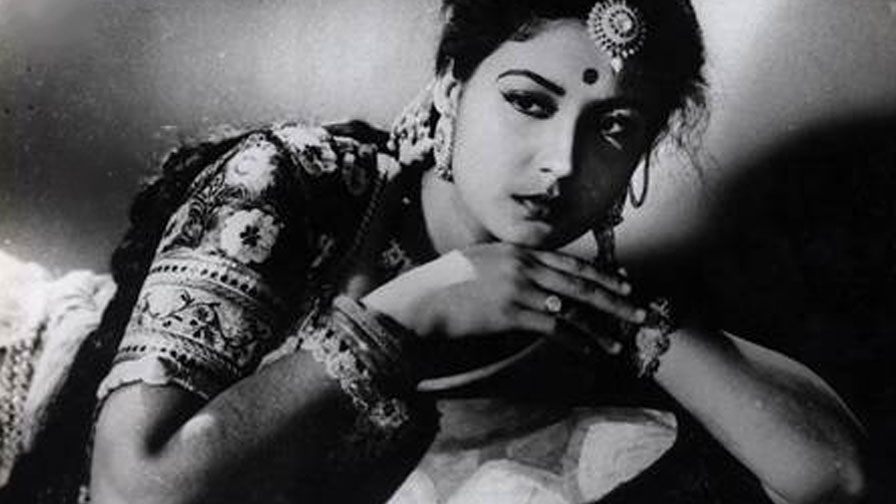
    It has been almost half a century since Meena Kumari (1933- 1972) passed away, and yet her evocative silver screen images come back again and again to stir our emotions. In death, as in life, she remains the creator of many stories, exactly resembling Princess Scheherazade of the Arabian Nights. The Arabian Princess wove endless stories within stories, and moved from one story to another without finishing the previous one, while Meena Kumari’s aura too, whether onscreen or off, inspires numberless stories, but with an unfinished undertone.

    Much has been said about Meena Kumari’s expressive eyes, yet [highlight background=”#f79126″ color=”#ffffff”]her expressions and her body language are always subtle and understated, leaving us wanting to know more and to hear more. Her beauty adorned with gossamer veils and downcast eyes tell us to look deep into her inner being, and deeper still.[/highlight]

    Meena Kumari was one who closely experienced life’s fragility and its many deceptions, and she trained herself to live life in moments and not let go of any opportunity that could make her happy. Her life certainly cannot be defined by stereotypical terms such as ‘tragedy queen’ or ‘queen of sorrows.’ She is not mythical Hecate, the melancholy goddess, constantly shedding tears, buried in sighs and laments. Instead, her indecisiveness and volatility compelled her to continuously search for a new meaning in life, forever going past whatever she had in life thus far.

    Coincidentally, all her iconic roles present life more as a journey than an arrival, a yearning more than a fulfillment. In Piya Eiso Jiya Mein, she is a woman completely lost under a spell. In Na Jao Saiyan, she is the one who tries the utmost to come out of hopelessness. In Mausam Hai Ashiqana, she offers love and protection, and simultaneously seeks the same. Certainly, the lyrics, music and every other thing worked in harmony with Meena Kumari’s way of carrying herself in different roles, to create an incredible upshot.

    Her screen images radiate an [highlight background=”#f79126″ color=”#ffffff”]arresting combination of softness and vulnerability, but with all her vulnerability, she had the strength and audacity to break her free spirit from everything else and let it move on its free will.[/highlight]

    Her life, abruptly cut short at the age of thirty-nine, makes her a symbol of eternal longing, like Keats’ immortal Grecian Urn. Whatever she could not deliver through her quivering lips and deep pitched voice, she rendered into her nazms:


    nami si aankh mein aur hont bhi bhige hue se hain

    ye bhiga pan hi dekho muskurahat hoti jati hai


    (Eyes were moist, and lips too /and see, this moisture is slowly turning into smiles)

    Is not this Meena Kumari in her truest self?


    [divider top=”yes” anchor=”#” style=”default” divider_color=”#999999″ link_color=”#999999″ size=”2″ margin=”0″]


    Filmfare Best Actress Awards — Meena Kumari

    Year Film Award
    1954 Baiju Bawra Won
    1955 Parineeta Won
    1956 Azaad Nominated
    1959 Sahara Nominated
    1960 Chirag Kahan Roshni Kahan Nominated
    1963 Sahib Bibi Aur Ghulam Won
    Aarti Nominated
    Main Chup Rahungi Nominated
    1964 Dil Ek Mandir Nominated
    1966 Kaajal Won
    1967 Phool Aur Patthar Nominated
    1973 Pakeezah Nominated
    [divider top=”yes” anchor=”#” style=”default” divider_color=”#999999″ link_color=”#999999″ size=”2″ margin=”0″]


    Meena Kumari was a great grand niece of Rabindranath Tagore. She made her film debut at the age of 4 years, and rose to be one of the most famous Hindi actresses of her time. She married and later separated from director Kamal Amrohi. Away from the glare of the public, she wrote Urdu poetry under the pseudonym, Naaz (Melwani, Lavina. Meena Kumari the Urudu Poetess You Didn’t Know. 2018)

    [youtube_advanced url=”https://www.youtube.com/watch?v=TCDbIT13MRY” width=”300″ height=”200″ responsive=”no” controls=”yes” autohide=”alt” autoplay=”no” mute=”no” loop=”no” rel=”yes” fs=”yes” modestbranding=”no” theme=”dark” playsinline=”no”]
  • Kaifi Azmi — the Poet of Love, Revolution & Regeneration

    Kaifi Azmi — the Poet of Love, Revolution & Regeneration

    Kaifi Azmi — the Poet of Love, Revolution and Regeneration
    Aaj ki raat bahut garm hava chalti hai
    Aaj ki raat na footpath pe niind aa.egi
    Sab uTho, main bhi uThun tum bhi uTho, tum bhi uTho
    Koi khiDki isi divar men khul ja.egi
     
    (A sultry wind blows tonight,
    Sleep won’t visit the footpath tonight,
    Rise, all; I’m rising too, you also rise, you too,
    A window is breaking open in this very wall)

    -Kaifi Azmi, ‘Makan’ (House)


    A great synthesizer of idyllic romance and revolutionary ideologies, of battle cries and patriotic hymns, and of tradition and modernity, Kaifi Azmi’s flexibility and versatility held him in perfect balance between modern Urdu literature and the Hindi film industry. The wavy hair falling over his shoulders, the never dying glint of his eyes, and the smile constantly playing in the curls of his lips together with his poise and baritone voice made him the cynosure of the poetic circle of his time; but all the same, he preferred to pass along unassumingly, shunning the mainstream for the margin, the centre for the periphery, and always voiced for the voiceless and supported their right to food, shelter and equality.

    The lyrics that Kaifi Azmi  penned for cinematic sequences too are equally embedded in true poetic exuberance combined with the silky splendor and lilt of Urdu. Even when isolated from the context of their respective cinematic narrative, his lyrics for films such as Kagaz ke Phool, Haqeeqat, Aarth, and Manthan emit the essential flavor of poetic concerto, in which specially chosen diction and images precede thought and meaning. Yeh nayan dare dare from Kohra evokes an arresting sensation of earnestness and Dheere dheere machal aye dil-e-bekarar from Anupama induces a mood of tenderness.

    Chalte chalte from Pakeezah is another unforgettable lyric of sheer poetic intensity, trimly wrought, and strung through a selected set of recurring words and phrases that constantly defer and elude interpretation. The whole narrative of the lyric is woven round an incident of a chance meeting and this aspect of chance or casualness runs throughout the lyric by expressions such as yun hi (just like that), and koi (someone non specific). The poetic persona is either not aware of the identity of the person whom she met, or she chooses not to reveal it. But the memory of that meeting lingers; and though life moves ahead, some part of it stays back in the thrill of that meeting, causing the speaker to yearn and wait uncertainly. Yet, in spite of all uncertainty, the speaker says that there are stories, spilling all over, from that mysterious meeting, though she herself is unwilling to utter a word about it. This sense of ambiguity is accompanied by the image of candles burning out as the night of waiting (shab-e-intezer) gradually wanes and the speaker too seems to acknowledge that all waiting eventually runs its course someday, the aspect of indefiniteness being reiterated by the line kabhi hogi mukhtsar bhi (will be over at some point of time). She identifies herself with the candles that burn with her in longing and desire. But the lyric leaves no more clues as to how the waiting will be over. With fulfillment, or, will it just wither away unfulfilled? Again, the contrast of Chalte chalte (as the journey continued) and sar-e-raah (the whole stretch of the road) is remarkable. This building up of paradoxes, images and ambiguities make Chalte chalte one of Kaifi Azmi’s most memorable poems, with minimalist expression that engages all senses.

    It is Azmi’s deep understanding of innate and perennial womanhood that enabled him to draw such a sensitive portrayal of the female psyche, be she a queen or a courtesan. This femininity, of course, has nothing to do with so called equality, emancipation and empowerment being voiced in today’s feminist movement. There is no way to know how much Azmi was aware of contemporary feminist debates; but his widely recited poem Aurat celebrates womanhood that accommodates contradictions and multiplicities, against the indivisible and unitary essence of manhood, and in tune with the recent feminist argument about men’s obsession with a stable self and women’s proneness to instability. In her discussion of the French feminist critic Luce Irigaray’s essay ‘This Sex Which is Not One’, Fiona Tolan comments, “Irigaray’s title is a heavily loaded pun; the woman is not the self (‘one’, or ‘I’) in masculine language, but at the same time, Irigaray is undermining the masculine binary system of positive/negative, by arguing that the female is not a unified position, but multiple: she is not one, but many.”1 Saying that a woman is not just an engaging story but also a reality and not just youth but also an entity, Azmi addresses women not from the usual male position of superiority, authority, pity and envy towards women, but in a joyful camaraderie to walk together with men, coming out of her “feminine mystique”2, that is, the societal construct or myth of femininity spun around her.

    The poetic voice of the invisible and the oppressed, Kaifi Azmi shall be remembered and revered so long as the ideas of love, revolution, freedom and equality remain relevant.


    References

    1. Tolan, Fiona. ‘Feminisms’, from Literary Theory and Criticism (ed. Patricia Waugh), Oxford University Press, Oxford, 2006.
    2. Friedan, Betty. The Feminine Mystique, W.W. Norton, New York, 1963.


    Photo courtesy

    1. Cover photograph: Official website of Kaifi Azmi


  • Saeed Jaffrey — the Transcultural Beacon

    Saeed Jaffrey — the Transcultural Beacon

    Saeed Jaffrey — the Transcultural Beacon
    “I cannot rest from travel: I will drink
    Life to the lees: All times I have enjoy’d
    Greatly, have suffer’d greatly, both with those
    That loved me, and alone, on shore, and when
    Thro’ scudding drifts the rainy Hyades
    Vext the dim sea.”
    -Alfred Tennyson, ‘Ulysses’


    Literally in love with the abundance of life, Saeed Jaffrey expertly bestrode the cultural hubs of three continents, daintily switching between radio, stage and cinema. He was the truest representative of the global culture that took the whole world in a whirlwind in the 1960s and 1970s, a phenomenon in which territorial distances diminished and cultural alienation made way for a synthesis of all sensibilities, bringing the East, West, North and South together, up on a common platform. This was the time when Satyajit Ray happened to meet Jean Renoir and Akira Kurosawa, and Ravi Shankar collaborated with George Harrison of the Beatles.

    Jaffrey was among the first Indians to set sail on the crest of this new cultural wave. He followed the diktat of his insatiable gusto to know and see more, and then to render whatever he had happened to see and know. Obtaining a Fulbright Scholarship to pursue a Master’s Degree in Drama was indeed a rare feat to achieve for an Indian in 1956, after which he never looked back.

    Saeed Jaffrey was [highlight background=”#f79126″ color=”#ffffff”]the cosmopolitan citizen who became, like Tennyson’s Ulysses, a part of wherever he had been.[/highlight] In his own words: “I am part of all that I have met.” He imbibed the exact spirit of each locale where his character was set, and craftily transforming himself into all casts, from a happy-go-lucky nobleman of a princely state of British India to a Pakistani migrant in postwar Britain, and a sporty shopkeeper with betel-reddened gums. While postcolonial political and cultural discourses are afloat with narratives of identity crisis, and dualities of home versus homelessness or root versus rootlessness, Jaffrey made the most of the postcolonial global cultural situation. Instead of ruefully lamenting over the issues of “hybridity” and the “in-between”1 space, Jaffrey drew on his ability to perceive these issues from inside, and brought out a credible portrait of multicultural existence through the characters that he played.

    Jaffrey’s type of versatility truly calls for a deeper understanding of the nuances of cultural diversity, be it across the continents or across the heterogeneous socio-religious-economic and linguistic groups. He was an artist who went by the dictum that ‘language is power’, took stride over a number of languages, including English, Hindi and Urdu, and used this mastery to add novelty to his passion and profession.

    Though his roles are mostly stereotyped in the category of ‘supporting actor’, his thoroughness and readiness made his approach no less assiduous than that of the protagonist. Most arguably, Jaffrey’s Mir Raushan Ali of Shatranj Ke Khiladi made an equally indelible mark side by side with Sanjeev Kumar’s Nawab of Awadh, not letting himself to be overshadowed by the stalwart actor’s genius even for a single moment. His scarlet cap and self-flattering cunning, which was self-oblivious too, makes him even more memorable than the Nawab himself. In the unforgettable Khule aam achal na leherake chaliye of Masoom he made a perfect partner to Naseeruddin Shah while playfully mimicking wooing and coquetry in the cloyed, flirtatious air of an evening soiree. He breathed the fullest of life even to the roles tagged as the smallest ones. [highlight background=”#f79126″ color=”#ffffff”]All he knew was to make his character the liveliest, and he made sure that it remained etched in the audiences’ memory forever.[/highlight]

    Saeed Jaffrey also seemed to have been driven by the motto of “carpe diem” (Horace, Odes), that is, seize the day. How else could he have juggled so immaculately with a variety of roles at one go, for Bollywood, Hollywood, Broadway and the BBC? We can only imagine that he was lifted and wafted, all through, by the swift footed zephyr.

    Certainly, Jaffrey’s life and works offer a promising site for the study of intercultural negotiations in the era of globalization. [highlight background=”#f79126″ color=”#ffffff”]His flamboyance, sanguineness and sardonic humor are reflections of the glint of his inner happiness and a happiness that he derived from living itself.[/highlight] He only knew how to look ahead and explore the unexplored parts of the human psyche and mannerisms in the same manner as Ulysses pledged to continue his quest till the last moments of his life.


    Reference:

    1. Bhabha, Homi K. The Location of Culture, Routledge, London, 2004.


  • Sharmila Tagore — A Journey Trapped between Promises and Possibilities

    Sharmila Tagore — A Journey Trapped between Promises and Possibilities

    Sharmila Tagore

    ‘From the east to western Ind,

    No jewel is like Rosalind.

    Her worth, being mounted on the wind,

    Through all the world bears Rosalind.

    All the pictures fairest lined

    Are but black to Rosalind,

    Let no face be kept in mind

    But the fair Rosalind’

    Shakespeare, As You Like It (Act III, scene ii)


    In her heydays, Sharmila Tagore was a path breaker, a sensation maker and a constant stirrer of surprises; after a long career of four decades, she now mellows with age, warmth and grace. Like Shakespeare’s Rosalind, the pert and robust heroine of As You Like It, Sharmila Tagore is certainly one of those handful of articulate, witty, strong willed and intellectually bent actresses of Bombay cinema, but sadly enough, she is also the one whose real potential went unrecognized there and despite her stardom, the promises of the brightness of a thousand stars remained a far cry. Had her brimming virtuosity been fully exploited, Bombay cinema of the sixties and seventies would have chronicled drastically different stories that would have been more enduring in art and appeal. For cinema in the sixties not only meant color images and exotic locations but also a confluence of many new waves and an emergence of a global culture with long lasting effects.

    For someone like Sharmila Tagore, who started off at the age of thirteen with a master ‘seer’ like Satyajit Ray as her mentor director, was guaranteed to have a long ride, rich and eventful. The ride was long, and eventful too, but in a hurry to finish that great length, it did not come to a halt to explore the treasure that lay on the wayside or within herself. When Sharmila Tagore first appeared as Aparna in Apur Sansar the intensity reflected in her eyes and facial contours indeed promised of a new beginning. Even without much speech—she mostly spoke in monosyllables, and rarely on her own—she brought forth the whole of a young bride, stepping into an unknown world, caught between the emotions of having to leave her parents on the one hand and the joy of being with Apu, her husband, on the other.

    But then, instead of finding her moorings in her own surroundings, she chose to respond to the calls from outside. And, in a twist of irony, when she was grafted into the highly commercialized and newly glamorized Bollywood, her speaking eyes became still and dumb and remained wide open all the while, forgetting to flutter and sparkle at life’s new experiences. Her face that had emoted many layered thoughts in a single moment, merely got cast into plastered masks. In Kashmir ki Kali she had no ‘role’ as such but to push around her shikara all over and lure away her lover, like the famous la belle dame sans merci, into frenzied twitching and gibbering (in pain or pleasure nobody knows). She meant to break the stereotypes all the while; but in movies such as Aradhana, Amar Prem, and Safar, for which she is mostly remembered, her directors dismally fell short of raising her above them, either in gestures or in speech delivery or a haunting consciousness of the camera gaze. In Mausam too her character set out to be unconventional, but the overall impact did not come out without the lingering question of art and artificiality.

    Namkeen, directed by Gulzar, to a great extent, brought back the freshness and naturalness of Sharmila Tagore the artist as Nimki, the eldest of three sisters in a remote mountain village. Sharmila is seen in one of her spontaneous best in her free and open postures and minimalist dress and make up. Surely, the raw landscape of mud walls and thatched roofs atop a rocky hill enhances this spontaneity, bringing alive all the nuances of her difficult situation in a seemingly uneventful life.

    In Shubho Mahurat, Sharmila plays the dubious Padmini Choudhury, an NRI producer who puts her money in a movie but does something diabolic. In this ‘enactment’ of an amoral character, every bit of Sharmila’s finesse as an actress comes out to the tip, even within the frame of a thriller—we certainly do not forget that it was adapted by Rituparno Ghosh from Agatha Christie’s The Mirror Crack’d from Side to Side; a cracked mirror being a metaphor for our fragmented selves or ‘schizophrenia’, a disorder in which a number of contradictory facets build up a single personality. In Padmini’s character, Sharmila brings out with her natural ease the hidden selves of a divided individual in whom success, wealth and fame are interlaced with hatred, jealousy, revenge and an inescapable sense of failure.

    In spite of all the overwhelming paradoxes in the illustrious career of Sharmila Tagore, given her talent, depth of personality and range of interests, we would have been happier to see the Sharmila magic burst and sizzle more vigorously like a never-ending cracker festival. We go about rapturously to call her the brightest jewel and the fairest of all faces like Orlando did in the forest of Arden for Rosalind, but we also wistfully reflect on what a difference it would have made had she walked with a halted pace to adore the hidden jewels.


  • Aparna Sen — A River Plunging into its Own Depths

    Aparna Sen — A River Plunging into its Own Depths

    Aparna Sen

    Where the bee sucks,
    There suck I;
    In a cowslip’s bell I lie;
    There I couch when owls do cry;
    On the Bat’s back I do fly
    After summer merrily.
    Merrily , merrily shall I live now,
    Under the blossom
    That hangs on the bough.

    -The Tempest, Act V, Scene I


    With all her vivacity and volatility, Aparna Sen can be very challenging as a subject. For it is actually difficult to catch her in a single mood, even while she sits for a discourse on a serious issue. She is always playful, always coming up with a surplus of ideas, and an endless string of ‘ands’, and almost never for any ‘either or’. If at all Aparna Sen can be perceived or defined in a single term, it has to be briskness. [highlight background=”#f79126″ color=”#ffffff”]With her fleeting gestures, twinkling glances and smiling lips, she hardly ever settles for a single mood. And by the time one tries to catch her mood, the next moment it is replaced by something else, which is constantly passing like the incessantly flowing river into which one cannot step twice.[/highlight] Or, like that eternal stream of moments ceaselessly becoming an ‘already’.

    Rare pic of Aparna Sen

    It is for this briskness that she is best embodied by the little squirrel Chorky — her companion in her first screen appearance as the mischievous teenager in Teen Kanya (1961). No wonder. It was Satyajit Ray, the master ‘seer’, who could feel the exact vibes of that swiftness; indeed, who else could have done that?

    But it isn’t just in terms of its gushing, linear movement, but also in its bottomless depths that Aparna Sen is exactly like a river; it is a river that is still thirsty and has set out to quench its thirst plunging into its own profundity. This river also comes up with the idea of the beyond, that is, the unseen part of the other bank, which always enchants people. For Aparna Sen isn’t simply extraordinarily beautiful, but something way beyond such; she isn’t simply outstandingly intelligent, but something way more. In her sharp features and elegant appearance, she literally embodies a classic exquisiteness.

    [highlight background=”#f79126″ color=”#ffffff”]In her multiplicity of roles as the scriptwriter, director and actor, Aparna Sen apparently resembles Prospero, the Duke of Milan, the magician, the creator and controller of events and at the same time, very much a part of those events. But, in essence, she is more akin to Ariel, the spirit of the air.[/highlight] For it is only Ariel, who sayeth ‘Before you can say “come” and “go”/ And breathe twice and cry “so so”’ in Shakespeare’s The Tempest, who can assure us of that quaintness and softness of action.

    In spite of all these attributes, she never demands deification, but only simple praise and admiration. This prevents her creations from being incredible or magical. With a perfect combination of subject matter, story and cast, whatever she creates always remains credible, grounded, and all too humane, an approach adopted only by a handful of master creators.

    Aparna Sen’s portraiture of two claustrophobic middle-aged housewives in Parama (1985) and Paromitar Ek Din (2000), marks this humane approach. Parama’s character (played by Rahkhi Gulzar) shows that being human means frailty, desire and failure as much as it means strength, austerity and success. The sudden appearance of Rahul in her life makes her yearn to live life on her own terms, refusing to be no longer assured by the fake domestic security. The film is by no means an attack on domesticity; it is only Parama who feels like stepping out of its monotonous circularity. Unfortunately, she becomes a little too wayward to return and fit into that circle again. Meeting Rahul is like remembering her lost youth. She wistfully tries to compensate for something she could not make the most of. But it is too late for her to realize that, like Rahul, her youth too is gone forever!

    Aparna Sen at a Press conference

    In Paromitar Ek Din, Aparna Sen is in her directorial and performer’s best as Sanaka, an unhappy, deprived housewife of a middle class family. She is surrounded all the time by her big joint family, but prefers to isolate herself from its mundane demands, and finds her mental escape in the tiny images of the small frame of the television box. Her mind is always moored in a ‘somewhere else’ and this she confesses to her daughter-in-law Paromita; she confides to her that if her former lover had asked her even once, she would readily have run away with him, leaving everything behind — her husband, children, everything. Sanaka’s reaction over the news of her husband’s death and her childlike joy of kite flying are some staple moments that we go back to, over and over again. Or, can we ever forget the dejected Violet Stoneham walking home alone, or lovesick Snehamay writing letters to his beloved far away in Japan? Whether in the overt handling of the theme of communal violence, the subtle politics of everyday life, the hilarity of family drama, or the delicate nuances of female friendship, Aparna Sen is second to none.

    [highlight background=”#f79126″ color=”#ffffff”]Aparna Sen is an example of how a woman can make bold statements about life and living by always remaining warm, tender and empathetic to others, preserving every feminine grace and charm and never ever being rude and aggressive.[/highlight] Her political stand is always very clear and both as a person and a professional she refuses to be presented by someone else’s vision. This is the reason why she switched over from acting to scriptwriting and directing. She has her own stories to tell and she tells them so intriguingly, leaving no loose strands to hang clumsily here and there. She is always driven by her own instincts and beliefs and never takes the audience for granted. Even as she turns seventy-five, she still remains the sprightly teenager that she had enacted sixty years before — never trying to surprise her audience with feeble twists, but always answering their pleasure exactly like ‘dainty’ Ariel, “be’t to fly, to swim, to dive into the fire, to ride on the curled clouds.”


    Awards
    Aparna Sen is the recipient of the Padma Shri as well as 9 National Film Awards.

    Photo credits
    Header pic of Aparna Sen on the sets, by Prem Prakash Modi
    Aparna Sen at Kolkata by Biswarup Ganguly
    Rare pic of Aparna Sen by Benu Banerjee
    Aparna Sen at The Japanese Wife press meeting by Bollywood Hungama


  • Book review — Chalachitrar Rashaswadan

    Book review — Chalachitrar Rashaswadan

    Of all the genres of mass culture, cinema is arguably the most popular and universal, yet it is also the most intricate. Cinema is rigorous multi tasking and meticulous teamwork. It is the ultimate example of intermedia art that brings together an assortment of technological expertise and artistic insight. In cinema we see people like us enacting our own emotions, bringing to the foreground slices of life that are very much like our own; albeit, larger-than-life figures. They are people of flesh and blood, yet in cinema we do not see them as real people. All that we see come to us as mere images. This existence of cinema between the tangibile and the intangible lends to it an enigmatic aura.

    If the making of cinema is massive multi tasking, writing a book about the art and technique behind cinema too calls for a great deal of meticulousness as well as some amount of practical experience of working behind the camera. Chalachitrar Rakhachadan by Utpal Datta, a National Award winning film critic who has also made a few short films, clearly stands as a testimony to this simultaneity of expertise, experience and insight. The book is a first of its kind not only in Assamese but also among the other regional languages of Nort East India. It serves to make the reader aware of the complex set of activities involved in the making of a film. The other equally relevant purposes is to draw the reader’s attention to the importace of the intensity of societal and humanitarian appeal of a film as well as the philosophy of the director. The author believes that the knowledge, observation and exploration of these aspects take the experience of watching a film to an altogether new joyous height.

    The book opens with the question pertaining to what should be the ideal plausible definition of cinema and also which Assamese word is the most representative. While ‘movie’ is one of the synonyms that is used in English, chalachitra (lit., moving pictures) can be the most acceptable Assamese word for cinema, the author suggests.

    An entire chapter is dedicated to the whole process of filmmaking, from pre-production (picturisation & planning), to production (the actual shoot), post production (editing, sound dubbing/mixing, colour correction, and special effects) and finally, distribution. Another, about the most vital part of cinema, aptly opens with the famous quote by Alfred Hitchcock, “To make a great film, you need three things—the script, the script, and the script”. The author points out that the magic of a script lies in its ability to speak through pictures, and not through simple words. Since the story and dialogues is necessitated to come alive in pictures, the cinematography, editing, and sound is crucial.

    One learns, while reading Chalachitrar Rakhachadan, that what we see as a complete film is actually a series of sounds and images strung together in a particular sequence. The expertise of the cinematographer lies in capturing the mood of the story in its totality through subtle mixing of the shots with right control and alignment of light, whether arificial or natural. That of the editor lies in their ability to coordinate between contradictory emotions—love/hate, laughter/tears, light/shade, youth/old-age—and  arrange these using an aesthetic flair. Talking about sound in films, the author draws our attention to how sound effects infuse life to a sequence of shots, how the economy of sound keeps alive the desired anxiety and suspense, and how, on certain occasions, silence can be more effective than sound.

    All this leads to the question: what is the role of the director, and what does it take to be one? The director, according to the author, is ideally the final creative authority, responsible for its ulitmate artistic form, its message, and its dramatic presentation. And although a university degree isn’t necessary, a director is necesssited to possess a high level of intelligence, creativity, confidence, and motivational and organisational skill.

    Since the book focuses quite a lot on the technical details associated with the process of making a film, the use of some amount of jargon is unavoidable; yet, that has not in the least made the narrative cumbersome. The author appears to be conscious of this aspect. His careful incorporation  of the technical phrases in a crisp and lucid narrative fabric keeps the reader’s interest fuelled all throughout. Stills from timeless classics such as Pyasa, Sholay, Modern Times, and Seven Samurai add to the charm. The cover page, designed by Sanjib Borah, has an inscription that drips with honey, suggestive of the rasa or the aesthetics of the art of cinema. The additional list of one hundred ‘must see’ films, both Indian and international, is a helpful guide. Chalachitrar Rakhachadan emphasizes that there is much more to cinema beyond action, dance and music. What is highly essential and missing is a chapter on acting.