Blog

  • Gantumoote, fallaciousness of the (fe)male gaze

    Gantumoote, fallaciousness of the (fe)male gaze

    Gantumoote, fallaciousness of the (fe)male gaze


    Films are the primary source of entertainment for Indians and the cultural constructs created by them strongly influence the thinking of men, women, and most importantly, the new generation.”

    -Cinema & Society: Shaping our Worldview: Beyond the Lens Investigation on the Impact of Gender Representation in Indian Films: Geena Davis Institute on Gender in Media & Oak Foundation Study.


    Life imitates art far more than art imitates life.”

    –Oscar Wilde.


    Objectification, commodification, stalking and sexual harassment of heroines in cinema all in the name of professing love, saving the damsel in distress, heroine giving in to the ministrations of the hero, has long been a bane, the world over.

    That, in majority cases, women, with aspirations, become willing participants looking to a glitz and glamourous career in the instant stardom providing industry, becoming putty in the hands of directors or film makers and producers, is another matter.

    More so, it is an accepted belief that, if it is a man behind the camera, he, all the more ensures his female characters become lascivious objects of male gaze to drool upon. Giving play to the lurid imagination of voyeuristic audiences that takes its own flight of fancy as pro-active participants in the vapid visual narratives that unveil before them.

    However, what is worrisome, and disconcerting is, that even women directors brook no bones being no better than their male counterparts when it comes to exploiting their own ilk, exceptions notwithstanding.

    They are equally easily culpable when it comes to depiction of women and their subtle exploitation, all in the garb of championing feminist’s cause, providing a feminine perspective, intended at empowerment and emancipation.  In the guise of tackling bold and women-centric concerns, women directors too, under this convenient ruse of giving voice to womenfolk, have no qualms conspiratorially playing to the gallery, driven by the vicious dictates of market economics, is what this essay perforce posits.

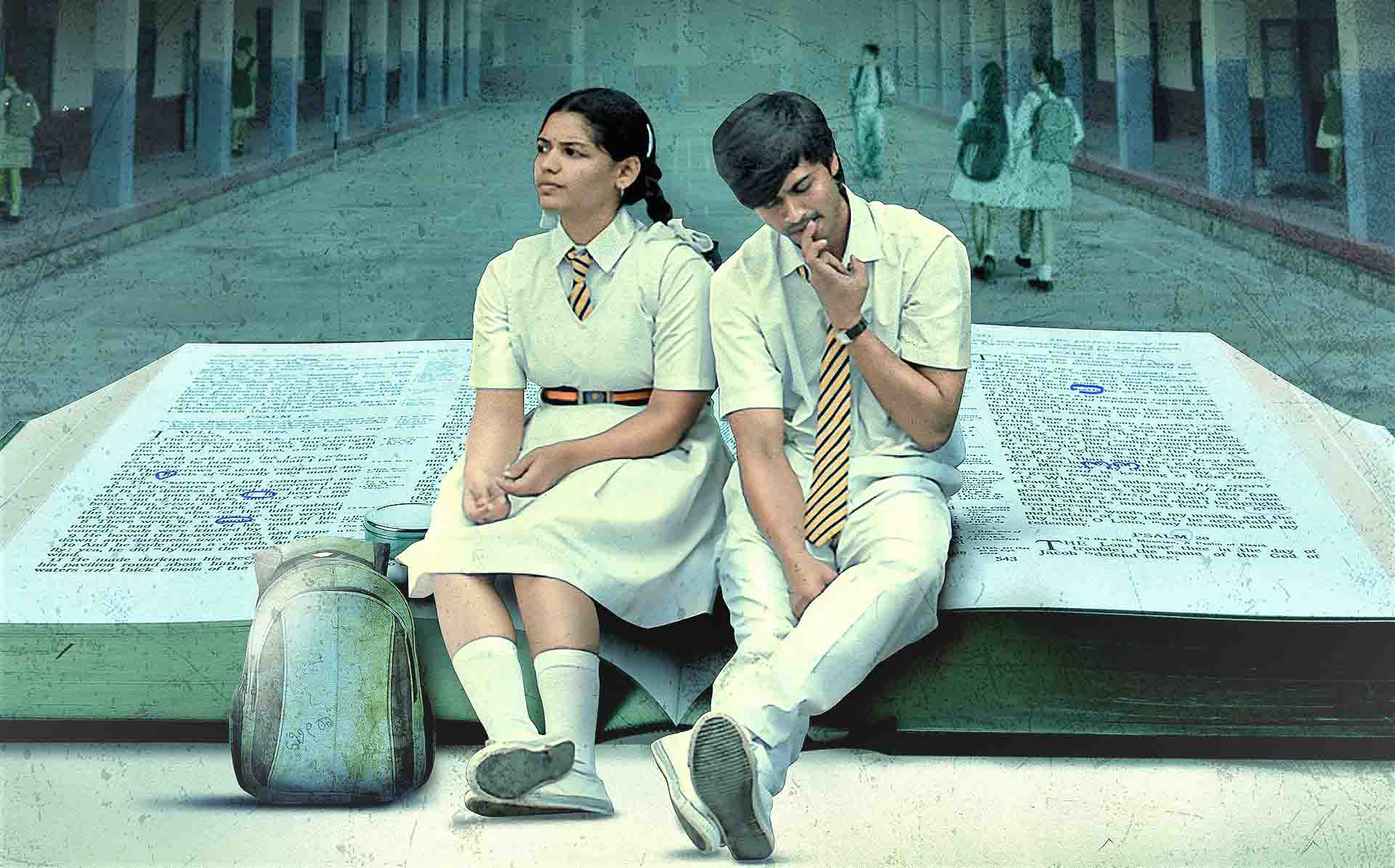
    The case in point, the recently released and much valorised Kannada film Gantumoote (Bag-Age) by debutant Roopa Rao. Ironically, the very eponymous title bespeaks the burden the young director bears such that her film succeeds both at commercial box-office as also catch the eye of discerning audiences alike. As goes the adage: Kill two birds in one stone.

    Roopa Rao, quitting her cushy job at IT bellwether Infosys, took to her aspirational calling, foraying into films after she cut her teeth with the 12 episode web series The Other Love Story, on lesbianism, where two girls from disparate backgrounds – Aadya and Aachal strike same-sex companionship as the case with the ill-fated boy-girl romance in Gantumoote.

    In The Other Love Story, a format faithfully followed in Gantumoote, the protagonist Aadya is obsessed with movies. She pens her thoughts in her diary stating “I don’t know why everything that happens around me feels like a movie. I feel like a spectator, it’s hard to involve, because when I involve it is painful,” about her inability to comprehend the situation she finds herself closeted in, the tentativeness and swirl she feels to the happenings, as does Meera, in Gantumoote. A poster stuck on the wall of her living room proclaims “In a conflict between heart and doubt, follow your heart.” And that is precisely what Meera, as does Aadya, do in their respective roles.

    At the pivot of Gantumoote is 16-year-old still pubescent teen Meera pursued by an emboldened classmate Babu, who, egged on by his friends, hands her a red rose to Meera. The director, on her part, seeks our indulgence to believe Meera is ignorant and innocent as to what it signifies by accepting it without batting an eyelid.

    Here, straightaway you have the classic case of the girl making way for the boy stalking her at every opportunity, and unsolicited intrusion into her freedom and personal space. The way the scene is played is also much to be desired and the dialogues that follow suit despicable.

    The director conveniently infuses in her heroine a facile naivety in keeping with her small town moorings to prove her immaturity in being unable to fathom what accepting the rose signifies and thanks Babu stating she could not have refused for the efforts he had put in.

    For, when Babu asks her “What just thanks”? She retorts: What more should I say? Wondering what the fuss all about is blissfully unaware that Babu is euphorically exulting:  “Macha she has accepted me friends.” To which they respond: Man you have indeed successfully snared her.”

    That the setting of the film is a school rather than a college is another point of disquiet one needs to take note of. The film set in still conservative and tradition bound ‘90s and not in today’s freeway and footloose and fancy-free Internet and Mobile age makes it unacceptable cinematic liberties the director has taken.

    In fact, Meera suffers nightmares from a disturbing episode in the cinema theatre when just nine, where a man had molested her. The trauma revisits her when Babu audaciously makes bold trying to get familiar and fresh with Meera.

    As a pretext of asking what she is sketching, Babu consciously and deliberating places his palm on her thighs triggering childhood memory Meera had suffered as she hurries away shocked by his audacity. Once again the visual blatantly planting in young boys the wanton seeds to mimic it in real life.

    Thereon, Meera tamely rebuffs Babu ignoring his and his friends Hi! Meera greeting, sloppily portrayed, with undue familiarity every time they pass her desk in the classroom, which again is much hard to digest, even in cinematic terms.

    Meanwhile, Meera’s first flush of romance and adulthood is sublimely awakened when she sets her eyes on an otherwise quiescent and nondescript classmate Madhusudan, with familiar codas of cupid play getting underway.

    Again as Meera sets her sights on Madhu she wonders whether it was the influence of cinema that propelled her to fall in love. What has attracted Meera towards Madhu is that his lock of hair falls on his forehead a la Salman Khan’s in Hum Aap Ke Hai Kaun which she had seen when in 9th standard.

    What’s more the director has not be able to shy away from portraying her protagonist as hero’s love interest, despite the fact it is her young heroine Meera who first gives Madhu the comeuppance stealing suggestive glances at him.

    Once this is established, with the girl opening her defenses, the entire dynamics changes with the boy slowly overcoming his awkwardness and boldly asserting his ownership of Meera as his prized property dictating his superiority getting familiar and fresh with her like a possessed tiger playing with its prey before the final kill.

    Rebuffed, and witnessing Meera fanning and mooning over Madhu, you have an enraged Babu slut-shaming by calling her “Dagar (meaning slut) as also writing the word, unfamiliar to Meera, on her desk. Yet another case of suggestiveness that would be locked in the recess of the young similarly disposed viewers.

    Every time Babu and his friends confront Meera they lose no moment in calling her thus with Babu even brushing himself against Meera – in a virtual case of physical assault as she passes him by. It is such scenes shown visually on the screen, without repercussions, that subconsciously trigger similar reactions in real life as well, leading to acid and other attacks on women happening in frequent manner by spurned Romeos who believe every girl are there for them to play wanton sport with and they quiescently succumb to such unwarranted attentions.

    Likewise, prior to the red rose scene you have the bus stop incident. Here, a bunch boys pass lewd and sexist comments at Meera speaking of how Roopa Rao, as a woman director, is abjectly insensitive to her own gender.

    “Boys/brothers (Maga) see what a super figure she has. Yeke Chinna (What Dear) won’t turn and acknowledge me? Hey Bulbul, Hey Dove, you are mine. Do you think I will simply let you off if you ignore and go away?” while his friend keeps whistling alongside.

    Nothing could be more obnoxious construct of a scene the director has taken to show the predictable ‘male gaze’ all of which only catalyse such enactments in real life as well, examples of which galore where women have broken the glass ceiling in aspects and marching stride by stride with menfolk.

    Likewise, you have another equally disturbing love play taking place in the classroom with Mohan authoritatively stating that he is love with Sajida, who much disturbed by this daring declaration, replies she does not like such things asking Meera to tell him that they are already looking for a groom for her.

    Hearing which Mohan starts tattooing her name on his hand with his compass, while he has etched her name on his chest as well, points out another boy. “I have to get her. That’s it. Tell her I am in love with her,” he tells Meera even as a teary and traumatized Sajida rushes to the washroom, with all vehemence.

    Meera then again wonders (note the film motif) whether it is the influence of Shahrukh Khan starrer Darr or Kannada film Shivrajkumar starrer Om that “I love you, you must love me,” has so influenced Mohan to even think that Sajida is his property and is meant for him alone.

    My critique of Gantumoote, therefore, supposedly women-centric cinema, pertains to such the fallacies and fanatical declarations it cleverly perpetuates, in the garb of providing female gaze of its protagonist’s life experiences (more so all drawn from director’s own past), and taking to the typical boy stalking girl formula, than a detached and more realistic and aesthetic portrayal.

    This is what I find problematic in films after films which are predominant commercial in nature. That Deepa Mehta created her own controversies with Fire with that slow-motion deliberate long take of love-making scene between Shabana Azmi and Nandita Das, is another classic case in point or recent Aruna Raje’s Marathi film Firebrand wherein you have the housewife encouraging another man to sleep with to rid the demons of childhood rape that still haunt her despite having an understanding husband.

    The very fact that the film’s protagonist deeply influenced by the film she has seen, Hum Aap Ke Hai Kaun which triggers the 9th standard girl’s romantic hormones validates my case which I seek to put forth in furtherance of my critique of Gantumoote that it is no better than any crass commercial potboilers but done with sophistication camouflaging its more economic aspirations.

    Furthermore, that her very first encounter during a cinema viewing session, at a nubile age of nine, when she is molested and which the heroine seeks to brush aside stating “why should I write about the abuse or even report it, thereby, give the molester prominence he may get as a result and it is better to move on,” only goes on to show, where director Roopa Rao’s sympathies lie and where her priorities are.

    The young Meera persists in watching the film from balcony this time from the earlier Gandhi class, only to scour who her molester could have been, further buttresses my argument, film makers must consider the visual impact their cinemas can have on young minds, unless aesthetically and sensitively done.

    That the girl at such a tender age was even allowed in a theatre to watch the film all alone is bit too hard to digest given the time the film is set in – the ‘90s, that too in a small town, despite all cinematic license one may excuse the director indulging in.

    As a young girl the director may have done that, but depicting it visually on screen is another matter and bit unacceptable. No wonder the censors prudently certified it ‘A’ much to the consternation of the director who bemoaned that young adults would be kept away from her film and rightly and wisely so.

    While it may be argued that one off incidents should not tarnish the entire industry. The most recent of episode of a man influenced to murder his wife after watching Malayalam film Drishyam and Tamil film 99, further strengthens my assertion unless audiences are educated to take sensible, detached and realistic approach to cinema and consider movies more than mere entertainment, strong, potent visuals take deep roots in their mind’s recess and psyche which they then reenact in reality believing they can get away like their heroes on the screen.

    As a result, societies continue to suffer misdemeanours and violent incidents such as Nirbhaya, and the recent Hyderabad tragedy, which haunt larger public in the society, rousing the collective conscience of the diaspora for instant justice raising questions about the safety and security of their girl children and womenfolk.

    While it is indisputable that one of the functions of cinema is to entertain its audiences, give wings to the assorted viewers to travel into an another world if only for its screen time, than lived, real one, providing window of escape from diurnal grind and mundanity of everyday life, one has to argue and assert that there is more to cinema than this.

    For, beyond being a popular vehicle of mass, affordable, and easily accessible consumption, it is also a fact that cinema also plays a pivotal role in moulding and shaping opinions, constructing either positive or negative images, thereby reinforcing dominant and prevailing socio-cultural and political values.

    Given cinema illiterate audiences that folk to theatres are susceptible to carry their screen experience into real life, it becomes even more incumbent upon film makers to exercise caution and be more responsible as to how they depict and delineate their narrative and its hidden homilies than duck under artistic liberty and freedom to do so.

    As Geena Davis study substantiates: though films reflect society around them, they have the unique power to change society as well. Besides the portrayal of women in main roles influencing us, there is invidious subliminal conditioning that takes place by only seeing women playing subsidiary roles on screen, may be even more instrumental in shaping our thoughts.

    I quote few observations from the study of those interviewed.


    Whoever has seen whatever movie, he will wonder if he should do that also.”

    –Dixit, 24.


    People also copy the fashion, clothes, and attitudes from movies.”

    –Vandana, 35.


    It affects the mind of children. It also affects our society and culture.”

    –Maneesha, 30.


    Children are deeply affected by these characters and movies as they immediately start copying it after watching them.”

    –Pinky, 38.


    See, nowadays, girls are also bold, they smoke, they drink… Now the girls also want to do everything which a boy is doing.”

    –Umeshbhai, 42.


    Incidents of rape are increasing in society now. This is because of the effect of movies.”

    –Rupa, 43.


    If they show such content, awareness may not increase, but such crimes would increase.”

    –Saleem, 44.


    Hence, it becomes imperative how the particular film is packaged and received by the ultimate consumers – the viewers / audiences without being prejudicial to civil society norms on public conduct. For, a notion/perception predominantly based on a director’s beliefs, attitudes and values, combined with director’s own larger but misconstrued understanding of what audiences’ want and pandering suit to popular market demands, must be consciously eschewed for the larger good of society.

    Furthermore, with women constituting a sizeable portion of cinema going population, and more so, the young adults – both male and female, the portrayal of women, the roles they play, the way they come across, on screen, the message these visual registers ultimately carry, is a crucial factor in breaking or reinforcing and determining the prevalent stereotypes that is already firmly entrenched in the society.

    Besides, how it impacts the psyche of diaspora habituated to films more as a means of entertainment, to pass time, than assimilate and approach it as art and creative form that depict social realities or life experiences on screen becomes equally relevant.

    Merely conceived and constructed just as entertainment, however, rabidly it may be, without an educated engagement and appreciation of cinema aesthetics as art form and not merely tool of entertainment, is doing great disservice to not only themselves but larger public in general.

    The film has several such disturbing fault lines in its very construction and scripting that one watches with aghast at the cupid caper played out before you. For example, in mathematics class room scene you have Madhu asking the lecturer whether if someone did not give what they had promised on time, should then they not do so with interest.

    The lecturer states it all depends what was agreed upon, who should have given what, without realising Madhu had asked Meera to kiss him which she had reluctantly not obliged. The next scene has Madhu cornering Meera in the classroom alone and series of kisses and lip lock picturised providing audiences gratuitous ideas to carry home with.

    As if such wanton cupid play was not enough you have even more gross visuals coming in the form of Madhu and Meera making it in the public libraries lip-locking and getting physical, as also during school picnic, where following sudden cloud burst sees Madhu remove his shirt a la Salman Khan.

    It is such blatantly exploitative and titillating visuals, pandering to familiar baser male desires to provide audiences pervert and prurient pleasures, with Meera and Madhu pirouetting on once they formalise their relationship that the director subvertly goes on catering to (fe)male gratification, with the two becoming licentious playground to milk their rendezvous for a trip in voyeurism. That you have another scene where you have Meera asking for cigarette and takes a puff also points to where the film’s intent lies and who it is surreptious catering to.

    Needless to say, despite being a woman herself, Roopa Rao gloriously takes to depicting the world of women is the most regressive, demeaning and depressing manner which constantly thwarts any expectations of seeing Meera in a more plausible and positive manner that would offer similarly disposed young audiences to reflect upon than providing them indirect inspiration to mimic in their lives from what they have seen and experienced in the dark confines of the cinema hall.

    Noticing that both Madhu and Meera are virtually pawing at each other, the mathematics teacher counsels them stating: I like you both as a couple, but you guys need to slow down, while cautioning especially Meera stating you will be the most affected from repercussions of your actions. You are my favourite student. The whole school depends on you. With two months for board exams be serious. To which a flippant Madhu, basking in romantic mood casually retorts there is a good two months to go, and we will make it.

    But sadly, while Meera, given her natural disposition to do well at studies, tops her class, it is one downhill slide for Madhu, who keeps failing, and thereafter, unable to digest the fact that Meera has fared well, and he has miserably failed, goes into depression and commits suicide. This not before the following interlude between the two love birds.

    Madhu asks Meera how you were able to top the school. I am not worthy to be with you. I am a repeater. What did you find in me? When Meera consoles him to not give up and there’s a next time he bites back so now you are a senior advising this dullard of a junior.

    As has been persistently pointed out, cinema being undisputed mediator of socio-realities and personal dreams, it is imperative that one brings under scrutiny and interpret the dissonances and discrepancies inherent in the representation of women, especially in popular cinemas, for audiences to appreciate it as informed receptors of the narratives.

    By showcasing the heroine as mere spectacle or an object of cupid play and dominant male desire, Roopa Rao allows her protagonist to be inexorably trapped in a world of callous, insensitive film making by faithfully following the time-tested template for formulaic no-brainer, insensitive  entertainers .

    Touted as an urban romance with the small town girl going through all the pangs of coming of age and experiencing the first flush of romance, Roopa Rao has not been to escape from the familiar stereotypical representation of her heroine as “sexual objects” the way men (read her young juveniles on the verge of adulthood) would enjoy seeing them on the silver screen….”

    Also by repeatedly perpetuating the very illusion of cinema that her heroine breaks, Roopa Rao, in frame after frame, reinforces the idiosyncratic dangers that films trap the young minds into mimicking them in real life imitating the doings of their hero/heroines. Thereby, as her heroine Meera reflects deciding not to take Madhu’s suicidal path consoling herself that the episode and experience will a “Gantumoote (Bag-age) in her life” so does Roopa Rao by pursuing a more mundane commercial path than provide for a meaning, sensible and subtle cinema that can be celebrated and cheered. Sad!


    References

    Analysis of Hindi women-centric-films in India. Srijita Sarkar. University of Louisville

    Stereotyping women in Indian Cinema. Vatika Sibal. St. Andrew’s College of Arts, Science & Commerce

    Ahmed, S. Akbar (1992). ‘Bombay Films:  The Cinema as Metaphor for Indian Society and Politics’. Modern Asian Studies 26, 2 (1992). 289-320. Great Britain.

    Ahmed S Akbar (1992). Bombay Films:  The Cinema as Metaphor for Indian Society & Politics. Modern Asian Studies 26, 2 (1992).

    Nandkumar S (2011). The Stereotypical Portrayal of Women III Commercial Indian Cinema. University of Houston.

    Laura Mulvey (1988) Visual Pleasure & Narrative Cinema. In Constance Penley (Ed), Feminism and Film Theory, New York: Routledge.

    Mulvey L 1989: Visual & Other Pleasures. Bloomington & Indiana: Indiana University Press.

    Cinema & Society: Shaping our Worldview: Beyond the Lens Investigation on the Impact of Gender Representation in Indian Films: Geena Davis Institute on Gender in Media & Oak Foundation Study.


    External

    Gantumoote on IMDB | Gantumoote official trailer


  • The Untold Story

    The Untold Story

    Manipur, on the easternmost part of India, bordering with Mynmar (Burma) is a small state having rich cultural heritage and charming landscape; its people are endowed with inborn talents in dance, drama and music; it has a thousand year old history with uniqueness of its own kind.

    Manipur had the experience of viewing peep show and magic lantern right from the later part of the 19th century. Mr. Grimwood, Political Agent of the British Colony, himself was a good painter, arranged slide shows for the Princes and the nobles of the palace. From the early part of the 20th century people had the experience of enjoying the Bio-scope which had surpassed all forms of entertainment in the society. However, Manipuris started late to make films of their own as late as 1972. They considered cinema as a part of production of the Western technology and thus was beyond their apprehension. At the same time the rule of the colonial government of the British blunted their sensibility from 1891-1947. However when they joined the select band of film makers in the North East, there was no looking back ever.

    Cannes Film Festival stands for superlativeness of both the Festival as well as the film. There is no further questioning about that. It is even regarded a notch higher than the Venice Film Festival which is the oldest of its kind. In the memorable Tous Les Cinemas du Monde (Cinemas of the World) Section in 2007 having viewed not less than in 108 Indian films Sergei Sabezyuski short listed only seven Indian Films – SAIBA (Director : Biju), LAGE RAHO MUNNABHAI(Director : Rajkumar Hirani), MISSED CALL (Director : Mridul Tulsi Das and Subramaniam), VEYIL (Director : Vasantlan), DOSAR (Director : Rituparna Ghosh), DHARAM (Director : Bhavana Talwar) and GURU (Director: Maniram). It must have been a perspiring job – to select 15 out of 108 in the first round and then to shortlist 7 of them finally. As Sergei Sabezyuski had said – “There was no compromise on quality”.

    Generally, a country is entitled to one day only to screen their entries, but India was given two days on that occasion. It seems western cinegoers have started warming up to the songs and dances that go inevitably into the making of an Indian film. In truth these songs and dances enable to express the emotions awakening in the viewers’ mind. These seven films were admixture of small and big budget films. The regional and diverse cultural elements must have nestled comfortably deep inside the French viewers’ psyche. Print and electronic media reported in earnest the screening of seven Indian films in Cannes. Sixteen years prior to this, in 1991 ISHANOU, a Manipuri feature film directed by Aribam Syam Sharma was screened in Cannes in it’s the “Uncertain Regard Section”. It was the only film selected that year to represent India not the film of Adoor Gopalakrishnan, Shyam Benegal, Manikaul, Kumar Shahni, Amol Palekar, Mrinal Sen or Jahnu Barua etc. The uncommon phenomenon of a possessed Maibee and the related folk dance movements that made up a holistic cultural presentation, the strong narrative of simple family might have charmed the establishment in Cannes. It was one of the highest honours ever shown to Manipuri film maker and the art of Manipuri film. But there was not a ripple of appreciation in the world of Indian cinema. There was nothing like a wide coverage from the side of the national media and to tell the truth the matter was scarcely reported in the papers. During the 15thAnniversary of the publication of Eastern Panorama held in Shillong, Union Tribal Affairs Minister, P.R. Kinda and Chief Minister of Assam, Tarun Gogoi were made to pour out the hurt in their hearts by saying that the national media intentionally neglected the north east. They did not try to know Manipuri film or they did not want to. But the French had already measured and measured well Manipuri films.

    X-Cine Productions (IMAGEE NINGTHEM) happens to be the first ever Manipuri film that got entry in the Panorama of Film Utsav, Kolkata in 1982. In those days the International Film Festival of India was held alternately with the Competition Section in one year under the title “The Film Festival” and Non- Competitive Section the next year under the title of “Filmotsav”. On 7th January, 1982 that year’s Panorama films were screened as Matinee Show in the New Empire Cinema Hall, Kolkata. The attendance consisted of about five or ten foreign delegates, Indian film actor – Amol Palekar, two gate keepers, one or two Festival staff on duty and the two or three persons who had gone there representing X-Cine Productions in that gargantuan cinema house that could accommodate at least fifteen hundred spectators. The director of IMAGEE NINGTHEM, Shyam Sharma did not participate in the Filmotsav. IMAGEE NINGTHEM was in black and white, the inherent technical flaws were extreme…patches of darkness or at best grim resolutions marred the clarity on the whole. The film lacked in clarity of images. Film critics – Derek Malcolm (Great Britain), John Warrington (Great Britain), Eichen Berger (Switzerland) and film maker – Patricia Moraz (Italy) on the other hand claimed this film as “Surprise of the Festival”. The beauty of the film was not affected at all by the technical flaws. Alain Jalladeau who was one of the Festival Co-Directors of the “Festival Des Three Continents ‘82’”, Nantes consisting of Asia, Latin America and Africa films came with his brother Phillip Jalladeau to view new films in the Filmotsav 1982. On 9th January, 1982 the third day after screening of IMAGEE NINGTHEM we that included K. Ibohal Sharma, Producer of the film, Smt. M.K. Binodini, Script writer and myself had a meeting with the two brothers Alain Jalldeau and Philip Jalladeau on the beautiful lawn of Grand Oberoi Hotel, Kolkata. In the course of the meeting, they handed us an Invitation to participate IMAGEE NINGTHEM in the Nantes Film Festival. It was unexpected because such a thing as extending an invitation to participate in another film festival while the present festival was going on is indeed a rare event which may not be seen again in the future also. The three of us did not know how to express our thankfulness. We were overwhelmed with wonder filled joyousness. Alain’s selection proved correct – in the festival des Three Continents, 1982, Nante the Manipuri film IMAGEE NINGTHEM bagged the Grand Prix and happened to be the first of its kind too for India as well.

    Indian cinema critics and film buffs usually limit their ken at the Bengal horizon. Any of renowned critics, film scholars as Iqbal Masood, Sunil Kothari, Amita Malik, Chidananda Das Gupta, John Dayal has not mentioned any Manipuri or Assamese film while making individual list of top ten Indian films. Iqbal Masood who writes for the Indian Express as well as the Illustrated Weekly of India, who had also cheered spraying champaign when IMAGEE NINGTHEM won the Grand Prix wrote under the title “Under Western Eyes” in the Festival News of the Film Festival of India, 1985 – “the film IMAGEE NINGTHEM was derivative, reflecting some of the worst features of the rebellious Bengali Cinema”. A French critic retorted to Iqbal Masood’s seemingly fault finding criticism. “My Son, My Precious (IMAGEE NINGTHEM)” conquered Europe by its innocence and exoticism – qualities not impressively visible to the Indian critics …. IMAGEE NINGTHEM which Iqbal Masood mentions and GODAN were considered in India as small insignificant films of no great and abiding interest. For us (Westerners), though they may not be perfect, their interest comes from the fact that they take simple subjects where rapport between the characters is invested, with a much large significance. This is what, in an entirely different way, Pialat, Rohmer and Godard too, are doing……. It appears there is a trend of suppression of smaller states and their achievements by bigger states in India when they start making themselves known in art, in the development of their cultural identity; in short when they make their general identity more fulfilled.

    Yves Thoraval, a French writer in his book the CINEMA OF INDIA (1826- 2000) has this to say – illuminating Manipur, a state between Assam and Myanmar, became a Union Teritory in 1956, gained statehood in 1972 (ch.xi, P.438) despite of some indiscrepencies in the historical facts, he says regarding the songs and dances of this land – “its musical and dance traditions, mostly of a religious character, figure among the most beautiful and the most personalized aspects in India”.

    Further he writes in details about Manipuri film directors as Aribam Syam Sharma, M.A. Singh, K. Ibohal Sharma, Oken Amakcham etc. as an introduction for them to other foreign readers.

    All these are about celluloid films that appeared on the scene about a quarter century ago in Manipur. What could we hope from the Video-Digital films today? When honoured guests seldom come, it is but natural for the host to take away the chairs meant for them.

    It is quite disturbing.


  • How the idiot box changed the silver screen

    How the idiot box changed the silver screen

    August 1 this year saw journalist Ravish Kumar being awarded the 2019 Ramon Magsaysay Award—the Asian equivalent of the Nobel Prize—for “harnessing journalism to give voice to the voiceless.” That is the ideal with which I had joined journalism, this very month of 1978.

    More than 40 monsoons have gone by since I had crossed the threshold of the Indian Express group as a Trainee Sub Editor. The compositors who would arrange the letters of the alphabet to read the matter we had churned out—and send out galleys that were to be subjected to minimum editing so as to avoid much alteration—are now an extinct species. Though I started as a sub—a backroom job that mostly involved ‘crossing the ‘T’s and dotting the ‘I’s—I was soon in the field reporting, thanks to BK Karanjia who joined Screen at that juncture. The result? I got to interact with giants of moving images like Peter Ustinov, Nutan, Krzystof Zanussi, Shyam Benegal, Girish Karnad, Basu Bhattacharya and Naseeruddin Shah. At the same time I also wrote a column ‘They Also Serve on the invisible backbones of the celluloid world: Men who lit up the floor from the catwalk, or wielded the scissor in the edit room; those who styled hair, or designed costumes; some served tea or provided furniture; some arranged music, some were stuntmen, some simply ushered viewers into auditoria…

    Many of these rose to be stars in their own right, while so many disappeared from the scene with the digitization of Celluloid. That is not all: Much like cinema, journalism itself has changed since 1978. We who started with newsprint have lived through television, fought the advent of colour on the small screen, coped with the proliferation of commercials on the idiot box, been awed by the satellite revolution, tolerated the mushrooming of private channels, appreciated the growth of regional languages, overcome by the emergence of the Internet, wondered at the dawn of online platforms—and succumbed to the reign of the Social Media….

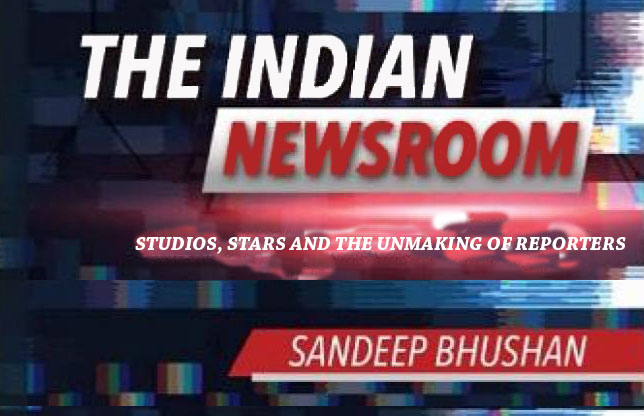
    I was therefore delighted to be invited by the Kolkata-based Prabha Khaitan Foundation to converse with Sandeep Bhushan, author of The Indian Newsroom: Studios, Stars and the Unmaking of Reporters. The author is a television journalist who has worked with pioneering satellite broadcast news channels like NDTV and Headlines Today; written on media for the Economic and Political Weekly, Hindu, Wire and Scroll—and taught at Jamia Millia Islamia, among others. His account of Indian television newsroom is, in many ways, the story of post-liberalisation India itself. “In just two decades, the country grew from the state-owned Doordarshan’s monopoly to a market dominated by umpteen private news channels,” he points out. “English language news has a particularly interesting trajectory here, both because of its disproportionate influence on the national conversation and its proximity to power,” he adds.

    Bhushan’s history of the industry scans the profession. More specifically, it takes a resolute look at what caused the marginalization of the reporter.  “How did technology impact the newsroom?” he poses. “How did India evolve the star system? What is access journalism, and what is wrong with it? Is the reporter-editor relationship necessarily adversarial? How does the owner-editor system—perhaps unique to India—work in practice? And corporate ownership—is it a boon or a bane?” Finally, he asks, “How does India compare with UK or USA—countries that have a longer history of television news and more mature markets?

    My years in journalism witnessed the Indian newsroom change irreversibly with the advent of the colour television. More so, with the growth of the Private Channels. Though owned primarily by those who were already big in Print Journalism—The Times of India group, the India Today group, the Ananda Bazar Patrika group, Eenadu TV overshadowed the earlier modes of mass communication.  Radio in particular suffered until FM came to India—again piggy-riding the news moguls. However the print media changed its stripes and managed not only to survive but also to emerge bigger in certain ways. Its outreach increased as more and more regional players entered the arena. This was the obvious fallout of TV’s impact. Equally big was the way it altered the complexion of Mainstream cinema.

    Satellite television can claim credit for changing everything. Prior to its appearance, when Doordarshan alone ruled, we had Video Magazines such as Newstrack—a sister publication of India Today—which recorded the poll mayhem at Meham in Haryana of 1990, something that would never be seen on DD. However the advent of Satellinte TV took to every home earth-shaking events like the armed Kargil conflict along the LOC between India and Pakistan in the summer of 1999, the Kandahar hijack involving the Indian Airlines flight 814 that led to the release of three marked terrorists including Masood Azhar—the architect of the Mumbai attacks—in December 1999, and the World Trade Centre attack in New York of September 2001.

    Given the immediacy of these events, and their unpredictable denouement, these developing stories were more gripping than any thriller on the silver screen. I for myself couldn’t take my eyes off the large screen on the second floor of the Times House in Delhi as the second tower of the WTC came crumbling down in New York. The story of the man stabbed inside the plane grounded in the Taliban-ruled Afghanistan city on a New Year’s Eve was heart breaking. We debated in high pitched voices whether the government should hand over the three men they—the terrorists supported by ISI of Pakistan—want to free? Kargil was the War Movie we could participate in from the safety of our own homes. Did these live reports sensitise us or do the opposite—desensitize us to War and Terrorism? And increasingly pertinent, perhaps, is the question: Should TV desist from showing things that are ‘against our national interest’?

    Closer home, colour television took films into our bedrooms, and that adversely affected not only the economy of cinema but also its content. By all accounts it had to become BIGGER and GLOSSIER. And, while we had channels serving content in Marathi, Bengali, Malayalam, Tamil, Oriya, Assamese—every language worth its salt—Doordarshan did away with the Sunday afternoon screening of Regional films that had given cross-country eminence to directors in the languages and made stars of Adoor Gopalakrishnan, Balu Mahendra, John Abraham, Jahnu Barua, Nirad Mahapatra, Buddhadev Dasgupta, Goutam Ghose… Soon Romedy and Thrillers came to be the staple of Prime Time tele-viewing.

    So many other things altered. When we were students, we watched Models grow up into Actors, like Shekhar Kapur. The idiot box changed the template, and soon even a veteran, nay, venerated actor like Amitabh Bachchan was selling Mirinda and Cadbury, Dabur, Emami, Kalyan Jewellery, Maggi Noodles, Parker Pen and Navaratna oil, ICICI Bank to firstcry.com… And Lambuji wasn’t the only player in the arena: Amir Khan, Akshay Kumar, Ajay Devgn, Shah Rukh Khan—you name them, and they were on the screen. Because? Franchise companies found that viewers developed a greater bond with the product if an actor they empathized with endorsed it. Print was stilled life; television was life lived, even if not king size…

    Fallout? An unthinkable spurt to the Celebrity Culture. Even in Print journalism, where it was not customary to see the mug of the writer, the editorials, the debates and opinions, the views and counter views— the Think pieces—on Budget days or otherwise, started giving preference to cricketers, actors, politicians. Inevitably the Glamour Quotient became more important than the Academic specialization or Depth of Opinion.

    Then, Headlines started to become the Content of the entertainment industry, taking it away from literature and its classics. Cinema gained Immediacy, but was it at the cost of processed observation? May or may not be so. This year’s National best, Uri: The Surgical Strike, unfolds around Major Vihaan Singh Shergill of the Indian Army who led a covert operation against a group of militants who attacked a base in Uri, Kashmir just three years ago, and killed many soldiers. Black Friday, made in 2004, is stuff of tele journalism. For it tracks the massive drive the police forces launched after the 1993 bomb blasts ripped Mumbai apart, yielding the names of the perpetrators of that terror act. Mumbai Meri Jaan, the 2009 film that won multiple Filmfare awards, was built on the aftermath of the multiple train bombings that rocked the Financial Capital of India in July 2006.

    Last year Hotel Mumbai set adrenalin flowing as it tacked members of Lashkar-e-Toiba who stormed the Taj Mahal Hotel and let loose gunfire and mayhem across the city, across the country, across the globe. The drama gained an emotional pitch that a documentary—or a tele-reporting—cannot achieve, by tying in the story of a brave chef and his staff who risk their lives while a desperate couple do what they can to protect their newborn. Batla House, Article 15, even No One Killed Jessica, the mowing down of pavement dwellers by a limousine—these are the brick and mortar of Tinseltown today, not boy-meets-girl or dancing-around-trees. [highlight background=”#f79126″ color=”#ffffff”]Any doubt that the success of television in grabbing eyeballs gave these directors the idea?[/highlight]

    In fact, the burgeoning of the Sports channels and the larger than life reporting of sporting events has given a spurt to films on cricket and hockey and even wrestling and boxing. Indirectly or otherwise, it has spawned Biopics on sportspeople—Flying Sikh Milkha Singh, ‘Soorma’ Sandeep Singh, athlete Paan Singh Tomar, wrestler Mahavir Singh Phogat and his daughters Geeta Kumari and Babita Kumari… They are the role models from the Sports pages, while Neerja about the courageous air hostess and Parmanu: The Story of Pokhran on IAS officer Aswath gave new heroes to the entire nation.

    This makes me wonder why television no longer has any intrepid reporters going after corrupt lots in power, nor any channel dedicated to Investigative journalism. During the recent Doctors Strike, no camera went behind the beds in the government hospitals to check what is lacking in the OTs, the testing labs, the pharmacies… Yet, we haven’t forgotten that channels gave Bollywood the role model of an Intrepid Lady Journalist in the mold of Barkha Dutt. Was that due to the rise in the numbers of women anchors? Can women take a stronger stance with a soft smile playing on their face?  Or do women—traditionally seen as more vulnerable—make more interesting protagonists?

    This brings us to the critical concern of commercials. Granted, they have been the grooming ground of celluloid masters from Satyajit Ray to Shyam Benegal, Mukul Anand to Rakeysh Omprakash Mehra, Rajkumar Hirani to Balki, Pradeep Sarkar to Shoojit Sircar, Aniruddha Roy Chowdhury to Nitesh Tewari. Yes, the Jackie Shroffs, Arjun Rampals, John Abrahams and Rajkumar Raos have also shed their jeans and suitings to rise-n-shine. But since the commerce of the channels depends on these commercials, Indian Television does not scan the pros and cons of the Business World the way business channels abroad do. How many has telescoped the malpractices within a Kingfisher, or of Only Vimal?

    Nor for that matter do we boast a Science channel although we have a number of them for Astha (confidence) in Faith. That is why we have drab statements reading out that India launched yet another Satellite without a hint of the excitement that prompts Hollywood to invest millions and zillions in Space Adventure flicks. They have taken a leaf out of the engrossment we felt full 50 years ago, when The Times of India spread out the image of Neil Armstrong and Edward Aldrin walk on the Moon.

    Is that why, despite the Magsaysays under our belt, we have yet to offer a desi Steven Spielberg?


    See also

    https://filmcriticscircle.com/journal/patriotism-in-the-cinema-of-hindi/

  • Patriotism in the cinema of Hindi

    Patriotism in the cinema of Hindi

    Being an effective mass medium, cinema h­­as for long been manipulated for the celebration of national pride and for the recognition of they who demonstrate the highest form of sacrifice and valour. The ‘soldier the­me’ has been a favorite of quite a few popular Hindi filmmakers from JP Dutta to Anil Sharma. Subhash Ghai’s Karma was a success back in its days, and its songs, penned by Anand Bakshi, are fondly hummed even now. The movies of Manoj Kumar were so closely identified with patriotism that he eventually earned himself the sobriquet ‘Bharat Kumar.’ There is a song too picturized on him—‘Bharat ka rehnewaala hoon, bharat ki baat sunaata hoon’. His movies such as Shaheed and Purab Aur Paschim connected well with Indian audiences, and the song Mere desh ki dharti from Upkar is an apt tribute to India.

    The 80s and 90s witnessed actors such as Nana Patekar and Sunny Deol donning the role of the saviors of the motherland—Krantiveer, Kohraam, Border, Gadar. Aamir Khan et al roused patriotism in Lagaan: Once Upon a Time in India as a team of village cricketers playing what passes off as a mental war of sorts, a tense match, against their British rulers. In recent times, films in this genre—Rustom, Baby, Naam Shabaana, Satyamev Jayate, Parmaanu, Uri: The Surgical Strike—have ensured actors Akshay Kumar, John Abraham, and Vicky Kaushal a major soar in their popularity.

    What is of significance is that unlike in the past, when patriotic Hindi movies were scarce even if successful, since the last half decade or so it has actually become a visible trend—battle movies such as Kesari; anti-terrorism movies such as Batla House; and biopics such as the sports-historical Gold that celebrate national achievements. This trend is still very much strong. On Independence Day this year, Mission Mangal, which celebrates India’s journey to Mars, released all over India. And coming up soon is 83, which focuses on India’s cricket world cup victory in 1983. Talks are on too for a movie centered on Abhinav Bindra’s Olympic feat.

    A lot has changed over the years, however, in the way movies in the genre get made. Earlier, there was greater drama and the plots weren’t multi-layered. Today, the drama is controlled, and the perspectives are varied. The songs in contemporary movies are no longer as memorable as those of then. The lyrics of present day songs fail to be etched in the memory. And the dialogues are devoid of hyperboles, and on most occasions, are crisp. The canvas has widened and the treatment and tone are varied, relative of the filmmaker’s sensibilities. The subject remains mainstream largely but there would be greater acceptance to a movie such as Dil Se in today’s times, which probably didn’t get its due at the time of its release. On the other hand, while Sunny Deol’s hand-pump lifting scene in Gadar was very popular in its time, it is debatable if such a presentation would be widely appreciated today.

    With more avenues to cover costs available and top stars willing to experiment, filmmakers have greater independence in treating the subject. Rang De Basanti used an interesting sub-plot that saw audiences relate to the flawed but eager-to-reform characters led by Aamir Khan. A tragedy triggers the activists within them and the holier-than-thou representation of central characters was avoided. Though predictable, Chak De India kept audiences engaged as Shah Rukh Khan delivered a thoroughly controlled performance of a hockey coach redeeming himself with purposeful resilience. Baby saw an understated performance from Akshay Kumar. The restraint kept the performance real.

    Contemporary filmmakers indulging in the nation glorification genre tend to lend importance to research. They consult authorities of the respective subjects; depict realistic setups; and avoid a lavish splash of songs and unreal dramatic sequences. Furthermore, they do not hesitate to address controversial issues employing multiple perspectives. Thus, Haider had a different take on the Kashmir crisis. And Fimistaan and War Chod Naa Yaar attempted to highlight the futility of war, and portrayed the common human challenges across the border. More filmmakers are now displaying the human side of characters. It is no longer a binary setup where one is for or against the national interest. The intent is to portray the challenges of conflict that aren’t resolved. Raazi and Romeo Akbar Walter both depicted the lives of a spy, but while the former was subtler, the latter did not withhold the drama. The template is just not the same anymore.


    The artworks are by the author himself. He has done well over 350 portraits of film stars from the early to the present eras.

  • Remembering a forgotten director star — Miklós Janscó

    Remembering a forgotten director star — Miklós Janscó

    There are film directors who create film stars and then there are film directors who become stars themselves.

    Since cinema started as a means of business, stars and star film directors have both co existed. A star could not survive without a good film director but a star film director could thrive without stars. Each national language cinema has had its fair share of both stars and star film directors. In India, individuals in both categories have lived and thrived by the dozens; while in countries with smaller film audiences, star directors have been few. Miklós Janscó was one such rare star among directors.

    Hungary after the Second World War produced one of its greatest film directors in Janscó, whose rise to fame and a career in cinema within his country was gradual and partly unnoticed. His first achievement with reference to the political scenario was that he survived the Big War. His second achievement was that he could pursue his passion for films starting from a still camera and moving to a movie camera to record the process of reconstruction of his country while making short documentaries. His third achievement was that he came to the notice of his authoritarian masters. His ultimate such achievement was that he survived his authoritarian masters and made anti establishment statements through his films.

    In a cinematic career spanning the years between 1954 and 2010, Janscó made 33 feature films, 19 documentary films and 28 newsreel topicals. Considering that the Hungarian film industry was destroyed by the occupation armies of Germany and was later resurrected by the Soviet administration, his total work output is truly impressive.

    Janscó came to be introduced to Indian audiences with his feature film The Round-Up, aka The Outlaws. The opening up of Hungarian cinema to Indian audiences occurred under rather strange circumstances. It happened towards the end of 1970 when a Hungarian anthropologist Geza Benphalve arrived in New Delhi with a package of films from his nation, and sought help to show them to the local audiences. Two decades later, he returned to New Delhi to be the Director of the Hungarian Cultural Centre. In his second outing he did not emphasize the fact that it was he who had introduced Hungarian cinema in India starting with the screening of Janscó’s The Round-Up. This film, it is important to add, had previously—in 1971 to be precise—been screened in India by the Federation of Film Societies of India (FFSI), but it was only during its reintroduction by Benphalve in the end-70s that it made its impact on Indian festival audiences.

    Today, Janscó is a person lost in time both in Hungary and in India. The rights of his films are controlled by the Hungarian National Film Fund, and they charge a royalty of around USD 3500 per show. Since he is not “entertainment,” no one wishes to pay to see his films, and so his films are not looked forward to. In India, more than a decade ago, FFSI had paid for the royalties and shown his films as a special retro, on request from the Hungarian Cultural Centre. The introduction that I had written was circulated along with Janscó’s films in the festival circuit. His films were received coldly at that time by 95 percent of the audiences here, and no one else was interested in writing on them. Furthermore, the leaders in the Directorate of Film Festival had not even heard of him. Hopefully, this write up will spark an interest among Indian festival directors to host a Janscó retrospective package. Presently, the number of people in India who have seen his films can be counted on one’s fingers.

    Janscó never did visit India. And a glance at the record books shows that India has received a far less number of his works than even that of his second wife Marta Mazarous. In fact, she was offered two retrospective packages in India while Janscó wasn’t afforded a single one in India in his entire lifetime. Mazarous served twice on the International Film Festival of India jury—the first time, as a regular member, and the second as the chairperson. Merit-wise, Mazarous acquired more national and international fame than Janscó, but it was on Janscó’s limited works and not Marta extensive works that film critics wrote extensively. Furthermore, Janscó’s The Round Up was reportedly seen by one tenth of the total population of his country, a rare feat by any standard, and it was the first hit film in post-WWII Hungary.

    Janscó is best remembered for a unique signature in film narrative that was marked by the sparing use of words in dialogues interspersed by long scene takes. In Red Psalms, this style took an extreme position when scenes were allowed to linger on for 9 minutes and more without a single cut. Film critics found in such depiction, symbolism that perhaps even the film director never thought of. But he accepted these interpretations since they created for him a distinct image that added to his cinematic aura in the international film circles.

    Miklós Jansco’s worldwide fame remained, till his demise in early 2014, with a fan following that aged along with him. Even in his old age, despite suffering from cancer, the film director was still at work. His last film So Much For Justice was made in 2010 when he was all of 90 years of age.


    [divider size=”1″ margin=”0″]


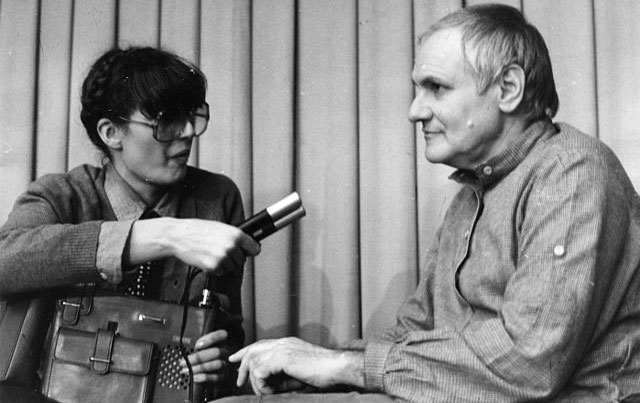
    Photo credit: Fortepan adományozó RÁDIÓ ÉS TELEVÍZIÓ ÚJSÁG / VERESS JENŐ felvétele. Jancsó Miklós interjút ad a Magyar Rádión munkatársának | CC-BY-SA-3.0


  • Dialogues Tell a Story

    Dialogues Tell a Story

    Cinema has come a long way from a time when long dialogues struck gold at the box-office and cemented a struggling protagonist’s position as a dependable hero to a time when it is cool to be conversational. Alongside, the big screen has ceded much of its audience to the small screen. Clearly, it is not merely a change in the format, but in the preferences as well. Audiences that immerse themselves in, groove to, and work and live out of, the small screen, prefer lines that are short and not necessarily sweet. Professionals, such as Prasoon Joshi who has dabbled in both screen forms, know quite well that the script and parameters, dialogues included, for a Bhaag Milkha Bhaag are necessitated to be radically different than those of a 30 second commercial for a Happy Dent.

    Way back in the heydays of multi starrers and family dramas, things were quite different. A dialogue such as ‘Babumoshai, zindagi lambi nahin, badi honi chahiye’ by Rajesh Khanna, the titular character of Anand, summed up his happy-go-lucky personality, and despite dying slowly every day on screen, the actor succeeded in leaving behind a wonderful mantra for life. In Meri Jung, Anil Kapur played a self-made lawyer whose conscience was pricked with a single dialogue. He took up what appeared to be a doomed case when he heard the same words his mother used in her plea to a lawyer to save her innocent husband from the gallows—‘Jiske paas koi saboodh ya gawaah nahin hota, kya vo begunaah nahin hota?’

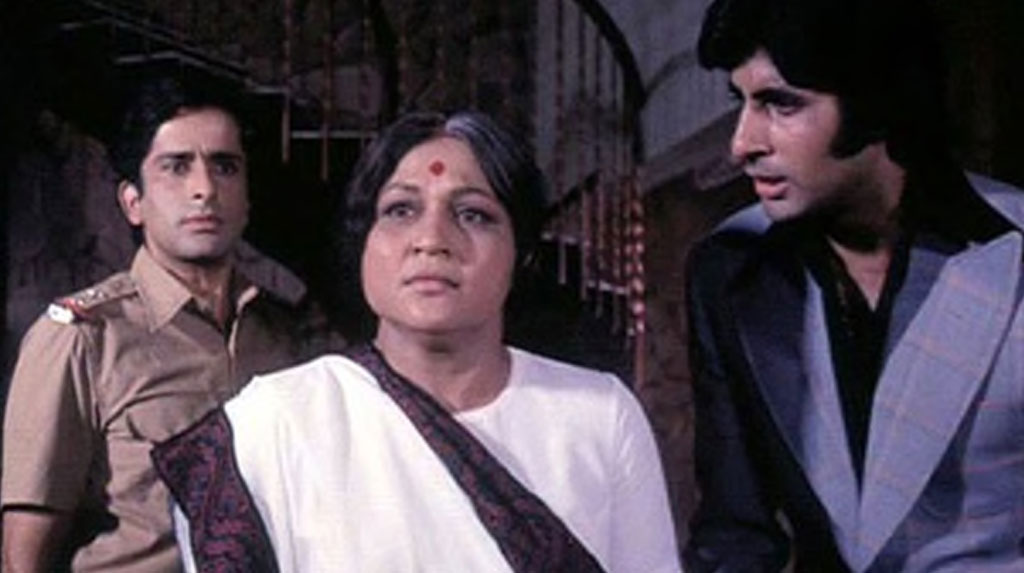
    Amitabh Bachchan’s iconic scene at the temple in the Deewar climax is etched in public memory. What made it so? It lent depth, and established layers for the flawed but loved protagonist. It gave space to his angst and emotions, and, to an extent, it justified his questionable and conventional choices. In the same movie, a scene between two brothers on diametrically opposite sides of the virtue scale ended with a dialogue that is still remembered today—‘Mere paas maa hai’. The dialogue emphasized that the virtuous brother, even though he had no material possessions, is the richer of the two because he had his mother on his side. In Trishul, when the angst-ridden protagonist proclaimed, ‘Aaj meri jeb me phoonti kaudi nahin hai aur main paach laakh ka sauda karne aaya hoon’, it highlighted his confidence. And in the climax, it lent expression to his grief when he threw the dialogue, ‘Maine aap jitna gareeb insaan nahin dekha’ to his biological father who had left his mother for wealth. ‘Mazdoor ka paseena sookhne se pehle use apni mazdoori mil jaani chahiye’, in Coolie, made it clear that a labourer shouldn’t be made to wait for the fruits of his labour. Khuda Gawah had Amitabh Bachchan mouthing a long dialogue in praise of love and how it triumphs over everything else.

    Dialogues such as ‘Na talvaar ki dhar se, na goliyon ki bouchaar se, bandaa darta hai to bas Parvar Digaar Se’ were used as a technique to introduce a central character or the ideology that they practised. Hollywood’s superhero Spiderman too had one to explain his—‘With great power, comes great responsibility’. Some dialogues evoked warmth of bonds and togetherness, or the reverse—‘Yeh to tune theek hi kaha… ki mar gaya raju aur khatm ho gaya veeru’ from Saudagar marked the moment of rift between two lifelong friends.

    Unlike in the olden days when dialogues were considered relevant, the advice of today’s industry folks to ‘keep it short’ or ‘cut it short’ seems to be a short cut, templatised approach to hook audiences who may find long dialogues to be too dramatic and unreal. For the audiences of today, dialogues don’t seem to be the tool to build a character; subtle mannerisms and actions seem to be the preference. We often talk of low-attention span, but does this not point at the writer’s failure to be able to hold the audience’s attention? Social media is full of timelines that reflect great love for smart and inspiring one-liners. Several youngsters wear t-shirts sporting smart one-liners to reflect their attitude and swag. Smart videos and memes seem to be forwarded in huge numbers. Perhaps, the wit of words works better on personalized platforms instead of the cinema screens. The fact remains, though, that powerful lines still leave the audiences spellbound. Even at the time when chocolate heroes were replacing the angry young man, the long dialogue by Amitabh Bachchan in Baghbaan, released in the early 2000s, succeeded in striking a chord with the audiences.

    What is it about dialogues that endear themselves to audiences? Is it mere wordplay? Are dialogues like closed curtains, using which we can get to know a personality better? Do dialogues have to be merely instructional or can they stand out as life mantras? The popularity of dialogues reflects the power of words in creating an impact on minds and hearts. What songs and dance are for expressions, dialogues are for the story. The inherent risk in keeping cinema stark real is that it can appear to be an isolated episode and not an integrated construct. Dialogues also reflect the fact that the character has a very good understanding of their life or their situations or their principles.

    Dialogues lend depth to the underdogs’ persona. It allows them a way to vent their angst and express their sorrow. They bear the burden of explaining their position, choices, and unfulfilled wishes to the audience. Dialogues rescue the underdog. The armor of words overrides the underdogs’ humble abode and modest clothing, and elevates them to the pedestal of the favoured victor. Often, in a vulnerable on-screen moment, it is a dialogue that helps the protagonist swing from being a subject of lament to a subject of pride and inspiration. Finely-framed dialogues rivet audiences to their seats by swinging the pendulum of power between the protagonist and the antagonist, who could be anything from a character to a situation, an illness, or a loan deadline.

    Dialogues that are criticized for being preachy may well be the mantra of inspiration for struggling individuals. And when aided by a well-integrated construct of all the other elements, including visual cues, story, and aesthetics, dialogues add depth to the film, which is why, in filmmaking courses, dialogues are an important chapter of study. The movies of today may rely more on conversational tones, but perhaps the drama will not emerge so powerfully without strong dialogues. This leads to the questions—In our bid to appeal to the smartphone generation, should long, dramatic dialogues no longer be considered in storytelling? And will long, dramatic dialogues in films someday eventually cease to be a primary element?


    [divider size=”1″ margin=”0″]


    The artworks are by the author himself. He has done well over 350 portraits of film stars from the early to the present eras.

  • The appreciation and promotion of cultural otherness

    The appreciation and promotion of cultural otherness

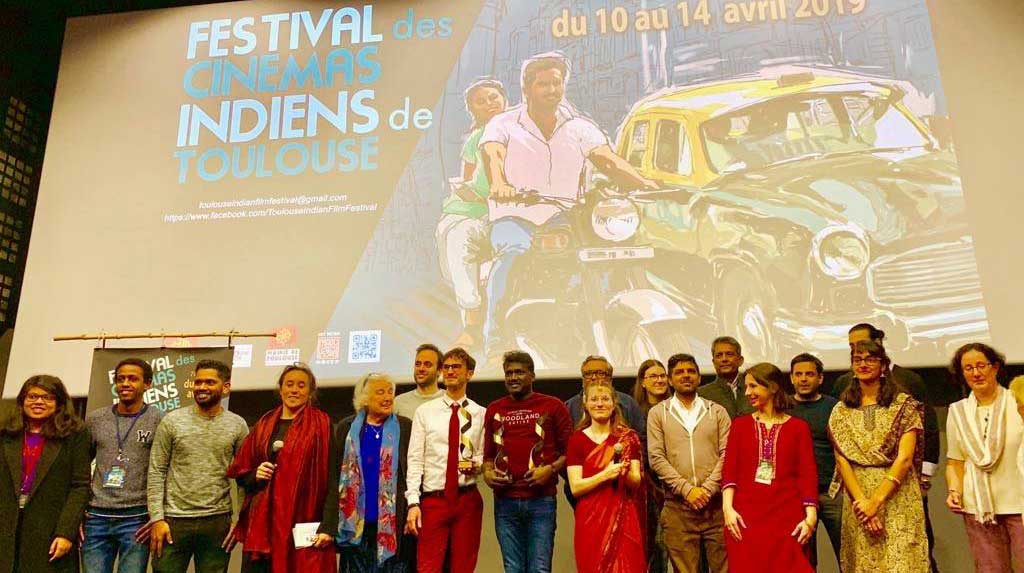
    A case study of the Toulouse Indian Film Festival

    Cinema is an important medium, and is highly responsible worldwide in constructing otherness.[1] Film industries, since time immemorial, have been aware of this power that it holds, and several papers on this aspect using Hollywood as an example are available.[2] This present study is a result of 10 years of research, backed with a field survey based on experience while conducting 7 editions of Le Festival des Films Indiens de Toulouse/Toulouse Indian Film Festival (TIFF). It examines the biases regarding Indian culture held by a sizeable number of French spectators—a majority of them still have incorrect ideas about contemporary India—and attempts to find a way to show them the truth.

    The primary reason for this widespread misinformation is the escapist Bollywood entertainers, such as Kabhi Khushi Kabhie Gham (15,363 tickets sold in 2001) and Devdas (98,338, in 2003) as well as a few notable films set in India and made by the West, such as Slumdog Millionaire (2,694,389, in 2009) and Indian Palace (271,131, in 2012).[3] What such canvasses unscrupulously exhibit is an India of contrasting images—grandiose wealth and dire poverty; glamorous haute culture and filthy rags; colorful, luxurious ceremonies and beggars, human trafficking, and exploitation.

    While regulars of TIFF have a clearer picture of the real India, new attendees are beginning slowly to see the other side. Though a gradual change in perception is observed, the nature of the questions raised at the post screening Q&A sessions are still indicative of years of wrong programming. When on the subject of Indian contemporary society, the questions tend to be related to rape culture, women’s rights, and poverty. When on the subject of geography, the questions generally tend to revolve around the holy city of Benares; the emblematic colonial Pondicherry; and that temple of love, the Taj Mahal. And when on the subject of politics and governance, the only question that comes up is related to World Yoga Day. Though factual, these narrowed questions demonstrate a very reductive perception about contemporary India, and consequently, of contemporary Indian cinema.[4]

    Much of this has to do with the imagery fostered by colonial empires and not updated since. The first problem, created by the colonists, relates to exoticism and the condescending approach attached to it. The second is the total reliance of people on created images/media (largely, fiction film) for information about a foreign culture—a kind of persisting neo-colonialist approach to view the “outside world,” one that leans on ideologies, psychoanalysis, and social issues: “la géographie culturelle ne peut être distinguée de la géographie sociale ou politique” [cultural geography cannot be distinguished from social or political geography].[5]

    TIFF came into existence in 2012—a time when there were no Indian film screenings in cinema halls outside the Parisian area and the only Indian films that a few French people had watched were that of Satyajit Ray. It is an NGO, and like most tiny NGOs in France, everyone is a volunteer, the team is small, and the budget is miniscule. Most everyone in France back then had however heard of Bollywood, which they viewed pejoratively as a pathetic genre of cheap entertainers that spilled out into real life in the form of fun and partying. Consequently, TIFF struggled for years in its attempt to convince the French that Indian cinema was worthy of a screening. Ironically, and unfortunately, the French were less interested in watching Indian films and showed more excitement in being invited to Bollywood song-and-dance parties.

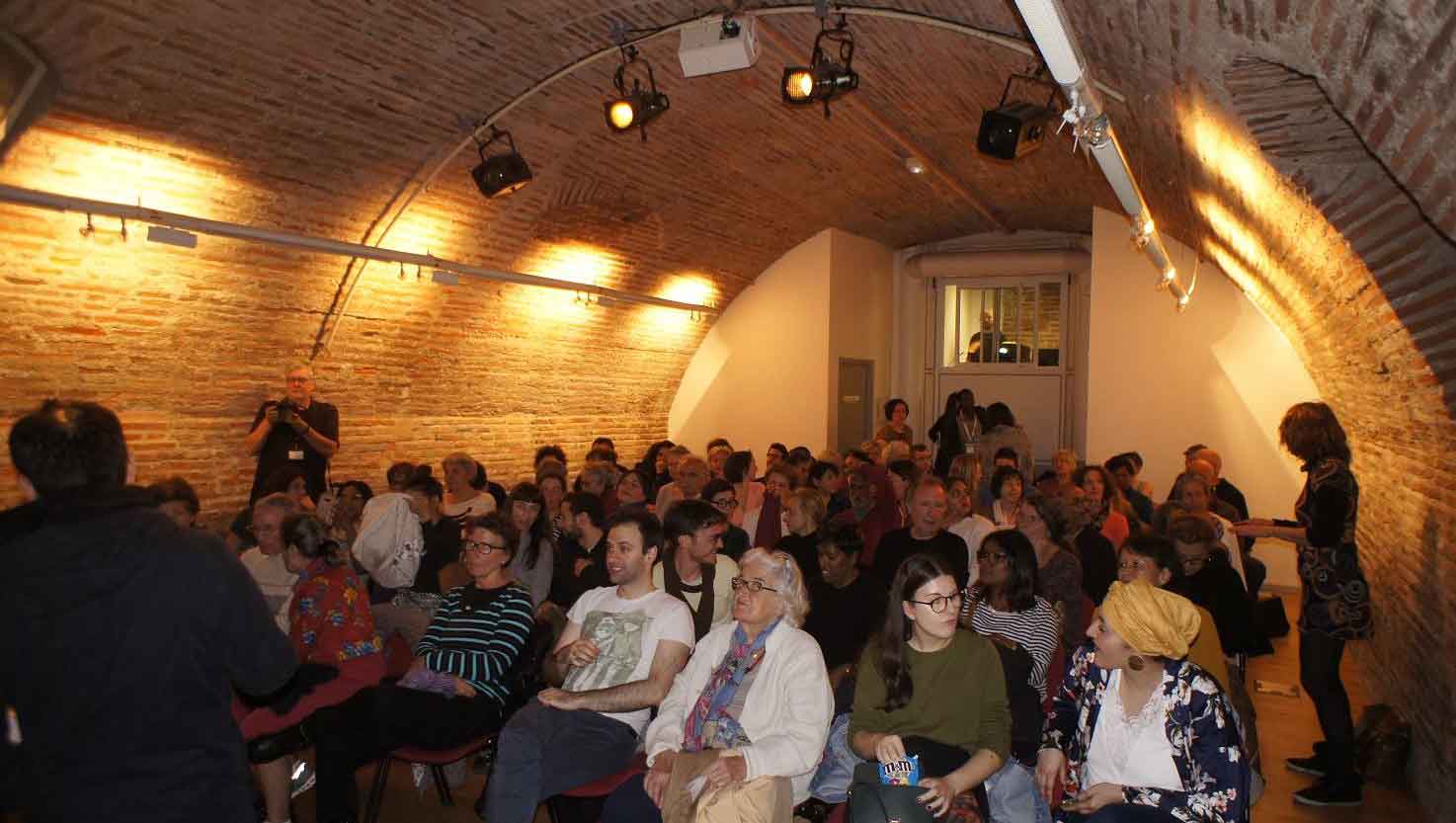
    A film festival audience is but a fragment and not a representative of a nation’s audience. The former is one that is eager to visit film theatres several times in a very short time, and even pay for each entry when required, even though they often have no idea what they are in for. They are willing to stake their time and money in return for the hope of discovering something new. The audience is an important part of a film festival, and this not just because they buy tickets—they are the very soul of a festival. At TIFF, as in many other such festivals, the audience appreciates that their film opinions are taken quite seriously, and they therefore enthusiastically look forward to being a part of the Audience Awards.

    The city of Toulouse in France, where TIFF takes place, is renowned for its cinephile audience. Its uptown and suburban areas is a noticeable observation point for the French film industry every Wednesday, the film release day in France. Also noteworthy is that Toulouse hosts well over 30 film festivals every year, a significant number even in a country that conducts one of the largest number of film festivals in the entire world.[6] It effectively means that no film festival here can rest on its past laurels.

    The journey of TIFF commenced sans variety, sans audience, sans budget. At the very start, diversity was non-existent, since most of the films screened were in Hindi. And the audience was scarce, since it seemed such a ridiculous, almost sacrilegious, idea to attend a festival of Indian films, and especially one that excluded the films of Ray. Forget audiences, even film journalists were totally confounded—one enthusiastic cutlet announcing the premier edition of TIFF published their story alongside the photograph of a native American.

    The purpose of TIFF has always been clear—to introduce French audiences to contemporary India and contemporary Indian cinema. Initially, there was hardly an audience for such films, and instead, just a lot of bias and flak. Thus, a primary strategy came into being—to host as many Q&A sessions as possible; with or without guests.[7] This experiment proved to be the turning point. These days, a Q&A session happens after the screening of every film, and audiences are encouraged to voice their opinions. Such sessions require immense energy; strong will and determination; and a thorough knowledge of Indian cinema, culture, and society. But the results are astounding, and prove that French audiences and programmers can be much more fascinated with Indian culture and films than anybody, including themselves, ever supposed.

    “We never imagined Indian cinema to be this,” “Why didn’t we hear about this (Indian) cinema before!” “Where can we get more information about Indian films and their context?” “Will this film be screened again, or released in France?” and “When would be the next edition?” are the class of positive, naïve, spontaneous testimonies of newbie French spectators of Indian cinema, these days, as they commence their wondrous journey into Indian culture.

    The spectatorship of TIFF is now comparable to many other important French film festivals and comprises majorly of French people ranging from the regular attendees to newbie individuals who neither have any special connection to Indian cinema nor are Bollywood fans. Strangely, despite a significant Indian community in the Toulouse area, very few attend the screenings. There are various possible reasons for this, but this is another topic altogether.French audiences are gradually being drawn towards this variety exhibit of storytelling, cultures, and languages so very different from their own—from Malayalam (Ee. Ma. Yau), Tamil (Pariyerum Perumal), Hindi/Gondi (Newton), Assamese (Ishu), Khasi (Onaatah – of the Earth), Manipuri (Loktak Lairembee), Tibetan/Pahari/Hindi (Sound of Silence), Urdu (One Half Widow), and Bengali (Runanubandha) to Marathi (Gulabjaam). They have begun to recognize that what is different isn’t necessarily inferior. And nowadays when they dislike a film, it isn’t because it is Indian but because the film whatever its origin failed to move them—this is far removed from that earlier subconscious, arrogant attitude towards the so-termed illiterate, kitsch, immature cinema.


    In conclusion

    Quantitatively, the distribution of Indian film in France is still rather ridiculous. Qualitatively, in the sense of diversity of production, the scene is even worse. That distributors of Indian films in France rely chiefly on the Indian-origin community for attendance points toward a sure prospect of failure in the short term. Festival programming statistics clearly indicates that French spectators are more than willing to entertain the diversity and dynamics of Indian productions despite the obvious cultural, economical, and political biases. This leads to the real questions—Who would be willing to invest money and energy in this challenge? Quite to the contrary to what is being witnessed in every film industry in this age of globalization, who would be willing to think beyond a short-term return on investment, in France and in India?


    [divider size=”1″ margin=”0″]


    Bibliography

    1. Staszak, La fabrique cinématographique de l’altérité. Les personnages de « Chinoises » dans le cinéma occidental, Annales de géographie 2011/6 (n°682)
    2. Ronald Brownstein, The Power and the Glitter. The Hollywood-Washington Connection, New York, Vintage Books, 1992
    3. Bianchi, Entretiens avec les spectatrices de Bollywood: La réception des films hindi en France, séminaire Cinéphilies populaires, Sorbonne nouvelle, Paris III, April 2014
    4. Françoise Benhamou, Les dérèglements de l’exception culturelle, 2006
    5. Cinémanageria, «Les Festivals de cinéma[archive]», consulté le 19 mars 2008
    6. Cagneaux, De la diffusion potentielle du cinéma bollywood en France, master degree thesis, Institut d’études politiques, Lyon, 2015


    Films listed

    • Devdas,  Sanjay Leela Bhansali
    • Ee. Ma. Yau, Lijo Jose Pelissery
    • Gulabjaam, Sachin Kundalkar
    • Indian Palace, John Madden
    • Ishu, Utpal Borpujari
    • Kabhi Khushi Kabhie Gham, Karan Johar
    • Loktak Lairembee, Haobam Paban Kumar
    • Newton, Amit V. Masurkar
    • Onaatah – Of the Earth, Pradip Kurbah
    • One Half Widow, Danish Renzu
    • Pariyerum Perumal, Mari Selvaraj
    • Queen, Vikas Bahl
    • Runanubandha, Amartya Bhattacharyya
    • Slumdog Millionnaire, Danny Boyle
    • Sound of Silence, Dr. Biju
    • Sunrise, Partho Sen-Gupta


    Cover photo credit

    • Pierre Rieu


    See also

    https://filmcriticscircle.com/journal/french-spectators-of-indian-films-bias-and-curiosity/

    https://filmcriticscircle.com/journal/understanding-habits-preferences-bengali-cinema-audiences/

  • Understanding the habits and preferences of Bengali cinema audiences

    Understanding the habits and preferences of Bengali cinema audiences

    [note note_color=”#f79125″ text_color=”#151113″ radius=”3″]The author’s film Andar Kahini has received innumerable awards at a variety of international film festivals, and is now set to release in West Bengal cinema halls. If you would like to be a part of it, check out https://www.wishberry.in/campaign/andarkahini-self-exile[/note]


    The cinema market of Kolkata/West Bengal has primarily been dominated by Bengali cinema since the last 5 years. The market leader is Venkatesh Films, a company with huge production & distribution networks. The company produces both critically acclaimed art as well as blockbuster commercial films. Additionally, it produces fiction and non-fiction reality shows for Bengali GEC channels such as Star Jalsha, Rupashi Bangla and Mahuaa Bangla; has a very strong distribution chain with total control of over 200 theatres of WB (films such as Raavan and 3 Idiots were released on WB. through their network); and has created superstars in the cinema of Bengali who involve themselves in promoting the company’s films all through the year.

    Almost all the stars in Kolkata, from directors such as Raj Chakraborty, Srijit Mukherjee, Ravi Kinagi, Sujit Mondal, and Rajeev Kumar; actors such as Dev, Jeet, Soham, Koel, Subhosree, Shravanty, and Payel; music directors such as Jeet Ganguly, Anupam Roy, and Debojyoti Mishra; editors such as Rabiranjan Moitra; to art directors such as Tanmoy Chakraborty, and Asish Adhikari are discoveries of Venkatesh Films. A majority of them are, naturally, loyal to their company and as a rule do not work for other producers.

    Among the young generation of Bengali cinema audience, Dev has an extremely large fanbase and well before the release of each of his films, his fans tend to go into a frenzy and there is frequently a scarcity of tickets. Furthermore, Venkatesh Films creates a huge publicity buzz before each of its film’s releases, so much so that time even good Hindi or English films releasing in the same week are literally compelled to pray for footfalls.


    MARKET SIZE OF BENGALI FILM INDUSTRY

    • Box office – 101 Crores ( Producer share – 45 Crs )
    • Other rights – 21 Crs ( based on current situation )
    • 85 – 100 releases in a year
    • COP – 40 lacs to 250 lacs
    • Digital – 20 lacs to 60 lacs
    • 515 cinema halls ( 11 multiplexes ) is the universe
    • Urban appealing movies are of high budget
    • Marketing & distribution spend – 15% to 40%
    • Mainstream cinema contributes 80% of business
    • Art house cinema has only strength in metro


    EXISTING CONTENT

    • Two categories
    • Metro centric/Art/Intellectual ( ~ 35 no. ) & mainstream/Commercial ( ~ 65 no. )
    • Big opportunity to bridge the gap
    • Success story is star/content driven for Mainstream & Story approachingsocial message is utmost important for Arthouse
    • Genres working well in Mainstream – Young love story, Actions & Comedy
    • Art House Directors came up Aniruddha, Bappaditya, Bratyo, Suman(2) since last two years
    • Mainstream dominated by Raj Chakravarty, Rajib kumar,Ringo apart from Swapan Saha, Haranath, Ravi Kinnagi etc.
    • The stallwards of Art house cinema are still Rituparno, Aparna, Buddhadev, Shekhar Das & Anjan Dutta.


    BOX OFFICE RECENT PAST

    • 52 Films releases in 2007. 1 declared Super Hit followed by 12 hit. ( hitmeans recovered money )
    • 65 released in 2008. Two again Super Hit followed by 10 hit.
    • Already 87 released in 2009 & 3 Super Hit again.
    • MLA FATAKESTO, TULKALAM – Over 4 years Super Hit
    • CHIRO DINI TUMI JE AMAR Broken all the records in 2008 ( no star –surprise hit ) followed by CHALLENGE same team.
    • CHALLENGE & PJJR (2009) has created again history in quick recovery
    • FELUDA KIND OF MOVIES are always a safe as a franchisee


    MARKETING

    • Newspaper, TV, Radio, Website, Publicity & Ground Activities
    • Word of Mouth & Star Power
    • Music Video is the key tool
    • Urban Movies has much focus in Metro
    • Well planned with Editorial support from media
    • Common media buying
    • Exclusive media tie up
    • In film branding just started


    DISTRIBUTION

    • Dominated by VENKATESH followed by Eskay Films & Surinder Films Strong control on Exhibitors
    • Bookers also has very strong network but traditional
    • Urban films confined to Metro & Suburbs only
    • Mainstream film can give the width
    • Monopoly & long relationship with the exhibitors
    • Emerging distributor PIYALI FILMS with strong system support


    EXHIBITION

    • Universe is 515 – 37 A+ halls & 53 A halls
    • 106 halls have UFO facilities. CUBE digital launched in bengal & 135 cube installed already.
    • Some 209 halls closed completely
    • Average ticket price is 40/- to 70/- in urban to 10/- to 25/- in suburbs
    • Can achieve 1 Cr. easily if its full show for a week with 60% occupancy.
    • Venkatesh trying to get 107 sick halls, got already 47 halls leased by him.
    • Piyali Films are growing heavily in strategising their entertainment wing to a diversified revenue source apart from their traditional business.


    WAY FORWARD PRODUCTION & CONTENT

    • Priority on new stories, new stars & new directors
    • At least 6 movies is getting signed by each & every producers
    • Genre is contemporary based on Love, Masala
    • Buying stories which is rich & best sellers
    • Signing good & new directors on contracts
    • Banking on new actors & actress
    • Doing R&D for public domain
    • Remake of Tamil, Telegu, Oriya & Hindi Blockbusters i.e. only in Mainstream


    WAY FORWARD DISTRIBUTION

    • High dependency on digitals
    • Penetration initial 2 weeks with max no of theatres
    • Some guys like Piyali Films adopted system very strongly Producer- Distributor planned year’s release well in advanceBig brothers started creating own chain
    • Multiplex creating troubles for show timing
    • Still no space for Mainstream in Multiplexes


    WAY FORWARD MARKETING

    • Taken a big leap beyond KOLKATA
    • NEW STARS exploited more in all activities.
    • IN FILM is on high focus which adding 20% revenues
    • Media Buying are essentially combined with tie up
    • Radio & Website has opened a phenomenal information inflow Hyped programme opens for release platform
    • Corporates investing money for Outdoor Media
    • FOOD JOINT is being targeted as a key zone for Youth.


    BRANDING & TIE UP

    • FESTIVALS are being targeted for a big budget movie
    • Corporate Co- branding is happening
    • Alliances are giving enormous mileage
    • Local Companies are highly pitching on movies
    • Barter deal is saving a substantial planned cost
    • College & Campus creating platforms for certain kind of films REGIONAL ICONS are placed in promoting the films in Premiere.


    Objective of the Project
    • An audience research study is conducted to identify the habit & preference of the cinema-going audiences.
    • The objective of this project also involves reason behind less watch or not watch of English movie.


    Research Methodology

    This research methodology was developed after considering the research objectives and the purpose of the project seriously.


    The Market Research Process

    The market research process consists of six steps. These include:

    1. Problem definition
    2. Development of an approach
    3. Research Design Formulation
    4. Field Work
    5. Data Interpretation and Analysis
    6. Report Preparation.


    Research Design

    Keeping the research objectives in mind, a research design was developed for conducting the study and collecting the required data.

    1. Research Instrument: A questionnaire was formulated. Most of the questions were closed-ended & a very few were open-ended.
    2. Nature of Data: All the data used for this project were primary in nature.
    3. Source of Data: The data collection method was that of Survey research,which in terms of marketing is defined as a ‘Systemic Collection of Information directly from the respondents.’
    4. Sampling Plan: The sample unit or target group is the cinema-going audience of Kolkata. They are of age group between 18 to 35 yr. and fall into various segments on the basis of gender, education, profession & locality.
    5. Sample Size: Total number of consumers surveyed was 138.
    6. Area Covered: At first single screen theaters & multiplexes were divided into various parts according to their geographic position & profile of audiences.
    7. Theatres covered for this survey:
      • INOX (SWABHUMI / CITY CENTRE / FORUM)
      • FAME (SOUTH CITY / HIGHLAND PARK)
      • CINEMAX (MANI SQUARE)
        LONDON PARIS (MUKTI WORLD)
      • HDIL BROADWAY BIOSCOPE
        NEW EMPIRE STAR
      • PARADISE ROXY
      • AJANTA PRACHI PRIYA NAVINA JAYA NANDAN INDIRA
    8. Contact Method: Data was collected by field survey via direct interview by the investigator to the respondents.


    Constraints of the Project
    1. Time Constraint: One of the main shortfalls of the research study was that the survey period was limited. Hence, because of this time constraint, more number of respondents could not be covered.
    2. Variation of movie: Actually to understand the taste & preference of audience is a long time process, audience profile varies from season to season, ie. During festivals a wide variety of audience go theatre to enjoy movie, who may be laggards. Their taste & preference is also important to bring them at theatre.

    Although care has been taken in putting across the observations meticulously, yet these constraints of information tend to cause some minor aberrations in the final analysis.


    Design of the Questionnaire

    A questionnaire contains a formalized set of questions for obtaining information from respondents. Typically a questionnaire is one element in data collection package that might also include

    • · Field work procedures such as instruction for selecting, approaching and questioning respondents.
    • · Some reward, gift or payment offered to respondents. Any questionnaire has three specific objectives:First, it must translate the information needed into set of specific questions that the respondents can and will answer. Developing questions that respondents cannot answer may render the collection of information difficult.

    Second, a questionnaire must uplift, motivate and encourage the respondents to co-operate and to complete the interview. Incomplete questionnaires have limited usefulness. The questionnaire must be so designed that it minimizesthe respondent’s fatigue and boredom. A well-designed questionnaire can motivate the respondents and increase the response rate.

    Third, a questionnaire should minimize the response error.

    Hence, the questionnaire for this project is designed keeping these information in mind.


    Interviewing Method

    An appreciation of how the type of interviewing method influences questionnaire design can be obtained by considering how the questionnaire will be administered under each method. In personal interview, the respondents see the questionnaire and interact fact-to-face with the interviewer. Thus various questions can be asked. In case of indirect interviewing method like through Email or mail, the questionnaire should be brief and easily understandable. Hence, for this project we have used mostly all primary data.

    In case of my project, the survey has been conducted by myself where I have personally visited theatres of Kolkata and interviewed the respondents. In this regard, I have tried my level best to keep the questionnaire respondent-friendly.


    [divider text=”” size=”1″ margin=”0″]


    Questionnaire: AUDIENCE RESPONSE SHEET

    Objective: To understand the habits & preferences of Bengali cinema-going audiences

    Part

    1. Name:
    2. Gender
    3. Age:
    4. Locality
    5. Profession
    6. Education
    7. Contact no. &/or E-mail id

    Sub-Objective 1: How genre of film varies from segment to segment

    Sub-Objective 2: Who are the target audience of ART of COMMERCIAL movie?

    Sub-Objective 3: Which is/are the preferred language(s) in which audience enjoys a movie?

    Sub-Objective 4: What combination of ingredients, the audience would like to watch a movie?

    Sub-Objective 5: What is the preferred Showtime

    Sub-Objective 6: What is the preferred mode to purchase movie tickets?

    Sub-Objective 7: When audience prefers to visit theatre after release of a movie

    Sub-Objective 8: What are the sources of information about a movie?


    AUDIENCE RESPONSE SHEET
    • · Where do you watch films – Theatres, TV, CD/DVD
    • · Why do you watch the films in this format (put some thought into this)?
    • · Do you watch TV?
      • What channels do you watch?
      • Which programs?
      • Which language?


    Technique and Theory for Data Analysis

    Some mathematical and statistical tools were used for the analysis of different objectives of the project. The Statistical techniques used are as follows.

    Percentage Distribution: Where the number in each category is expressed as a percentage of the total.

    Bar Diagram: Pictorial representation of equidistant rectangular bars, one for each category is used to represent the data.

    Pie Chart: A pictorial representation where circle is used to represent the total area and is divided proportionally among the different components by converting the proportional values into proportional segments of the circle.

    Thurston technique of ranking: An analysis which helps in ranking different attributes according to their importance and also the distance between their levels of importance.


    [box title=”Thurston Scale” style=”default” box_color=”#333333″ title_color=”#FFFFFF” radius=”3″]In psychology, the Thurston scale was the first formal technique for measuring an attitude. It was developed by Louis Leon Thurston in 1928 as a means of measuring attitudes towards religion. It is made up of statements about a particular issue, and each statement has a numerical value indicating how favorable or unfavorable it is judged to be. People check each of the statements to which they agree, and a mean score is computed, indicating their attitude. Thurston’s Method of Paired Comparisons can be considered a prototype of anormal distribution-based method for scaling-dominance matrices.[/box]


    Research Analysis

    Ranking by audience about their preference regarding genre of movie
    

    Genre of films is divided into: Romantic, Drama, Action, Thriller, Comedy, and Experimental. In below audiences are segmented into various parts & how preferences of genre of film varies from segment to segment, that was measured.


    RANKING BY AUDIENCE ABOUT THEIR PREFERENCE REGARDING GENRE OF MOVIE

    In the below

    • R’ stands for ROMANTIC
    • ‘D’ stands for DRAMA
    • ‘A’ stands for ACTION
    • ‘T’ stands for THRILLER
    • ‘C’ stands for COMEDY
    • ‘E’ stands for EXPERIMENTAL


    Overall Ranking


    Thurston Scale Measure

    INFERENCE: From above analysis it can be said that overall preference of cinema-going audience of Kolkata regarding genre of movie is Romantic movie & closely followed by Comedy movie. Drama is least preferred by them.


    GENDER-WISE RANKING

    [A]FEMALE RANKING


    Thurston Scale Measure

    INFERENCE: From above analysis it can be said that overall preference of female cinema-going audience of Kolkata regarding genre of movie is Romantic movie & followed by Comedy movie. Drama is least preferred by them.


    [B] MALE RANKING:

    Thurston Scale Measure

    INFERENCE: From above analysis it can be said that preference of male cinema-going audience of Kolkata regarding genre of movie is Action movie, followed by Comedy movie. The market position of Romantic & Thriller movie is same. Drama is least preferred by them.


    AGE-WISE RANKING

    [A] LESS THAN 22 yr.


    Thurston Scale Measure

    INFERENCE: From above analysis it can be said that preference of cinema- going audience of age group less than 22yr. regarding genre of movie is Comedy movie & closely followed by Romantic movie. Drama is least preferred by them.


    [B] UPTO LESS THAN 23 yr.

    Thurston Scale Measure

    INFERENCE: From above analysis it can be said that l preference of cinema- going audience of age group less than 23yr., regarding genre of movie is Romantic movie & closely followed by Comedy movie. Drama is least preferred by them.


    [C] 22yr. to less than 28 yr.


    Thurston Scale Measure

    INFERENCE: From above analysis it can be said that preference of cinema- going audience of Kolkata regarding genre of movie is Romantic movie & closely followed by Comedy movie. Drama is least preferred by them.


    [D] 28 yr. To 35 yr.


    Thurston Scale Measure

    INFERENCE: From above analysis it can be said that preference of cinema- going audience of age group between 28 to 35yr., regarding genre of movie is comedy movie, followed by romantic & experimental movie. Overall market position of romantic & experimental movie is same. Drama is least preferred by them.


    LOCALITY-WISE RANKING

    [A] SOUTH KOLKATA

    (Includes Jadavpur, Jodhpur park, Golf-club, Selimpur, Garia, Mahamayatala, Patuli, Bansdroni, Kasba, Ruby Santoshpur, Picnic garden, Tollygung, Golpark, Rashbehari, Hazra, Bhowanipur, New-Alipur, Behala, Parnashree, Baruipur.)


    Thurston Scale Measure

    INFERENCE: From above analysis it can be said that preference of cinema- going audience of south kolkata regarding genre of movie is Romantic movie & followed by Comedy movie. Drama is least preferred by them.


    [B] NORTH KOLKATA & ITS SURROUNDING

    (Includes Shyambazar, Hatibagan, Baguiati, Saltlake, New town, CIT road, Beliaghata, Dumdum)

    Thurston Scale Measure

    INFERENCE: From above analysis it can be said that preference of cinema- going audience of North Kolkata regarding genre of movie is Comedy movie & closely followed by Romantic movie. Drama is least preferred by them.


    [C] PART of NORTH 24PGS,HOWRAH, HOOGLY ATTACHED TO KOLKATA

    (Includes Howrah, Shibpur, Kalyani,Chinsurah, Chandannagar, Barasat, Naihati,Serampur, Baranagar, Belghoria, New Barackpur)


    Thurston Scale Measure

    INFERENCE: From above analysis it can be said that preference of cinema- going audience of attached part of Kolkata, regarding genre of movie is Comedy movie & very closely followed by Romantic movie. Drama is least preferred by them.


    PROFESSION-WISE RANKING

    [A] Working professionals:

    Thurston Measure Scale

    INFERENCE: From above analysis it can be said that preference of cinema- going audience of service professionals, regarding genre of movie is Romantic movie & followed by Comedy movie. Drama is least preferred by them.


    [B] STUDENT

    Thurston Scale Measure

    INFERENCE: From above analysis it can be said that preference of cinema- going students, regarding genre of movie is Comedy movie, closely followed by Romantic &Thriller movie. Drama is least preferred by them.


    EDUCATION-WISE RANKING

    [A] GRADUATE OR UNDERGRADUATE


    Thurston Scale Measure

    INFERENCE: From above analysis it can be said that preference of cinema- going graduate or undergraduate audience regarding genre of movie is Romantic movie , closely followed by Comedy movie. Drama is least preferred by them.


    [B] POST-GRADUATE OR STUDENT OF POST-GRADUATE

    Thurston Scale Measure

    INFERENCE: From above analysis it can be said that preference of cinema- going post-graduate audience regarding genre of movie is Romantic movie &Comedy movie. Both have same ranking. Drama is least preferred by them.


    ONLY ART FILM AUDIENCE

    Thurston Scale Measure

    INFERENCE: From above analysis it can be said that preference of art film audience regarding genre of movie is Comedy movie. Drama is least preferred by them.


    ONLY COMMERCIAL FILM AUDIENCE

    Thurston Scale Measure

    INFERENCE: From above analysis it can be said that preference of only commercial movie audience regarding genre of movie is Romantic movie, closely followed by Comedy movie. Experimental movie is least preferred by them.


    GENERALLY ART FILMS, SOMETIMES COMMERCIAL FILM AUDIENCE

    Thurston Scale Measure

    INFERENCE: From above analysis it can be said that preference of this segment of movie audience regarding genre of movie is Romantic movie, closely followed by Action, Comedy & Thriller movie. Drama is least preferred by them.


    GENERALLY COMMERCIAL FILM AUDIENCE

    Thurston Scale Measure

    INFERENCE: From above analysis it can be said that preference of this segment of movie audience regarding genre of movie is Romantic movie, followed by Comedy & Thriller movie.


    ENGLISH & HINDI MOVIE AUDIENCE

    Thurston Scale Measure

    INFERENCE: From above analysis it can be said that preference of this segment of movie audience regarding genre of movie is Comedy movie, closely followed by Thriller movie.


    HINDI & BENGALI MOVIE AUDIENCE

    Thurston Scale Measure

    INFERENCE: From above analysis it can be said that preference of this segment of movie audience regarding genre of movie is Romantic movie, followed by Comedy & Thriller movie.


    ENGLISH, HINDI & BENGALI MOVIE AUDIENCE

    Thurston Scale Measure

    INFERENCE: From above analysis it can be said that preference of this segment of movie audience regarding genre of movie is Romantic & comedy movie, overall preference of this segment of audience regarding Romantic & comedy movie is same. Drama is least preferred by them.


    MARKET OF ART & COMMERCIAL MOVIE

    Movies are broadly divided into 2 types: art film & commercial film. For this survey, audiences were asked which kind of film(s) is/are watched by them to know their preferences. The options were as following:

      • [A] Audience of Only ART / INTELLECTUAL films which is expressed as A in chart below.
      • [B] Audience of Only COMMERCIAL films which is expressed as B in chart below.
      • [C] Audience of Generally ART / INTELLECTUAL films & sometimes COMMERCIAL films which is expressed as C in chart below.
      • [D] Audience of Generally COMMERCIAL films & sometimes ART / INTELLECTUAL films which is expressed as D in chart below.


    People watch or like to watch art or commercial movie according to their taste & preferences.


    PREFERENCE OF AUDIENCE TOWARDS LANGUAGE OR COMBINATIONS OF LANGUAGES

    In Kolkata, mainly 3 languages of films run at theatres: English, Hindi, and Bengali. Apart from that Tamil & Bhojpuri films also have a very small market. During survey, audiences were asked about various combinations of languages of film, which they generally watch or prefer to watch.

    The total scenario is represented below, in chart form.

    MOST PREFERRED COMBINATION OF A MOVIE

    To understand the preference of the audience, they were asked that if a cinema will be made according to their choice, then what would be their preferred combination. The ingredients were romance, action, comedy & drama and audience had to response their choice as % against each ingredient.

    The main ingredients of a film: Romance, Action, Comedy & Drama may be at any of the following 3 states, i.e. high (0 to < 20%), medium (20 to <60%), low (60 to 100%).High state is decoded as 1, medium state is decoded as 2 & low state is decoded as 3.


    Outcome from service professionals:


    Outcome from students:


    Market viable outcomes:


    Total sample size for this question: 100 (Student: 63 & Service: 37):


    Preferences about show time:


    Preferences about mode of purchase of movie ticket

    How movie ticket are purchased

    • Online
    • Advance
    • Current
    • By friends or family members
    • The group of audiences who purchase ticket through friends or family members; they are not decision maker regarding purchase of movie tickets.

    ROGERS ADOPTION-INNOVATION MODEL

    Adopter categories

    Rogers defines an adopter category as a classification of individuals within a social system on the basis of innovativeness. In the book Diffusion of Innovations, Rogers suggests a total of five categories of adopters in order to standardize the usage of adopter categories in diffusion research. The adoption of an innovation follows an S curve when plotted over a length of time. The categories of adopters are: innovators, early adopters, early majority, late majority, and laggards.

    Adopter category Definition

    • [A]Innovators: Innovators are the first individuals to adopt an innovation. Innovators are willing to take risks, youngest in age, have the highest social class, have great financial lucidity, very social and have closest contact to scientific sources and interaction with other innovators. Risk tolerance has them adopting technologies which may ultimately fail. Financial resources help absorb these failures.
    • [B] Early Adopters: This is the second fastest category of individuals who adopt an innovation. These individuals have the highest degree of opinion leadership among the other adopter categories. Early adopters are typically younger in age, have a higher social status, have more financial lucidity, advanced education, and are more socially forward than late adopters. More discrete in adoption choices than innovators. Realize judicious choice of adoption will help them maintain central communication position.
    • [C] Early Majority: Individuals in this category adopt an innovation after a varying degree of time. This time of adoption is significantly longer than the innovators and early adopters. Early Majority tend to be slower in the adoption process, have above average social status, contact with early adopters, and seldom hold positions of opinion leadership in a system.
    • [D] Late Majority : Individuals in this category will adopt an innovation after the average member of the society. These individuals approach an innovation with a high degree of skepticism and after the majority of society has adopted the innovation. Late Majority are typically skeptical about an innovation, have below average social status, very little financial lucidity, in contact with others in late majority and early majority, very little opinion leadership.
    • [E] Laggards: Individuals in this category are the last to adopt an innovation. Unlike some of the previous categories, individuals in this category show little to no opinion leadership. These individuals typically have an aversion to change-agents and tend to be advanced in age. Laggards typically tend to befocused on “traditions”, likely to have lowest social status, lowest financial fluidity, be oldest of all other adopters, in contact with only family and close friends, very little to no opinion leadership.

    Rogers model is utilized to segment the audiences as innovator, Early adopter, early majority, late majority, laggards. Among Cinema going audience there are some people, who always try to watch movie at the early days of release. There are also some people, who watch movie after a long time of release . Cinema going audience can be classified as per Rogers model.

    In a 4 week life span of cinema the audience can be divided as follow:

    1. INNOVATORS
    2. EARLY ADOPTERS
    3. EARLY MAJORITY
    4. LATE MAJORITY
    5. LAGGARDS

    The audience were asked, when they go to watch a film after release? The options were as follows:

    1. Always try to watch movie 1st day 1st show
    2. Try to watch movie within 1st 3days of release
    3. Try to watch movie within 1st week of release
    4. Watch movie at 2nd to 3rd week, after recommendation by friends
    5. Watch movie after long time of release, when reviews & feedback become good


    SOURCES OF INFORMATION REGARDING A MOVIE

    Audiences were asked about the sources of information regarding a movie. This was an open-ended question & feedback was plotted in pie-chart form below.

    PRINT MEDIA

    TV CHANNELS

    FM CHANNELS

    MISC. SOURCES


    WHAT IS THE REASON TO WATCH MOVIE AT A THEATRE OR ON TV OR CD/DVD?

    During the survey this question was asked to the audience. This was an open- ended question & feedbacks is as noted below.


    REASON TO WATCH MOVIE AT THEATRE

    • Good picture & sound quality at theatre.
    • Likes to enjoy movie with friends or loved ones which cant possible athome.
    • It’s possible to forget all the external pressure during that time.
    • It’s easy to be familiar with characters at big screen.
    • It’s a part of outing or get together.
    • Likes to watch film when it release.
    • Fewer disturbances.


    REASON TO WATCH MOVIE ON TV

    • No investment of money.
    • No need to travel anywhere.
    • Movies can be enjoyed at favourable time.


    REASON TO WATCH MOVIE ON CD/DVD

    • Less investment of money.
    • Can see a movie at favourable time.
    • Can pause or stop at any time.
    • Not too much shout like local theatres.
    • Repeat watch is possible.
    • A person can enjoy 5 movies only for Rs.25, then why will he invest Rs. 100 for a movie.
    • All family members can enjoy a pirated movie DVD at cost of less than Rs. 1 to watch a movie (assumed that, no. Of family members: 5 & DVD contains 5 movies at Rs. 25), so why price-sensitive people will invest Rs. 100 per head for a movie?


    REASON FOR LESS WATCH OR NOT WATCH OF ENGLISH MOVIE

    People were asked why they don’t watch or less watch English movie. This was an open-ended question & feedback regarding this question is noted below:

    • Cannot associate with characters or story
    • Use of too much technology cannot touch heart.
    • Language problem
    • Basic taste & preference is developed from childhood & till then peopleused to watch regional language film with guardians.
    • Social structure, culture is different in Bengal.
    • Less no. of theatres show English movie
    • No such promotional events like Bengali or Hindi movie
    • Frequency of publicity is very less.
    • Late release of English movie at India or Bengal: as a result pirated CD/DVD becomes available in market & due to this delay of interest toward the film falls down
    • Very good quality of Bengali films
    • Strong distribution chain of Bengali film producers
    • Films under banner of Venkatesh/ Surinder films release at more than200 theatres in WB
      • Venkatesh/ Surinder Films have built up their own distribution channel & made a strong rapport with theatre owners.
      • Piyali Films has also strong distribution chain with their loyal followers of theatre owners
      • Producers of Bengali movie are doing strong campaigning for Bengali movie in a regular way, which is destroying the market of Hindi/English movie.
      • Venkatesh / Surinder Films release their movie with their strong chain once after another with an avg. Life span of 3 months. Other producers cannot enter those theatres.
    • Producers of Bengali movie also produce serials in Bengali GEC channels & they use their channels for promotional purposes before release of the film.

    • Too much involvement into the fictional or non-fictional reality shows of TV. Even young generation is also watching Bengali GEC channels too much now a day. The TV industry is almost changed over 2.5 years after introduction of Star Jalsha.

    In West Bengal there are 6 Bengali GEC (General Entertainment Category) channels:

    1. Star Jalsha
    2. ZEEBangla
    3. E-TVBangla
    4. Ruposhi Bangla
    5. MohuaaBangla
    6. Akash Bangla

    (Arranged as highest rating to lowest rating, as per TAM report)

    Name of some TV shows with outstanding TRP (TELEVISION RATING POINT):

    Preference of channels by audiences regarding shows:

    The young generation of multiplex cinema-going audience of Kolkata also follow Hindi GEC channels such as Star One and Colors.


    Recommendations
    • This research project indicates that most of the respondents’ preference goes for Romantic movie & Comedy movie. Both genre are highly preferred by each & every segment and as well as overall market. Remembering this fact, to release Comedy or Romantic film in Kolkata market may be a wise decision.
    • Media plays a big role to promote a movie. Selection of proper media is highly recommended to promote a movie before its release at Kolkata.
    • Kolkata cinema market has a potential customer-base of English movie. To develop the market regular PR activity, organising of events before film release, press meet, interview of actors of movie is highly required. This will help to make a loyal English movie audience. It is highly recommended to target young audience of Kolkata & positioning of English movie among them. This may be a wise decision for future aspect, because basic taste & preference regarding movie develops during their school or college life.
    • Kolkata film market has a huge opportunity/ possibility for English movie. As there is no other corporate houses (i.e. Warner Brothers, Paramount, Disney) promoting English movie in Kolkata market, so there is big opportunity for SPE to capture the market. If this becomes possible, then SPE can enjoy first movers’ advantage.


    [divider size=”1″ margin=”0″]


    Cover pic credit: Anirban Mukherjee. At the extreme left is the author, seated along with the audience at the screening of his film Andar Kahini.


    See also

    https://filmcriticscircle.com/journal/the-appreciation-and-promotion-of-cultural-otherness/

    https://filmcriticscircle.com/journal/french-spectators-of-indian-films-bias-and-curiosity/


  • Dalits and Victimhood in Indian Film

    Dalits and Victimhood in Indian Film

    Art cinema in India began as a movement partly in order to intervene in social injustices by propagating the right attitudes among the public, although popular cinema had also done it much earlier. Dalits and caste discrimination have frequently been the subjects in Indian cinema from Achhut Kanya (1936) to Sairat (2016) and the general consensus about these films is positive, that they are courageous attempts to deal with a burning issue that has stubbornly refused to be resolved, and will probably continue to resist resolution for a long time to come. Still, it would be useful to look at the representation of Dalits in Indian film as it could tell us something about dominant perspectives on social victimhood in India that could well stretch beyond film, perhaps into every aspect of culture.

    If one were to consider international films dealing with social conflict and victimhood, one could place them under several political categories like Colonialism (Battle of Algiers), Fascism (The Great Dictator), Capitalism (Wall Street, Erin Brockovich), Stalinism (Man of Marble), Maoism (To Live), Patriarchy (The Life of Oharu), the films coming usually from countries (or set in countries) where the particular form of political oppression is pertinent. An aspect common to the above films is that while they all deal with victims they try to present well-rounded pictures of the situations they engage with.  Much of The Great Dictator is taken up with life before the spectre of Fascism gains ground, with the barber’s dealings in the ghetto. They pursue mimesis in that they try to base their political discourses on social observation and the victimhood of the protagonists by forces without is only an aspect in their lives, although an extremely important one. This gives them a degree of complexity that might have been elusive if bare victimhood was all the films were about.

    When we come to Indian cinema we find victimhood treated differently and this is true of the portrayal of Dalits as well. The tendency is to show the Dalit victim as belonging to a monolithic category transacting only with those outside. A common issue here is that of the forbidden inter-caste romance in which one of the lovers is Dalit. There are a series of films which work by this formula which, when analysed, yields the sense that ‘Dalithood’ gains significance only in relation to caste society. One does not, for instance, find romances between two Dalits from different strata which might also have been opposed. Films about Dalits appear to proceed from social preconceptions rather than unbiased observation and this is apparently because Indian cinema has not favoured mimesis.

    Mimesis is a critical and philosophical term pertinent to the arts that carries a wide range of meanings – including imitation, representation, mimicry of life, and the presentation of the self. To paraphrase the general understanding of the notion, art was considered to be an imitation of the world that also allowed for individual expression, i.e.: the subjectivity of the creator of the work of art was accorded a due place. Cinema, because it begins as an imprint of reality is ideally placed to pursue mimesis and the earliest films (by the Lumière brothers) were recordings of events – like workers coming out of factory and train coming into station. A little later, a magician named George Meliès understood that since what was projected on the screen was taken to be reality by the spectator, cinema could also promote illusion or the imagined. This then became a way of introducing subjectivity into film and that is what cinema has broadly been – a recording of reality with subjectivity as a constituent element.

    In India, however, film took a different route when the first films by DG Phalke were neither documentaries nor fantasies but mythological films. Phalke insisted that his films based on themes from mythology were ‘realistic’ because they were bringing known ‘truths’ to life. Even when Indian cinema moved out of the genre of the mythological film it continued to purvey familiar truths from the epics and puranas, though most of them were nominally set in contemporary times. Unlike films from world cinema that pursue mimesis (including fantasy films where inner reality often becomes the subject) Indian popular cinema has been preoccupied with transcendental truths not reliant on empirical knowledge but on traditional wisdom and beliefs. If films follow mimesis, complexity and ambiguity become virtues – since the world itself is complex – and their interpretation by critics becomes pertinent. Indian films, because they purvey truths that precede experience, rarely permit/provoke interpretation. This is not true only of popular cinema but also of art cinema where the truths from social texts replace puranic truisms or truths pronounced by tradition. As an instance, working class solidarity and the deceitfulness of the powerful would be ‘truths’ preferred by Marxist filmmakers.

    Why Indian cinema takes this separate path can only be speculated about but one recollects a popular maxim heard within India from the school level onwards – that ‘knowledge is within us.’ The question to be put here is what kind of knowledge this might be, since it cannot pertain to agriculture or industry; the answer that presents itself is that it is received knowledge handed down and /or realized by our traditional wise people. To all appearances this would be ‘Brahminical’ knowledge since the Brahmins were custodians of the theoretical propositions underlying most Indian beliefs.

    To all appearances the portrayal of Dalits has been ‘theory down’, victimhood made the essence of Dalit life.  This is evidently a view from above since a Dalit would be aware of more aspects of his/her experience – while someone from above would only take note of what his or her own class has inflicted upon the Dalit. Most films about Dalits has come from upper-caste filmmakers and one could cite a series of films where Dalit /Adivasi portrayals are patently unconvincing: Devika Rani in Achhut Kanya, Shabana Azmi in Ankur, Smita Patil in Aakrosh, Nutan in Sujata; still, there is more to it than unconvincing character portrayals.

    Nagraj Manjule’s Fandry (2013) is much more convincing because Manjule is himself a Dalit but there is an aspect to Fandry that merits specific comment here. This has to do with the portrayal of the family’s vocation which is pig catching or breeding and the members are shown to be unable to go about it effectively. For instance, when their task is the capture of a pig, they throw stones at it, which only drives it out of reach. The argument offered here is that when people are tied to a vocation they would develop some expertise in it and the film is portraying the Dalits thus because of its disdain for the vocation itself. A Lithuanian film Miracle (2017) seen in recent film festivals (like GIFF) deals with pig farming without fixing such a disrespectful gaze upon it and my proposition here is that the gaze in Fandry is ‘Brahminical’ – since it would be a Brahminical view that Dalit vocations are ignoble. It would seem therefore that Brahminical ideology is all-pervasive – ‘ideology’ used here in Engels’ sense of ‘false-consciousness’, i.e. the motives in the representation once historically engendered now seem autonomous .

    Pushing the argument further one could propose that the tendency of Indian cinema to see the Dalit experience only in terms of its relationship to caste society stems from Brahminical ideology. Dalit communities (like all other communities) would have conflicts of their own and also be rich in interpersonal relationships within, but this is not given expression to. A comparison here would be the African-American experience in Hollywood films where people from within the community are shown to transact with each other. Where African-Americans are shown to wield some power (as in gangster films) Dalits are consistently shown to be powerless. One supposes that a Dalit activist as in Court (2014), performing in an urban centre, would find political patronage, which the film does not allow; its apparently Brahminical viewpoint is that unrelieved victimhood is the essential condition of the Dalit.

    It is difficult to recollect an Indian film in which diversity within Dalit communities is acknowledged, so monolithic are they seen to be because of the gaze being consistently from the top. Such essentialization – although it may be the product of a ‘liberal’ outlook – is consistent with Brahminism itself, which proceeded by essentializing the jatis as varna categories and placing them within a hierarchy. The varna system was the result of classifying and hierarchizing various vocations – but it can be argued that any kind of vocation would be better placed than that of ‘victim’ since the latter category is not even allowed to take pride in its work, the skills it has developed doing whatever it has been doing.

    It is in this context that mimesis becomes a necessary way of portraying social conditions since it relies on observation and experience rather than apriori ‘truths’. Eschewing mimesis in order to be ‘politically correct’ and taking acceptable positions may be a safe alternative for filmmakers today but in such a course can also be detected a ‘hegemonic’ Brahminical perspective – that places preconceptions over empirically derived knowledge. A ‘hegemonic power’ is one that defines the rules of the game and Brahminism has apparently defined the rules for Indian cinema in its portrayal of the Dalit experience.


    See also:

    https://filmcriticscircle.com/journal/dalit-identity/

  • French Spectators of Indian Films — Bias and Curiosity

    French Spectators of Indian Films — Bias and Curiosity

    Our primary research on French spectators of Indian films was conducted nearly a decade ago: the ideal age for a first assessment. At present, although reception studies have begun taking hold in France, there are very few publications for the subject. Firstly, working on the audience-level reception is still not fashionable, and secondly, it is actually more restrictive, moving and gigantic than studying from pre-existing material (statistics, professional interviews, and the film object itself). Additionally, the subject seriously lacks visibility, at least with regards to quantity. Few Indian films find a release in France, and even less reach audiences beyond Indian and fan communities.

    Reception study of foreign films is never far from postcolonial studies. While working on French spectators of Indian films in mainland France it is logical to face issues from other disciplines. Staszak reminds us that geographical imaginary is inseparable from colonialism and exoticism.[1]The Frenchcontextis not an exception to this rule, especially regarding, firstly, the non-existence of a French market for Indian films, and secondly, the particular spontaneous interest for Indian films (or Western films set in India) by French spectators.

    In this paper, by ‘Indian films’, we mean ‘Indian production films exclusively’. We shall not discuss ‘co-productions’.


    Spectator profiles

    From a survey we had conducted from 2010 to 2013[2]focused on spectators of Bollywood films, three significant profiles in Indian film spectatorship are observed: spectators of Indian origin, the Bollywood fan community, and spectators of foreign origin. For the survey, 80% of the respondents were women and 68% were in between 15 to 40 years of age. If statistically women are overrepresented, in a way it refers to French spectatorship specificity in film theatres: women are more numerous than men. With reference to the participants’ age, even as French film theatres spectatorship is getting older, this specific population is younger: 35% for 15-25 years of age and 34% for 25-40 years of age. If we refer to the CNC survey conducted in October 2018, film theatres audience distribution is 20% for 15-24 years of age and 22% for 60 years of age and beyond.[3]

    Bearing in mind that the aim is to develop a French spectatorship for Indian films gives a significant clue regarding our specific audience potential for the near future. It would be interesting, in another paper, to present their enthusiasm and reasons for watching Indian films although there is very little about Indian cinema that appeals to the popular French film market.


    Kind of films being discussed in this paper

    It is worth noting that in this survey a majority of the target audience watches only Bollywood and Kollywood films. Theirs is not a deliberate rejection. The reason is the mass unawareness of films of the other Indian regions /languages. Such ignorance is perfectly understandable. For, even in official releases, one only gets to hear of films of Bollywood and Kollywood productions. The same is true in the cases of pirated versions subtitled in French, of the legally streamed films in France, and of the legal copies available in French DVD stores. Occasionally, a French “generalist” distributor may release an Indian film such as Umrikaor Hotel Salvation. [By “generalist” here is meant “not focused on Indian productions.”] For a country with an annual release of more than 1500 films produced all over India, and not just in Mumbai or Chennai, this reveals a serious lack of intent.


    Options for French spectators of Indian films in France

    A spectator who wishes to watch an Indian film in France has a very limited scope if they do not understand English. The situation gets more bleak if they do not live in the Parisian area.[4] Around 30 Bollywood /Kollywood films are released in the French market every year. And they follow a similar pattern: a single screening (or, at times, 2-3 screenings on the weekend) in a few cities in France and daily screenings for a single week in Paris (some of these films are released only in Paris and sans French subtitles).

    Subscription to a VoD service such as Netflix or Amazon Prime, who have been streaming Indian films with French subtitles since 2014 and 2016, respectively, is another option. However, no French subtitles are available for Indian films distributed by Eros International, which pioneered this streaming service way back in 2012. French spectators who crave to watch Indian films as soon as they are released wouldn’t want to subscribe to several VoD channels. Instead, they would prefer to buy or rent DVDs; this isn’t at all a good idea unless they chance to live in the Parisian area, for there would be no stores of this kind in their town. Furthermore, the pirated DVDs available in French markets are inferior in quality, and the French subtitles are sometimes not even understandable.

    The remaining option is the pirated version available online. The Internet offers spectators the opportunity to watch the latest Bollywood films as well as quite a few Bollywood cult films, made available by fan communities, and with French subtitles. It also allows French spectators to enter a community where they may share films in a like-minded environment. (It must be mentioned here that French spectators of Indian films in France attract judgmental comments.)

    Consequently, French spectators all over France are at least enabled to watch Indian films, get the latest updates on Indian films and film events, share views, and learn more about Indian culture. The language barrier too is fast disappearing with the availability of free subtitles created by volunteers. These fan communities are highly active and possess­ a huger catalogue than any other platform and are thus a truly warm and friendly place to discover Indian cinema. Of course, this is simply an observation and not a personal endorsement of piracy in any way.

    It is also observed that, irrespective of the medium, a majority of the films in the catalogue are mainstream Bollywood, a few are mainstream Kollywood, and the  exceptions are small-budget Hindi and Tamil films. In the rarest of rare cases, one comes across a film such as Fandry, a Marathi film by Nagraj Manjule (available on Netflix France). Sadly, since there isn’t any available publicity/literature, it is improbable that such films come to the notice of French spectators. Even in the cases when a French spectator is aware that Indian cinema is larger than these Bollywood /Kollywood blockbusters and wishes to watch Indian films of other regions /languages, they would have no access to these films. Furthermore, being curious about Indian cinema requires a certain kind of braveness.

    The prevailing misconception in France, therefore, remains that mainstream Bollywood /Kollywood constitutes Indian cinema. And French people continue to know very little about India, and in particular, about contemporary India and contemporary Indian cinema.

    To understand the primary cause of this belief, it is necessary to examine the psychology of a nation. At the beginning of the twenty-first century, knowledge of Indian cinema in France was almost zilch, but the term “Bollywood” was widely used as a synonym for films from India that were of an inferior quality – a kind of ‘illiterate and childish cinema’. Though a totally unfortunate and unfair tag, it says a lot about the subconscious refusal of the elitist French to legitimize a film industry that neither belonged to a Western storytelling tradition nor swore allegiance to Western culture supremacy, in particular, in the field of cinema. This denial by the French cultural intellectuals was in line with their tendency to consider their own culture as the torchbearer.  It isn’t at all surprising then to read the following words from the write-up on the Hindi film Gangs of Wasseypur, published in the 2012 edition of a French magazine: “le cinéma indien entre dans sa phase adulte et américanisée” (“Indian cinema enters its adult and Americanized phase”).[5]

    The subtle contradiction between ‘becoming an adult’ but ‘under the hegemony of American cinema’ expresses the arrogant position from where these words arise—a country proud of fighting American film industry hegemony around the world, and proud of its own ‘cultural exception’. The famous “exception culturelle” (1993), related to French politic in culture undoubtedly has very positive effects, but these effects disguise with difficulty a cultural protectionism towards not only the American film industry but all foreign cultures[6]. (In turn, it becomes a perfect twist in the use of CNC financial support to local production/distribution when these financial helps to produce/distribute foreign big budget mainstream films in the French market. This is another topic altogether.) The fact is that there is an invisible cultural barrier, and crossing the limit exposes one to a blame for cultural betrayal, and it is taken as a proof of poor taste and a lack of style. This won’t help French spectators to be brave and curious. I still remember my first presentation at a symposium. At the end of the Q&A, a professor came up to me and asked, anxiously, “My dear, you don’t really watch these films, do you?”


    [divider size=”1″ margin=”0″]


    Bibliography

    1. Staszack,L’écran de l’exotisme. La place de Joséphine Baker dans le cinéma français, Annales de géographie, 2014, 1-2 (n°695-696)
    2. Bianchi, Séminaire “Le Cinéma en situation”, Sorbonne nouvelle, Paris III, January 2012
    3. https://www.obs.coe.int/en/web/observatoire/consulté April 29
    4. Bianchi, Paradoxes d’une dynamique de la gratuité: les films populaires indiens en France et leurs publicsin Art & Culture, Le coût et la gratuité, tome 1, L’Harmattan, 2013
    5. Les Inrockuptibles, December 2012
    6. Françoise Benhamou, Les dérèglements de l’exception culturelle, 2006


    Films listed

    • Umrika, Prashant Nair
    • Hotel Salvation, Shubhashish Bhutiani
    • Fandry, Nagraj Manjule
    • Gangs of Wasseypur, Anurag Kashyap


    Cover photo credit

    • Eric Bouchart


    See also

    https://filmcriticscircle.com/journal/the-appreciation-and-promotion-of-cultural-otherness/

    https://filmcriticscircle.com/journal/understanding-habits-preferences-bengali-cinema-audiences/