Blog

  • Entertainment industry eyes a Phoenix, post pandemic

    Entertainment industry eyes a Phoenix, post pandemic

    Entertainment industry eyes a Phoenix post pandemic
    The global entertainment juggernaut that was having a great gambol run was arrested in its stupendous stride with the Ides of March bringing in its wake the world’s deadliest virus, quickly christened Covid-19. As ‘Social Distancing’ became the new lingua franca, the entertainment industry, which had witnessed robust business and was in celebration mode to usher in 2020 in grandeur fashion, with big ticket movies set to populate the screens across the globe, saw its aspirations cruelly crushed. Thereby, virtually pushing the otherwise robust and resilient industry and its various constituents and stakeholders into dark times of uncertainty and a state of stasis. It seemed as if Dooms Day had arrived.

    With government after government announcing lockdowns curtailing the free movement of their diaspora, cinema as a collective experience was stifled and strangulated, and cinema loving people were compelled to relinquish their regular romance with the multifarious and multitudinous creative works that had always held them in thrall.

    Needless to say, with huge sums of monies having poured into big ticket movies, the entertainment industry was left starring at humungous losses with virtually no window of hope in the near future to recoup the investments made in anticipation of a huge windfall at the box office. The cascading effect was such that it left the entire value chain of the entertainment industry lurching in a limbo adrift like a rudderless boat wondering will there be a better morrow turning 2020 in to one of annus horribilis never ever envisioned by the dream merchants.

    But then, like a sliver of hope, you had the streaming platforms providing the much-wanted avenue to an industry that had been pummelled into a vortex of darkness and left floundering for a ray of sunlight to survive and revive itself.

    True to the survival instinct of India’s big ticket entertainment industry—Bollywood—you had the stakeholders taking to the streaming platforms like a horse to the water, releasing films like Gulabo Sitabo, Choked, Dil Bechara, Shakuntala Devi, Miss India, Ludo, Ponmagal Vandhal, Soorari Pottru, Penguin, V, Ka Pe Ranasingham, Miss India, French Biryani,Law, C U Soon, Sufiyum Sujatavum, Ayyappanum Koshiyum, Kappela and a host of others in multiple Indian languages.

    Initially, filmmakers boarded the OTT bandwagon quite reluctantly. As one after the other jumped into the bathwater to test the waters of uncertainty, the traditional theatre owners and exhibitors were roiled and much chagrined at their counterparts’ hurry to wrest back their investments. Cannibalisation soon becoming the new survival order in this dog-eat-dog world where huge sums of money had been invested and quickie returns envisaged that there was no other remaining option. ‘Being served rightly and on time’ became the new pecking order as OTT platforms courted and coveted those in dire straits, lobbing the carrot of ‘recover and survive today if you want to make a kill tomorrow’.

    As a result, the streaming industry saw a sudden resurgence and an hitherto unexpected fillip to register a 55-60 percent year-on-year growth in the pandemic hit fiscal, according to the Boston Consulting Group and Confederation of Indian Industry report. Meanwhile, the theatrical exhibition business plummeted, suffering over Rs 3,000 crore plus between March and September.

    Theatres in India were finally permitted to open in October, but only to half their occupancies. The Hollywood film Tenet and a host of Indian films with star attraction attempted to woo back audiences grown up on a theatrical, collective experience of big screen outings and draw them out of their cloistered and boxed-in living room entertainment.

    The traditional exhibitionists of the entertainment industry were now faced with a new question: besides true value for money, how best to cater to the insatiable appetite of the movie public for paisa vasool entertainment following democratisation of screens across the spectrum making it a win-win situation for all the stakeholders in the survival game?

    With the inimitable charm of theatres, a sense of commune in collective, community viewing experience of films, the entertainment industry is perhaps in for a churning and long overhaul where content will dictate who will collect the sweepstakes and who will fall by the wayside.

    While industry watchers believe that there is bound to be a quantitative rise in the content, however, in the new tall order, much emphasis would be on the quality of content and how that content would be stitched and suited to the needs and demands of the streaming platforms and theatrical circuits who will be looking to it. Gone will be the days when one size will fit all and cinemas that will be rich in content, as diverse and disruptive in its execution and engagement in a dystopian world that the entertainment business has been driven into will be the order of the day.

    Sure enough, as industry watchers posit, segmentation and segregation of content would be the new transaction of trade in the times to come, with platforms catering to the niche palates of audiences from the discerning and aesthete to the pure play commercial entertainment seekers.

    One can hazard and envisage to posit that a quiet cinematic revolution is in the offing as a sense of sanguinity sets in to the various stakeholders of the entertainment empire as they seek to put their business back on the rails. Indeed, one can say that a Phoenix act could be witnessed as the pashas of entertaining and engaging cinemas play the roulette of survival to create an annus mirabilis.


  • Mani Kaul — Prophet of Pure Cinema

    Mani Kaul — Prophet of Pure Cinema

    In the long history of Indian cinema there have been very few film directors who could be called as being possessed of genius minds. Dada Sahib Phalke was in that realm. He founded the film industry in India, stamping his image in all departments of film making. Satyajit Ray was another person. SS Vasan, in my view, was another. They had a wide repertoire of achievements and creativity. But the world also pulled in a young man from Rajasthan into this category—one who had very little to show to his generation but was a totally original artist.

    The commercial film fraternity will not react to a name of Mani Kaul, but for any film student Mani Kaul rings the bell with great admiration and veneration.

    Born in Jodhpur with the name of Ravindra Nath Kaul, he got his nickname of Mani from his family who had a later distaste of the regular Bengali derivative of Robin. Ravindra Nath fell by the wayside and Mani prospered.

    Mani completed his graduation from Jodhpur University and then sought admission into the film direction course at the Film Institute of India, Pune as it was then known. Mani was also influenced with the fame and glory achieved by his uncle Mahesh Kaul, who was a well-known film director of the 1940s and early 1950s. There were already at this time a string of senior Kashmiri Pandits who had been working in the film studios of Mumbai with the leading stars, namely, Prem Adib, Jeevan Dar, Ulhas Kaul, Chandramohan Watal and the only woman comedienne, Yashodhra Kathju, to inspire the younger generation of talent from Kashmiri families.

    At the film institute, however, under the guidance of his mentor, Ritwik Ghatak, Mani Kaul found the film library of the Institute fairly well stocked with the recent films from France and Germany, which were labeled under the heading of New Wave Cinema. Film literature, referred to as Cahiers de Cinema, also provided explanations to the products from Europe that went contrary to the style of the story narrative from Hollywood.

    Mani Kaul’s diploma film ‘Yatrik’ pointed to the kind of cinema that Mani Kaul would contemplate. He received intellectual support from his film institute teachers like Jagat Murari and Ghatak and from his colleagues like Sayyiad Mirza, KK Mahajan, and Shatrughan Sinha.

    Launching Mani Kaul into the realm of feature film production proved to be more difficult. No financier was willing to underwrite the young man and his experimental cinema. Finally it was left to the Chairman, B.K. Karanjia of the Film Finance Corporation, who risked the public funds, and based on the recommendations of the teachers of the film institute, offered the funds that finally helped Mani Kaul to begin work on his first film.

    This film, which we remember today as ‘Uski Roti’, left its viewers confused, but the film students raved on its styling. ‘Uski Roti’ brought Mani Kaul his first film award from the votes of film critics. It won acclaim as a breadth of fresh wind blowing from India at various international film festivals and BK Karanjia could fend off his critics in the government that  his decision to fund Mani Kaul’s project was well grounded.

    Mani Kaul’s fellow traveler, Kumar Shahani, shared the same passion for wrecking conventional forms of film narrative. But Mani finally overtook Shahani in his productivity of alternate cinema. It was his belief that cinema only required movements by humans over a landscape and that there should be minimum use of words. Rabindranath Tagore had also made a mention of the same sentiment when in the 1930s he had stated that ideal cinema was one that spoke without words.

    Most of the films made by Mani Kaul narrated their stories in as close as real time as possible. In the first public screening of ‘Uski Roti’, the married woman is seen waiting for her truck driver husband to appear, to take his packed meal of two rotis and cooked vegetable. The scene is without music, in open sound and without much stirring of the figure sitting by the roadside. Nearly eight minutes passed before the figure moved and when this happened there was a round of derisive clapping. What the audience missed in its viewing was the loneliness experienced by the wife in the dark of the night, waiting for her husband to appear. It was a real time cinematic experience and the audience was not used to this suggestion.

    With Uski Roti, Mani Kaul was also later said to be a harbinger of the rights of the portrayal of women in cinema, though perhaps he may never have visualized this compliment for himself.

    Mani Kaul made in all 23 films, both feature and short films. Today he is best known for four works, Uski Roti, Duvidha, Asaad Ka Ek Din, Dhrupad and Siddheshwari. The first three mentioned are feature films while Siddheshwari is a feature length biopic documentary. Dhrupad is a research based topical on classical Indian music.

    Mani Kaul shunned the use of popular artists from the commercial Hindi film industry, but when the best-known faces of Hindi screen wanted Mani to use them gratis, he found roles for Shekhar Kapoor in his film ‘Nazar’, and for Shah Rukh Khan in his film ‘The Idiot’. The two actors do not ever speak publicly of their Mani Kaul films, but deep down in their artistic careers both the artists will state proudly their association with Mani Kaul.

    This also explains why Mani Kaul is such an invisible man in Indian Cinema and so well known abroad. Primarily, we must fault ourselves to identify our best artists, because the audiences are overfed with the dazzle of colour, fast action, songs and dances and the whole artificial environment painted on the cinema screen that we totally miss the grinding reality of our ordinary lives. It is left to artists like Mani Kaul to point their camera lens to this reality that we shun because it is so real. In the feature length well researched documentary film ‘Dhrupad’ the final sequence runs for a good six minutes when a rendition of Dhrupad is on, while the camera takes a long slow sweep of the Dharavi slum lived by a few lakh poor. The eloquent and the harsh both merge as the frame dissolves into total darkness.

    Mani Kaul lived frugally. His films brought him no financial windfalls. Invited to foreign Universities to lecture on the forms of cinema, he used the opportunity to showcase his films to illustrate his narratives.

    At home in the early 1990s, Mani was forced to accept a teaching offer in his alma mater, the Film and Television Institute at Pune, where he did not lack a keen audience. This sabbatical helped Mani to keep his body and soul intact and pull himself from the brink of depression, but after creating a new generation of film makers including the now well-known Gurinder Singh, Mani was still without money and acclaim.

    It did not help Mani Kaul to know that the Central Government had given him open assurances that it would get his films on the national channel. That promise remained unfulfilled. Mani also briefly shifted base to live in Rotterdam when he found poverty threatening his family. He worked as a resident film advisor on the Rotterdam Film Foundation. At the end of his tenure, he returned to settle down in Delhi where he could keep out the expensive and rotten world at bay.

    Today Mani Kaul is more openly talked about in the country. He is linked with the founding of the New Wave Cinema, an alternate style of movie making that kept out colourful studio sets, an 100 piece orchestra on the sound track, buxom girls dancing in the background, and linear narrative. But the tragedy remains that his films are all out of sight. Any announcement of a screening still keeps the audiences away. He thus remains a prophet unwanted in his own land.

    It was in 2010 that Mani Kaul was afflicted with an incurable disease. He was with his sons and daughters, settled in life, and a film script based on the illicit romance of the Italian film maker Roberto Rossellini with a married Indian woman. It would have been a departure for Mani Kaul to step on the border of commercial film making. Happily, life itself intervened to keep him steady in his pure form of classicism.

    Mani Kaul passed away on July 6, 2011, aged 66, mourned by very few in the country of his origin. Some may now want a memorial to be erected for him. Others may not even worry on this idea. After all the question will remain:  Mani Kaul Kaun Tha?


    Author’s note:

    It was necessary to write on Mani Kaul, no relative of mine, because of his relevance to Indian cinema. The reader is unlikely to come across his works, but if the accident happens, perhaps this introduction will help. This piece was commissioned and read by All India Radio (AIR) External Services in 2016.


  • Sharmila Tagore — A Journey Trapped between Promises and Possibilities

    Sharmila Tagore — A Journey Trapped between Promises and Possibilities

    Sharmila Tagore

    ‘From the east to western Ind,

    No jewel is like Rosalind.

    Her worth, being mounted on the wind,

    Through all the world bears Rosalind.

    All the pictures fairest lined

    Are but black to Rosalind,

    Let no face be kept in mind

    But the fair Rosalind’

    Shakespeare, As You Like It (Act III, scene ii)


    In her heydays, Sharmila Tagore was a path breaker, a sensation maker and a constant stirrer of surprises; after a long career of four decades, she now mellows with age, warmth and grace. Like Shakespeare’s Rosalind, the pert and robust heroine of As You Like It, Sharmila Tagore is certainly one of those handful of articulate, witty, strong willed and intellectually bent actresses of Bombay cinema, but sadly enough, she is also the one whose real potential went unrecognized there and despite her stardom, the promises of the brightness of a thousand stars remained a far cry. Had her brimming virtuosity been fully exploited, Bombay cinema of the sixties and seventies would have chronicled drastically different stories that would have been more enduring in art and appeal. For cinema in the sixties not only meant color images and exotic locations but also a confluence of many new waves and an emergence of a global culture with long lasting effects.

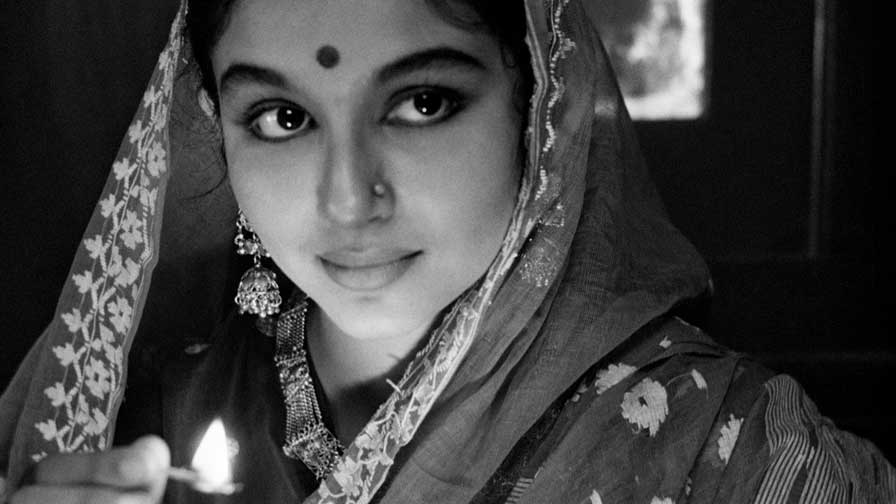
    For someone like Sharmila Tagore, who started off at the age of thirteen with a master ‘seer’ like Satyajit Ray as her mentor director, was guaranteed to have a long ride, rich and eventful. The ride was long, and eventful too, but in a hurry to finish that great length, it did not come to a halt to explore the treasure that lay on the wayside or within herself. When Sharmila Tagore first appeared as Aparna in Apur Sansar the intensity reflected in her eyes and facial contours indeed promised of a new beginning. Even without much speech—she mostly spoke in monosyllables, and rarely on her own—she brought forth the whole of a young bride, stepping into an unknown world, caught between the emotions of having to leave her parents on the one hand and the joy of being with Apu, her husband, on the other.

    But then, instead of finding her moorings in her own surroundings, she chose to respond to the calls from outside. And, in a twist of irony, when she was grafted into the highly commercialized and newly glamorized Bollywood, her speaking eyes became still and dumb and remained wide open all the while, forgetting to flutter and sparkle at life’s new experiences. Her face that had emoted many layered thoughts in a single moment, merely got cast into plastered masks. In Kashmir ki Kali she had no ‘role’ as such but to push around her shikara all over and lure away her lover, like the famous la belle dame sans merci, into frenzied twitching and gibbering (in pain or pleasure nobody knows). She meant to break the stereotypes all the while; but in movies such as Aradhana, Amar Prem, and Safar, for which she is mostly remembered, her directors dismally fell short of raising her above them, either in gestures or in speech delivery or a haunting consciousness of the camera gaze. In Mausam too her character set out to be unconventional, but the overall impact did not come out without the lingering question of art and artificiality.

    Namkeen, directed by Gulzar, to a great extent, brought back the freshness and naturalness of Sharmila Tagore the artist as Nimki, the eldest of three sisters in a remote mountain village. Sharmila is seen in one of her spontaneous best in her free and open postures and minimalist dress and make up. Surely, the raw landscape of mud walls and thatched roofs atop a rocky hill enhances this spontaneity, bringing alive all the nuances of her difficult situation in a seemingly uneventful life.

    In Shubho Mahurat, Sharmila plays the dubious Padmini Choudhury, an NRI producer who puts her money in a movie but does something diabolic. In this ‘enactment’ of an amoral character, every bit of Sharmila’s finesse as an actress comes out to the tip, even within the frame of a thriller—we certainly do not forget that it was adapted by Rituparno Ghosh from Agatha Christie’s The Mirror Crack’d from Side to Side; a cracked mirror being a metaphor for our fragmented selves or ‘schizophrenia’, a disorder in which a number of contradictory facets build up a single personality. In Padmini’s character, Sharmila brings out with her natural ease the hidden selves of a divided individual in whom success, wealth and fame are interlaced with hatred, jealousy, revenge and an inescapable sense of failure.

    In spite of all the overwhelming paradoxes in the illustrious career of Sharmila Tagore, given her talent, depth of personality and range of interests, we would have been happier to see the Sharmila magic burst and sizzle more vigorously like a never-ending cracker festival. We go about rapturously to call her the brightest jewel and the fairest of all faces like Orlando did in the forest of Arden for Rosalind, but we also wistfully reflect on what a difference it would have made had she walked with a halted pace to adore the hidden jewels.


  • Corona chokes Kannada Cinema’s cheerful climb

    Corona chokes Kannada Cinema’s cheerful climb

    It is nine months now since the curtains were called on a thriving Sandalwood industry that had to shut shop when Corona came calling.

    The pandemic has had the entire world under its virulent tentacles, spreading dread and death, virtually putting an end to public entertainment in its conventional and traditional sense; theatres and multiplexes shutting down for fear of the spread of the virus in community surges.

    Cancellations or postponements of film festivals and other film screenings were the order of the day while the world grappled with finding a quick off-the-shelf vaccine to check Corona in its stride.

    Soon, as months passed by, you have had “hybrid” forms of both digital and theatrical screenings of films being experimented with in the hope the enduring allure of movies would draw the entertainment opiated audiences back while lockdowns were lifted and ‘social distancing’ norms became the new standard operating procedures for public entertainment.

    While the film industry, the world over, grappled with the new Standard Operating Procedures by which they could bring the opiate of the masses to their neighbouring theatre screens, the Kannada film industry too had to face the harsh reality of the new Covid-carved script.

    Nearer home, not too long ago, you had the nerve centre of the Kannada film business—KG (Kempe Gowda) Road—bustling and teeming with die-hard and entertainment-seeking film buffs queuing up at the last vestiges of a handful of single screens that dotted its surroundings.

    Huge posters and cut-outs, traditional drums and percussion instruments and bursting of crackers, and dousing the cut-outs of favourite stars in milk, to sound the arrival of a new film at the theatre in all attendant fanfare were the fanboys’ way of greeting their reel gods.

    Even as each rising multiplex and mall sounded the death knell of the once upon a time pride of the Capital City Bengaluru, the single screens that purveyed ‘entertainment’ in multiple languages, thereby, acting as a unifying force of humanity, saw the arrival of Corona. In its wake, the very survival of the industry was put in jeopardy.

    From the month of March onward, you had the entire spectrum of the entertainment sector down shutters, as nations and governments grappled with the pandemic. Corona, like other epidemics and pandemics that have tested mankind’s resilience to fight the fatal diseases, has brought in a whole new lexicon of transaction by which the entertainment industry would conduct its business in future.

    Herein lies the nub of the problem that has put paid to Kannada Cinema’s otherwise unfettered stride in its over glorious 85-year chequered history.

    The Kannada film industry, in earlier times, was bogged down by the hegemony of other language films—in particular, Hindi films from Bollywood and English films from Hollywood; in addition to Tamil, Telugu, and Malayalam from its southern siblings; and on top of all this, Bengali and Marathi too.

    It recently started getting into its own rhythm and finding its feet. So much so that it had pipped the much-envied Hindi cinema to the top spot as the highest film- producing industry in India. More happily so, giving the likes of big budgeted Bahubali and the like competition a taste of its own medicine.

    The last decade had seen Kannada Cinema on a great trot churning out more than 300 plus films a year in regimental fashion, both nurturing content-driven films and action surcharged, larger-than-life character-dominated money-spinners.

    According to Karnataka Chalanachitra Academy Chairman Sunil Puranik, Sandalwood’s annual turnover was around Rs 1,000 – Rs 1,500 crore. In addition to films, it produced quite a number of television shows as well.

    You had Rocking Star Yash’s KGF: Chapter 1, Rakshit Shetty’s Avane Srimannarayana, Rishab Shetty’s Bell Bottom, Raj B Shetty’s Ondu Motteya Kathe, Raam Reddy’s Thithi, Rama Rama Re and the like ensure that the competitive film industry marquee sit up and take notice of Kannada Cinema. Bollywood, in fact, picked up a few to be remade in Hindi.

    The 85-year-old Kannada film industry, which was enjoying an unprecedented productive spell of late, was suddenly left reeling under the deathly impact of Covid and was served a “death warrant.” Corona struck like a lightening out of the blue just as the Kannada film industry started to expand its regional imprint. It ground to dust all the good work and brownie points that the Kannada film industry had achieved in the last few years, leaving it totally adrift and in dire straits with a bleak and uncertain future driving it back to the drawing boards.

    The situation seemed very reminiscent of the troublesome and traumatic 105 days that the Kannada film industry had voluntarily shut down following the kidnapping of Sandalwood’s father figure thespian Dr Rajkumar by dreaded sandalwood smuggler Veerappan. The industry began to re-function only after the much-revered Annavaru was returned back into their midst and normalcy was ensured at KG Road and all across the State.

    Today though you have the industry stakeholders sitting on the edge of the fence with their monies locked up, wondering whether to take that leap of faith and board the Over The Top (OTT) bandwagon or wait for further normalcy to return for single screen theatres to function. Meanwhile, the losses incurred with each passing day due to this indecision is mounting tremendously.

    Darshan starrer Robertt, Puneeth Rajkumar’s Yuvarathna, Yash’s KGF: Chapter 2, Kotigobba-3, and Salagaare some of the many such big ticket films waiting in the wings for a much more conducive milieu to return to ensure that die-hard fans will fall back to the theatres to watch their favourite stars in action.

    A noted Kannada film producer notes that the pandemic induced paralysis of the film industry seems like a death warrant handed to people like him. He dismissively states that it is a waste of time to speculate when a vaccine would provide the sliver of silver lining for the industry in deep freeze, and that if the current situation persists, only divine intervention can save the industry.

    As part of its structured lifting up of its lockdown policy, the Centre recently gave the green signal for single screen halls and multiplexes to open from October 15 with the rider of only 50 per cent capacity.

    Mansore of Nathicharami fame took the bold decision of testing the waters with the release of his latest visitation at the turnstiles, Act 1978, in cinema halls. It was the first South Indian film release in a theatre post lockdown. However, on the first day, only a few brave hearts were in attendance, the fear of Corona possibly at the back of their minds. It is to be seen how many like Mansore will bite the bullet of uncertainty and release their big ticket heavy-budgeted star-shouldering films in the single screens in these uncertain times.

    The director, however, exudes confidence that that this is the right time to release smaller films at theatres since there would be no big-budget films to steal the thunder. According to him if his film even runs to 50 per cent capacity for at least three weeks, he would be able to recover a part of the production costs. Additionally, the OTT platform is always available post a theatrical release.

    Presently 13 single-screen theatres and a host of 46 multiplex screens are soldiering on with this new gambit.

    The Sandalwood mandarins though had thought it better to wait than bite the bait and burn their fingers. Hence, the release of big budgeted, mega star movies have all been put on hold in the hope of a better morrow.

    This brings to mind what a character in the 1968 film 2001: A Space Odyssey states: “Don’t open the pod bay doors, HAL. We need social distancing.” It looks like the Kannada film stakeholders have pressed the pause button on film releases to ensure that they don’t suffer huge losses. The entire film industry is unanimously waiting for good times and normalcy to resume before they can breathe easy.

    Of course, the OTT platforms may be providing a window of opportunity for the industry with just a handful, such as Bhinna, Law, French Birayani and Mane Number 13, taking courage to release their film on the Internet and test the pulse of the audiences.

    Some have also taken to re-releasing their films on OTT platforms. However, the muted and not-at-all-encouraging reception has deterred others from sullying the fate of their ambitious projects for which they have invested humungous sums of money.

    With “Social Distancing” becoming the new lingua franca of human transaction in these pandemic times and the whole world trying to adjust itself to the new social order of entertainment consumption, disruption has become the new global order in the way films are purveyed to the entertainment-starved audiences.

    After a great gambol run, the Kannada film industry has been finally been zapped by an existential crisis. Compelled to press the ‘entertainment’ rethink button, it has been brought down on its knees, like the situation the world over.

    Like a bolt out of the blue, [highlight background=”#f79126″ color=”#ffffff”]the Kannada film industry is faced with a new surreal Sisyphean dilemma. After scripting and spinning sagas after sagas and having the entire humanity in its thrall, it is now stumped by the Corona nemesis whose cataclysmic repercussions has shaken and stirred its very survival.[/highlight]

    The life-altering Corona has sent shockwaves through the ‘entertainment’ industry, fitfully and fearfully left staring into an abyss of uncertainty working out its losses with no early succour in sight.

    The Kannada film industry has indeed been pushed into a state of self-introspection and quick calculus mode, with ‘Social Distancing’ becoming the new currency of public transaction.

    With people dreadful of contracting Corona, not wanting to venture into crowded theatre, these are indeed tough times for Sandalwood satraps whose huge sums have been bankrolled in films that are yet to see the light of the day.

    With masks and sanitisers as additional gears for safety, how these extra appendages and expenditures are going to affect the film-going habits of the diaspora and change the very dynamics of savouring the film watching experience is to be seen.

    Given that cinema is a collective experience, how the post-Corona world would pan out is very hard to hazard be it at the single screens or the plus multiplex theatres facing a bleak future despite all the safety SOPs in place.

    With no quick-fix solution in sight, the entertainment industry per se is left with questions and searching for answers itself despite governmental interventions for the revival of the industry and those that are dependent on it for their livelihoods.

    For now, though, the Kannada film industry can only find a sliver of hope and consolation in the words of film director Christopher Nolan, “When this crisis passes, the need for collective human engagement, the need to live and love and laugh and cry together, will be more powerful than ever.” (quoted from The Washington Post)

    In that sense, in hindsight, Corona seems to be a God Send, providing the entertainment industry such as the Kannada film industry, a chance to rethink, rejig and revisit its monumental mistakes and assumption that “this is what the audience wants” and go for a complete changeover in the way the ‘entertainment’ industry functions henceforth in the near future.

    With producers and exhibitors waiting for cinema halls to return to full capacity and consciously shunning the OTT platforms all hopes now lie with the early founding of a possible vaccine for normalcy to return.

    Amidst this pall of gloom and despair, however, an optimistic few still hold onto the eternal hope that once the challenge of Covid 19 is conquered with the arrival of vaccine, audiences currently gorging on Netflix, Amazon Prime and other OTT streaming platform sumptuous menu of movies, would certainly throng back to the theatres.

    The [highlight background=”#f79126″ color=”#ffffff”]OTT platforms have in hindsight ensured a new visual literacy to the audiences and it would be up to filmmakers from now on to match this new sensitivity and approach to cinema when they take to making films in future.[/highlight] For, the familiar olden-days dross of mundane masalas would no longer cut the ice with audiences wanting to experience cinema on the big screens.


  • SPB — Tenor Nonpareil

    SPB — Tenor Nonpareil

    Here once was a colossus cultural phenomenon nonpareil — SPB — a peerless performer par excellence whose magical, mellow voice saw legions of listeners drawn like bees to a honeycomb, as if a Pied Piper has cast a spell upon them to transport them to an Elysian world.

    Like many of his ilk in his time, he has left us with a memory of his humungous achievements in this mortal life—4,000 plus songs, spanning over a chequered career of 50 sing-sing prodigious years. Covid may have consumed the great SPB at the ripe, still-active age of 74, but his rich, luminous legacy shall live forever. His life he led less ordinary. Led by his self-belief motto: I love my life. If possible, I do not want to die. I have a passion for life.

    Indeed, if only the Almighty Creator was as gracious and benevolent enough, the rotund, ever infectiously smiling super singer would still be busy recording, hopping from one studio to another, or performing live; bringing sunshine into the lives of people, up, close and personal. But then, trust one to be unable to defy one’s own date with destiny. It is, and was, not to be. Virtually battling for over a month with the deathly Corona, the songster who soothed many a soul with his rapturous renditions finally gave in, leaving the music world, both in India and the world, in deep mourning.

    So, Sripathi Panditaradhyula Balasubrahmayam, known more so as simply SPB, or Balu, faded away into the horizon, after living a fulfilling, fulsome life nestling in the hearts every human being by the songs he sang, by the peace and quietude they brought into the lives of ordinary mortals.

    A musician, playback singer, television anchor, music director, actor, dubbing artist, film producer, and a roly-poly powerhouse, perfectionist songster, he was not just phenomenally versatile. [highlight background=”#f79126″ color=”#ffffff”]Tiaraed with a Padma Shri and a Padma Bhushan as crown jewels of an illustrious and fulfilling career, he was an iconic institution all by himself. [/highlight]

    SPB was a polyglot who had a flair and felicity for effortlessly rendering songs in 16 different languages. In addition to singing in the four major South Indian languages—Tamil, Telugu, Kannada, and Malayalam—SPB was also a virtuoso in Hindi, a terrain that even the likes of the exalted Kamal Haasan has not been able to conquer.

    And [highlight background=”#f79126″ color=”#ffffff”]records were like second nature for SPB, be it the Guinness Book of World Records for his 40,000 songs, or the coveted six National Film Awards for Best Male Playback Singer, or the recording of 21 songs in Kannada for composer Upendra Kumar from 9 am to 9 pm, or the 19 songs in Tamil and 16 songs in Hindi that he recorded on a single day.[/highlight]

    Of course, his dad being SP Sambamurthy, a Harikatha artist, it was only to be expected that this lad from a Telugu Brahmin family from Nellore, the erstwhile Madras Presidency, would take the trail less trodden and not the traditional ones of an engineer or a doctor or such other academic led careers.

    Despite enrolling himself in an engineering college, he gave it up, stricken by typhoid as well as total disinterest. The call of music was strong in the impressionable boy, so he pursued the study of musical notations, and very soon, while still a youth, he began his long and successful journey of winning music awards, one after the other.

    The decisive turn came in 1964 when he bagged the top prize at a music competition for amateurs as a leader of a light music troupe with an upstart/undiscovered Ilaiyaraaja as his chief guitar and harmonium accompanist. At his debut audition, SPB rendered Nilave Ennidam Nerungadhe, a song of his peer, a contemporary and equally-erudite crooner, PB Srinivas, who was more in the mould of Manna Dey and Mohammad Rafi.

    SPB doing a duet with KS Chithra
    SPB duet with KS Chithra. Photo courtesy: Jayanthjwala

    Brilliant with his boggling range of eclectic expressions and enthralling cadence that music directors expected of him and sought him for, he lit up the musical world, sticking true to the destined philosophy “I planned to be an engineer. Then music turned the course of my life. I realised not to plan and let things play out for me.” That was SPB.

    SPB made his debut with Sri Sri Sri Maryada Ramanna (1966), a Telugu film. Eight days after that first recording, he sang for a Kannada film. However, it was the 1980 Telugu film Sankarabharanam and his classical Carnatic rendition of the songs that pitchforked him into the big league. Despite not being classically trained, SPB’s impeccable aesthetic music sense and renditions fetched him his first of four National Film Awards for Best Male Playback Singer.

    For the Carnatic-oriented songs in Saagara Sangamam (1983) and Rudraveena (1988), Ilaiyaraaja and him won the National Film Awards for Best Music Director and Best Male Playback Singer, respectively. SPB was a super success in the cinema of Hindi too. He received a National Award for Best Playback Singer for Ek Duuje Ke Liye.

    In 1989, he became the singing voice of the young-as-a-yuppie upstart Salman Khanin Maine Pyar Kiya. In 1994, his rendition for Didi Tera Devar Deewana in Hum Aapke Hain Koun..! turned him into the Dil Deewana for the audiences of the North of the Vindhayas, firmly cementing his place in Mumbai as well as the recess of India’s cow belt. Indeed, [highlight background=”#f79126″ color=”#ffffff”]SPB became the offscreen voice of the bad boy of Bollywood in the same manner as his equally ersatz senior Kishore Kumar had earlier become Rajesh Khanna’s singing alter ego.[/highlight]

    AR Rahman’s score in Mani Ratnam’s Roja ensured SPB would be sought after if his alto voice was required to niftily render the soothing lyrics in all its nuances and notes.

    As if playback singing was not enough proof of his virtuousness, you had the legend lending his voice to Kamal Haasan, Rajinikanth, Vishnuvardhan, Salman Khan, K Bhagyaraj, Mohan, Anil Kapoor, Girish Karnad, Gemini Ganesan, Arjun Sarja, Nagesh, Karthik, and Raghuvaran in as many languages as they acted in, proving that dubbing too came as easily as singing a song in the studio or in front of a packed auditoriums the world over.

    A prodigious, youthful and zestful singer blessed with that rare artistry in several languages, his evergreen songs that embellished the Indian movie marquee for half a century has left a treasure trove of glistening gems, such as Aayiram Nilavae Vaa for MGR in Adimaippenn, Iyarkai Ennum Ilaya Kanni for Gemini Ganesan in Shanti Nilayam, Tere Mere Beech Mein Kaisa Ye Bandhan  for Kamal Haasan in Ek Duuje Ke Liye,  Pehla Pyar Hai for Salman Khan in Hum Aaapke Hain Kaun,  and Dorakuna Ituyanti Seva and Saamaja Varagamana for JV Somayajulu in Shankarabharanam.

    With a mirthful, mischievous laugh here, and an angst-ridden sigh there, playful, and pert, [highlight background=”#f79126″ color=”#ffffff”]SPB has lent a uniqueness to his repertoire,  rendering songs that are an inseparable part of the common man’s everyday lives.[/highlight]

    The words of the Bard of Avon William Shakespeare, “All the world’s a stage… And one man in his time plays many parts” ring so true for SPB. The velvety voice with its multifarious mellifluousness that brought meaning to our existence will never be stilled. Like many of the other greats before him whose works still resonate and reside with us, quite many of the innumerable songs of this gentle genius genie have become a part of our collective conscience and shall for a very long time becalm and be a balm to soothe the void.


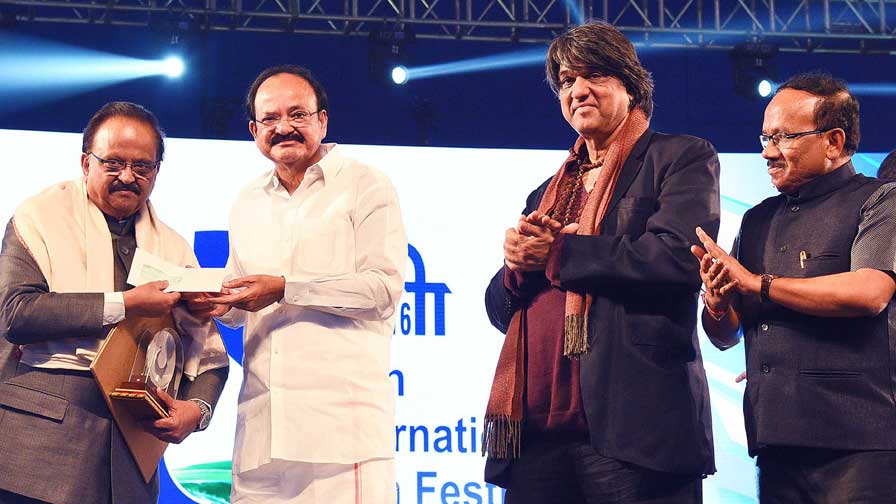
    Header pic: The then-Union Minister Shri M. Venkaiah Naidu presents the centenary award to SPB at IFFI-2016. Also seen is Shri Laxmikant Parsekar & Shri Mukesh Khanna, CM of Goa, & Chairman of the Children’s Film Society of India, respectively, in 2016. Source: PIB


  • Aparna Sen — A River Plunging into its Own Depths

    Aparna Sen — A River Plunging into its Own Depths

    Aparna Sen

    Where the bee sucks,
    There suck I;
    In a cowslip’s bell I lie;
    There I couch when owls do cry;
    On the Bat’s back I do fly
    After summer merrily.
    Merrily , merrily shall I live now,
    Under the blossom
    That hangs on the bough.

    -The Tempest, Act V, Scene I


    With all her vivacity and volatility, Aparna Sen can be very challenging as a subject. For it is actually difficult to catch her in a single mood, even while she sits for a discourse on a serious issue. She is always playful, always coming up with a surplus of ideas, and an endless string of ‘ands’, and almost never for any ‘either or’. If at all Aparna Sen can be perceived or defined in a single term, it has to be briskness. [highlight background=”#f79126″ color=”#ffffff”]With her fleeting gestures, twinkling glances and smiling lips, she hardly ever settles for a single mood. And by the time one tries to catch her mood, the next moment it is replaced by something else, which is constantly passing like the incessantly flowing river into which one cannot step twice.[/highlight] Or, like that eternal stream of moments ceaselessly becoming an ‘already’.

    Rare pic of Aparna Sen

    It is for this briskness that she is best embodied by the little squirrel Chorky — her companion in her first screen appearance as the mischievous teenager in Teen Kanya (1961). No wonder. It was Satyajit Ray, the master ‘seer’, who could feel the exact vibes of that swiftness; indeed, who else could have done that?

    But it isn’t just in terms of its gushing, linear movement, but also in its bottomless depths that Aparna Sen is exactly like a river; it is a river that is still thirsty and has set out to quench its thirst plunging into its own profundity. This river also comes up with the idea of the beyond, that is, the unseen part of the other bank, which always enchants people. For Aparna Sen isn’t simply extraordinarily beautiful, but something way beyond such; she isn’t simply outstandingly intelligent, but something way more. In her sharp features and elegant appearance, she literally embodies a classic exquisiteness.

    [highlight background=”#f79126″ color=”#ffffff”]In her multiplicity of roles as the scriptwriter, director and actor, Aparna Sen apparently resembles Prospero, the Duke of Milan, the magician, the creator and controller of events and at the same time, very much a part of those events. But, in essence, she is more akin to Ariel, the spirit of the air.[/highlight] For it is only Ariel, who sayeth ‘Before you can say “come” and “go”/ And breathe twice and cry “so so”’ in Shakespeare’s The Tempest, who can assure us of that quaintness and softness of action.

    In spite of all these attributes, she never demands deification, but only simple praise and admiration. This prevents her creations from being incredible or magical. With a perfect combination of subject matter, story and cast, whatever she creates always remains credible, grounded, and all too humane, an approach adopted only by a handful of master creators.

    Aparna Sen’s portraiture of two claustrophobic middle-aged housewives in Parama (1985) and Paromitar Ek Din (2000), marks this humane approach. Parama’s character (played by Rahkhi Gulzar) shows that being human means frailty, desire and failure as much as it means strength, austerity and success. The sudden appearance of Rahul in her life makes her yearn to live life on her own terms, refusing to be no longer assured by the fake domestic security. The film is by no means an attack on domesticity; it is only Parama who feels like stepping out of its monotonous circularity. Unfortunately, she becomes a little too wayward to return and fit into that circle again. Meeting Rahul is like remembering her lost youth. She wistfully tries to compensate for something she could not make the most of. But it is too late for her to realize that, like Rahul, her youth too is gone forever!

    Aparna Sen at a Press conference

    In Paromitar Ek Din, Aparna Sen is in her directorial and performer’s best as Sanaka, an unhappy, deprived housewife of a middle class family. She is surrounded all the time by her big joint family, but prefers to isolate herself from its mundane demands, and finds her mental escape in the tiny images of the small frame of the television box. Her mind is always moored in a ‘somewhere else’ and this she confesses to her daughter-in-law Paromita; she confides to her that if her former lover had asked her even once, she would readily have run away with him, leaving everything behind — her husband, children, everything. Sanaka’s reaction over the news of her husband’s death and her childlike joy of kite flying are some staple moments that we go back to, over and over again. Or, can we ever forget the dejected Violet Stoneham walking home alone, or lovesick Snehamay writing letters to his beloved far away in Japan? Whether in the overt handling of the theme of communal violence, the subtle politics of everyday life, the hilarity of family drama, or the delicate nuances of female friendship, Aparna Sen is second to none.

    [highlight background=”#f79126″ color=”#ffffff”]Aparna Sen is an example of how a woman can make bold statements about life and living by always remaining warm, tender and empathetic to others, preserving every feminine grace and charm and never ever being rude and aggressive.[/highlight] Her political stand is always very clear and both as a person and a professional she refuses to be presented by someone else’s vision. This is the reason why she switched over from acting to scriptwriting and directing. She has her own stories to tell and she tells them so intriguingly, leaving no loose strands to hang clumsily here and there. She is always driven by her own instincts and beliefs and never takes the audience for granted. Even as she turns seventy-five, she still remains the sprightly teenager that she had enacted sixty years before — never trying to surprise her audience with feeble twists, but always answering their pleasure exactly like ‘dainty’ Ariel, “be’t to fly, to swim, to dive into the fire, to ride on the curled clouds.”


    Awards
    Aparna Sen is the recipient of the Padma Shri as well as 9 National Film Awards.

    Photo credits
    Header pic of Aparna Sen on the sets, by Prem Prakash Modi
    Aparna Sen at Kolkata by Biswarup Ganguly
    Rare pic of Aparna Sen by Benu Banerjee
    Aparna Sen at The Japanese Wife press meeting by Bollywood Hungama


  • Muzaffar Ali — Opulent Decadence

    Muzaffar Ali — Opulent Decadence

    When renowned poet Faiz Ahmed Faiz watched Gaman (1978), he was overcome by so many emotions that it was nearly impossible not to say anything about it. He wrote a letter to Muzaffar Ali, the 34 year-old adman who had directed the film. Faiz wrote, “Gaman is a poem in visuals. Its tragic lyricism and muted eloquence is deeply perceptive. It is a sensitively conceived and truthfully captured slice of reality around us, the beauty and the heartbreak of the human situation makes it a sheer delight, a veritable tour de force.”

    Mumbai is the Indian version of the American Dream. The proverbial land of opportunities, where thousands converge every year in search of livelihood and a better life. By the mid-19th century, Bombay had become one of India’s most significant ports and trading hubs, which attracted a significant number of migrants from different parts of the world. In 1947, during Independence, more than 50% of Bombay’s population comprised of migrants. For those uprooting themselves from their homes in other states, it represented an erosion of their own societies. In Gaman, Ghulam Hassan (Farooq Sheikh) leaves his wife Khairun (Smita Patil) and his mother back in the village, and lands up in Bombay at the insistence of his friend Lallulal Tiwari (Jalal Agha), who was already pursuing his dreams in the city. The film chronicles the lives of migrants from Lakhimpur Kheri, Muzaffar Ali’s own backyard.

    Rajah Muzaffar Ali of the Royal Muslim Rajput family of Kotwara. oocities.org

    Muzaffar Ali grew up in the UP township of Lakhimpur Kheri, and the culture of Awadh, along with the age-old tradition of Ganga-Jamuni Tehzeeb deeply fascinated him. While studying at Aligrah Muslim University, this fascination only got deeper and richer. He was influenced by the poetry of revered Urdu poets like Dr. Rahi Masoom Reza, Shahryar, Ali Rahman Azmi, Makhdoom Mohiuddin, and Faiz Ahmed Faiz. These poets at the turn of the century were concerned with a breakdown of what they referred to as “Muaashra”, a construct that is representative of a way of life — the closest English equivalent is ’society’. While consuming their verbiage at an impressionable age, Muzaffar shared their worries about erosion of this way of life. But eventually when his career brought him to the bustling metropolis of Bombay, it was finally clear to him what all this was leading towards. Scores of migrant labourers flocked to the city, disillusioned by rising unemployment in their hometowns. This nudged him in the direction of his first film, Gaman, in which he chronicled the migrant experience. Muzaffar’s Ghulam Hassan finds himself trapped inside the massive belly of the all-encompassing metropolis, finally earning a living but unsure whether he’d be able to leave the city even if he wanted. The City of Dreams had devoured him whole, as evinced by these lines by Shahryar:

    Seene mein jalan, aankhon mein toofan sa kyon hai

    Iss shahar mein har shaks pareshaan sa kyon hai

    Tanhayi ki yeh kaun si manzil hai, rafeekon

    Ta-hadd-e-nazar ek bayabaan sa kyon hai

    (What is this burning inside the chest…

    What is this fire in the eyes…

    Why is every person in this city so distressed?

    How lonely is this place, friends,

    That it’s wilderness as far as the eye can see?)

    One film that weaves both his obsessions — poetry and the Awadhi culture — into an elegant bundle of storytelling — is Umrao Jaan, Muzaffar Ali’s magnum opus.

    Mirza Hadi Ruswa, a man literally born at the cusp of history, in 1857, produced an abundance of Urdu pulp fiction, had a whirlwind affair with a Frenchwoman named Sophia Augustine, got his heart broken, and carried on amorous adventures with the courtesans of Lucknow. But the man would be known in history for a novel that he insisted was inspired from personal experience, Umrao Jaan Ada. According to Ruswa, an ageing Umrao Jaan herself narrated her life story to him. Sometime in the 70s, Muzaffar Ali, a young advertising executive and budding filmmaker, happened upon the book, which painted a picture of decadence, the last breath of Awadh’s opulence, lyricism and debauchery. Muzaffar recorded the whole book on an audiocassette and listened to it in his car every day. There were moments in the story that he seemed to have experienced in his own life. The resonance was uncanny, and he felt these ‘moments’ could be recreated on film.

    Rekha in Muzaffar Ali’s Umrao Jaan

    Spotting Rekha — her face and her eyes — on the cover of a magazine, sealed it for Muzaffar that she should be his Umrao. Poet Shahryar was flown in from Aligarh, and Muzaffar Ali hosted him in his own house at Juhu. Music director Khayyam too stayed just around the corner. They sat together for hours, trying to weave the poetry that became the soul of Umrao Jaan. It took them about a year and a half to compose all the songs. Khayyam himself researched extensively on the raagas and singing styles of the 19th century which the courtesans of Lucknow regaled their patrons with. Much like Ghulam Hassan, who had to leave his village to come to an alien Bombay, Amiran is forced to leave her home and end up in a city of boundless exploitation, soul-stirring poetry, exquisite beauty and a promise of love that’s never quite realised. This uprooting was just as painful and Amiran somehow finds it in herself to transform into Umrao Jaan, the queen of a thousand hearts. But unlike Ghulam Hassan from Gaman, she is able to express herself through her art. Shahryar reimagines this soulful quest through the dazzling ghazals encapsulated in the film, with Asha Bhsole breaking form to venture into a domain she had never quite tried before. Rekha completely internalised the alienation, the pain and ultimately the redemption of Umrao Jaan. It had a stellar cast of spectacular actors, all in the prime of their careers: Naseeruddin Shah, Farooq Sheikh, and Raj Babbar. Umrao Jaan swept the National Film Awards and Filmfare Awards announced next year.

    After Umrao Jaan, Muzaffar Ali continued exploring themes of alienation and breaking down of communities. Aagaman (1982) is an antithesis to Gaman in the sense that one of its protagonists, Mohan (Suresh Oberoi), comes back to the village after being educated in the city, and tries to unite sugarcane farmers so their exploitation by the mill-owners can stop. The film introduced a talented young actor by the name of Anupam Kher, who played Mohan’s father Ramprasad. With Anjuman (1986), Muzaffar Ali went back to old Lucknow and the erosion of old-world values. And like migrants in Gaman, courtesans in Umrao Jaan, sugarcane farmers in Aagaman, Muzaffar Ali adopted the milieu of chikankaari artisans of Lucknow.

    In the 80s, many trips to Kashmir endeared Muzaffar to the concept of Sufism and Sufi philosophy. Intrigued by the enigmatic Kashmiri poetess from the 17th century called Habba Khatun, he mounted his dream project Zooni on an epic scale. Dimple Kapadia was cast in the titular role, and Vinod Khanna in a role opposite her. Dimple and Vinod had just returned from their respective sabbaticals and their casting caused plenty of media attention. But Muzaffar’s lofty vision for the film, his perfectionism, insurgency in Kashmir, lackadaisical attitude of the government and similar logistical challenges kept stalling the project. Muzaffar Ali kept trying to revive the film till as late as 1997, but to no avail. His dream remains unfulfilled, much like his muse Umrao Jaan Ada, who lamented,

    Justajoo jiski thhi, usko toh na paaya humne

    Iss bahaane se magar dekh li duniya humne

    Tujhko ruswa na kiya, khud bhi pashemaan na huye

    Ishq ki rasm ko iss tarha nibhaaya humne

    (I could not get the one I coveted

    But I did find what the world was all about

    I neither dishonoured you, nor shamed myself

    And thus did I fulfil the demands of Love)


  • Dev Anand — Yesterday was Another Day

    Dev Anand — Yesterday was Another Day

    Dev Anand was Dorian Gray, Peter Pan and matinee idol all rolled into one. There may only be a handful of actors or filmmakers anywhere in the world whose career spanned 7 decades. Dev Saab, as he is still remembered, was one of the most pos­itive persons I have ever met. His effervescent charm, his enthusiasm and his optimism were contagious. I met him when I was in college in Delhi in 1969 and at the end of that fortuitous meeting I had made up my mind that film was the career option for me. Dev Saab not only facilitated my entry but became a mentor. I was merely one of many people who owe their career to him.

    Lyricist and production executive Amit Khanna with Tina Munim (Tina Ambani) and Dev Anand at the premiere of film ‘Lootmar’. (Source: Express archive photo on 17.10.1980)

    Dev Anand came to Mumbai in 1944 with a graduate degree, a bagful of dreams and a charming smile. His first job was at the office of the Government’s censor department, where he read letters from soldiers to their families back home. However, he was clear that his future lay on the silver screen. His older brother, meanwhile, was nursing his own dreams, even as he worked elsewhere, at BBC and Doon School, before landing in Mumbai to pursue his own celluloid dreams. Chetan the more cerebral of the two had links with the left cultural movement and both brothers briefly got involved with the Indian People’s Theatre Association (IPTA). Dev Anand however kept studio hopping until he attracted the eye of DN Pai, one of the founders of the legendary Prabhat Studio in Pune. Dev Anand was immediately signed as an actor and made his debut in PL Santoshi’s Hum Ek Hain (1946), a film in which director Guru Dutt worked as an assistant. The duo would go on to forge an enduring friendship. After a few hiccups, Dev Anand, starring opposite Kamini Kaushal, got his first hit via Ashok Kumar in Bombay Talkies’ Ziddi (1948), written by Ismat Chugtai and directed by Shaeed Latif. Incidentally this film marked the debut of Kishore Kumar as a singer under composer Khemchand Prakash. The film turned out to be a hit. Dev Anand the star had arrived.

    Vijay Anand, Dev Anand, and Amit Khanna. (Source: Silhouette)

    In 1949, he set up his production house, Navketan, with his elder brother, Chetan (Dev Anand would leave in a few years and his place would be taken up by his younger brother, Vijay). Chetan had by then made the richly-acclaimed film Neecha Nagar, which had won the Grand Prix at the first Cannes Film Festival in 1946, sharing the prize with David Lean’s Brief Encounter. Navketan, fueled by the money Dev Anand the actor earned working outside, got its first hit in 1950 with Guru Dutt’s debut film Baazi (1951). Navketan by then, along with RK Films, was to become an important institution in modern Indian Cinema; both lasted for decades. Navketan would become a nursery of talent. Guru Dutt, SD Burman, Ustad Ali Akbar Khan, Raj Khosla, Vijay Anand, Sahir Ludhianvi, Jaidev, Johnny Walker, Biren Naug, Yash Johar, and later Neeraj, Shatrughan Sinha, Zeenat Aman, Zahida, Tina Munim, Jackie Shroff, Richa Sharma, Tabu and many others would spring from this creative garden. Navketan has made over 40 films, of which Baazi, Taxi Driver, Kala Pani, Kala Bazar, Hum Dono, Guide, Tere Ghar Ke Samne, Prem Pujari, Hare Rama Hare Krishna and Des Pardes are considered landmark films. Over 100 well-known filmmakers, writers, and technicians were nurtured at Navketan.

    Dev Anand remained active till his last breath. His later films may not have met with success but his zest for life, his passion for cinema and his keen eye to hunt talent remained alive and kicking.  Among all his contemporaries his films still remain on the rerun circuit on TV and the internet. Songs from Navketan Films are still hummed by five generations. In my long association with him I have seen him at music sessions with composers like SD Burman, RD Burman, Laxmikant Pyarelal, Rajesh Roshan, Bappi Lahiri and others. He also had the pulse to pick the right melody and poetry. He followed global trends and while abroad would visit all kinds of concerts, stage performances and museums. [highlight background=”#f79126″ color=”#ffffff”]Dev Anand was also that rare star in India who replied to letters and answered phone calls. He loved eating but was largely a frugal eater. However, contrary to popular perception, he did not follow a strict diet or exercise regime. He just took care of his body and mind.[/highlight] He had a special affinity for mountains and never missed an opportunity to shoot at different mountain locations in India and abroad.

    Not many people are aware that Dev Anand was a truly renaissance man. From his early days he befriended writers like Agyei, Pearl S Buck, Raja Rao, Manohar Malgaonkar, KA Abbas, Somerset Maugham, Irving Stone, Ismat Chugtai, Kamleshwar, and Kamala Das. Kailash Vajpayee once talked about his meetings with Manto. In the early days of Navketan, classical musicians like Ustad Ali Akbar Khan, Pandit Ravi Shankar, Pannalal Ghosh, Samta Prasad, Alla Rakha, and Halim Jaffer Khan played in his songs. He had hosted eminent directors like Frank Capra and Michelangelo Antonioni, and actors like Shirley MacLaine and Martin Sheen. He had visited the Cannes, Berlin and Moscow film festivals. He was an avid reader, and had a large collection of books on different subjects. He was also a patron of the arts. He was fond of travelling and his films often featured unusual locations both at home and abroad.

    Dev Anand the actor also stands out in several films especially early in his career. In fact, [highlight background=”#f79126″ color=”#ffffff”]Dev Anand was the first major star and producer to make noir cinema in India.[/highlight] Films like Baazi, Taxi Driver, House No 44, and Kala Bazar are some of them. His performances in Ferryman, Nao Do Gyarah, Baarish, Paying Guest, Asli Naqli, Hum Dono, Tere Ghar Ke Samne and of course Guide stand out. He always encouraged young talent. Countless artistes, technicians, writers and directors from Navketan went on to make hugely successful careers.

    Unfortunately, towards the last part of his career, he became self-indulgent and his choice of stories was questionable. My sense is that if he had directed films on others’ screenplays, he would have made far better films. His command over the medium and his craft was good. Only his writing was mediocre.

    Drawing by Saurabh Turakhia

    A lot of us who interacted with him will always remember him with warmth. From kings and prime ministers—He had interacted with almost all the Indian leaders as well as several foreign heads of states—to the next-door neighbors, everyone has only good things to say about Dev Saab. He never spoke ill of any of his colleagues—He spoke fondly of Guru Dutt, Raj Kapoor, Nargis, Dilip Kumar, Madhubala, Nutan and all his costars—or others. His cinema will live on for generations. He was a rare gentleman who was made of the stuff that dreams are made.

  • Mysskin — Missing the forest for the trees

    Mysskin — Missing the forest for the trees

    A perspective peek at the nonet of films that have pitchforked Mysskin into the exalted realm of Kollywood’s cinematic sense


    Straddling the Kollywood movie marquee in the last dozen plus years like a lodestar among his peers, Tamil film director Mysskin, nee Shanmugha Raja, since his trailblazing debut in 2006 with Chithiram Pesuthadi, has been the toast of elitist and eclectic film critics, especially in Tamil Nadu. So much so, he has been [highlight background=”#f79126″ color=”#ffffff”]valorised as a shrewd filmmaker whose films carry a certain idiom of visual expression to his narratives, of which much has been written about in eulogising terms. Given that they take an academic approach to film criticism glossing over the film’s otherwise mundane and banal reality.[/highlight]

    Sure enough, basking in this newfound fame of critics’ fascination with his films, you have had the director unabashedly flaunting his erudition and education on cinema, from its aesthetics to its functionality, and naming the choicest celebrated auteurs who have influenced his appreciation and understanding of the craft, which “finds visual expression” in his own films.

    Born Shanmugha Raja, he went on to baptise himself professionally as Mysskin—much inspired by Prince Myshkin, the protagonist in Russian novelist Fyodor Dostoevsky’s celebrated classic novel The Idiot.

    His low budget directorial debut Chithiram Pesudhadi coveted critical appreciation for his unique narrative style and mise en scene, while Anjathey, his sophomore essay, catapulted him into the big league of the Kollywood film industry, making him a name to watch out for with awe. His subsequent forays have brought him much appreciation and accolades for his visual style and directorial acumen. Additionally, [highlight background=”#f79126″ color=”#ffffff”]Mysskin has been hailed as one of the trendsetters of contemporary Tamil cinema, changing its otherwise accepted staid image of rolling out familiar flicks in an assembly line fashion.[/highlight]

    Given his favourite subjects—his protagonists, caught on the wrong side of the law, are violent and bloody thirsty in nature—his films have also been termed as dark, dismal and dreary.

    In a Masterclass on Film Appreciation with film critic Baradwaj Rangan, you have Mysskin profoundly stating, “Cinema acts as a therapy when any good story is properly told. It also acts as a metaphor.”  Citing Robert Bresson’s A Man Escaped and Akira Kurosawa’s Seven Samurai, among the films that have greatly influenced him, Mysskin eulogises, “Simplicity is the hallmark of a classic.” He goes on to say, “ If Leo Tolstoy and Fyodor Dostoevsky were alive today, they would be making films.”

    In another interview, justifying the excessive, and graphic, violence in his latest film, Psycho, Mysskin says, “All sincere stories have death. All sincere stories have murders. All sincere stories are full of evil.”  Further, the director has no qualms about blatantly justifying stalking as a means of expressing one’s love to another. “I like my protagonists to be like lightening. Their unpredictability creates an interest in my audience.”

    If only one could fulsomely agree with Mysskin’s idea of cinema and appreciate his approach to film making, which is quite the contrarian to the classics and the masters of cinema and their influences that he so effusively cites in interview after interview!

    Of the nine films in his repertoire so far, nearly four of them virtually run on the time-tested template of most violent and virulent bloodletting, be it his very first foray, Chithiram Pesuthadi, wherein you have the protagonist turn hit man to stave off his debtors, or Anjathey, where you have the reckless hero indulging in violent tiffs, before turning into a new leaf to wear khaki. Thereafter, in Yuddam Sei you have a trail of bloody bodies as a CID officer embarks on a mission to trace his missing sister. Mugamoodi, inspired by various comic book heroes, has the hero chasing criminals who leave a trail of dead bodies.

    And not to discount his latest and most obnoxious, Psycho, whose serial killer hero systematically severs heads of females leaving their decapitated bodies in the open for the police to find.

    However, his Nandalala, incidentally inspired by Takeshi Kitano’s Kikujiro, is surprisingly sublime and sedate, marking a clear departure from his violent preoccupation. Other equally enterprising ensembles that provide a saner, subtler and much appreciable side of Mysskin are Onaayum Aattukkuttiyum, Pisasu and Thupparivaalan—the last being an ode to Sherlock Holmes and his Baker Street irregulars.

    If Onaayum Aattukkuttiyum provides a comedic but realistic portrayal of how good Samaritans end up being culprits for having done a good deed of saving a dying man on the street, Pisasu with its ghost thriller angle spotlights on various social issues.

    Otherwise, you have Mysskin faithfully following in the footsteps of Asian directors such as Takeshi Kitano, Kim Ki Duk, Park Chan-wook, and Miike Takashi known for their bloody, gut-wrenching violent portrayals, and American director Quentin Tarantino known for his macabre violent films full of blood, guts, and gore.

    It is understandable and somewhat acceptable that film directors such as Mysskin resort to stark depiction of visual violence as mise en scène acting as a crucible for social commentary on marginal lives ostracised by social opprobrium and driven by circumstances. However, one is unable to digest the fact that where subtlety and nuanced narration and suggestive visuals could effectively convey the angst and anxiety of these fringe people, Mysskin prefers distasteful and disgusting visualisation of violence to evoke empathy towards the victims. According to him, these persons, who come across as violent, if showered with affection, love and care, which job is conveniently left to female protagonists, change, and are otherwise benign souls but for mitigating circumstances.

    It is at this juncture, one would hazard to state, that [highlight background=”#f79126″ color=”#ffffff”]cinema, given its overarching influence on susceptible and impressionable minds, needs certain modicum of sanctity. A certain ethical sense of sensitivity. An iota of sanitation. A dose of subtlety and sensitisation. Above all, certain aesthetics whose narrative does not cross the Rubicon of excessiveness to achieve its larger social and moralistic purpose.[/highlight]

    For, cinema is a collective experience. The visual images received and assimilated in the receptacle of the darkened theatre is subconsciously internalised into an individual’s own moral and ethical dispositions and the cultural moorings that they have evolved from. The majority of these audiences are unable to differentiate between reel depictions and the harsh reality of their own everyday existence.

    That being the case, it indeed becomes incumbent and imperative upon a film maker to realise his immense responsibility and ethical duty towards civil society and the disparate audiences that come to watch his films drawn by the media-created halo, and to ensure that his films do not corrupt the gullible or vitiate the discerning and more cinema literate viewers’ sensibilities.

    Given that each person carries his/her own individual experience and understanding from the visual narrative they have been relentless bombarded with for the nearly three-hour-plus running time of the film—most of Mysskin’s films are that long—it becomes imperative that the film does not leave a bitter aftertaste.

    Mysskin on the setsMysskin may argue that his foregrounding of gut-wrenching violence is to specifically critique the social inequalities and the disenchantment that his protagonists find themselves in, in the world around them, and speak of the trauma of societal alienation, and therefore, in response, brutally lash out. But it is a given fact that, unlike in a majority of narrative cinema, the characters’ violent actions do not necessarily lead to “empathetic” resolution.

    Instead, as researchers note, violence only creates a recursive loop, as is evidenced in the brutal killings, rapes and other forms of real-life violent incidents that one sees in real society today.

    Instead of being a cathartic experience, the brutal cinemas of directors who push the representation of violence to its point of acme, repeatedly, using it as a justified means to legitimate ends, has only triggered a wave of such formulaic films to cash in on its success.

    By their celebration of violence in the most stylistic fashion, such as in Mysskin’s Psycho, they become counter-productive to their intended objective, leading to misplaced formulations of masculinity, driven by the viewer’s sense of self-esteem and personal identity injured and defeated by social injustices.

    Violent depictions of this sort only catalyse and instigate the minds of susceptible and vulnerable audiences to mimic their theatrical experience in their own real existence as a form of valorous requirement, justifying their acts that run contrary to the very ethos of normal, law abiding, socially obligatory living.

    It is here that Mysskin’s handful of films and his central motif of taming the violent brute in the form of an understanding, all-sacrificing female principle is contrarian to his own assimilated views on cinema, given his exhaustive reading and learnings about films and film making and cinema as an art form.

    One would like to suggest that Mysskin works on the rather indulgent self-belief that the majority of the audiences who grace his films seeking “entertainment” would also be erudite enough to read the metaphors, symbolisms and allegories and appreciate the fine craft of cinematic excellence that he is trying to bring from his own knowledge and education.

    [highlight background=”#f79126″ color=”#ffffff”]Unfortunately, these “cinema illiterate” as well as “poorly literate” masses who indulge in such “escapist entertainment” to rid themselves of their diurnal worries and problems, wistfully cheer at the goings on, being lost in the world of make-believe, unlike erudite critics who seek to gloss over the film’s inherent dangers at the peripheral level and its construct of images[/highlight], perforce, mandatorily mimic it in real life, being overawed by its enticing allurement to uplift themselves from their own station in society and living conditions.

    The larger and purposefully intended motif and metaphors of Mysskin’s films are simply lost in the high decibel volatile action and explicit execution, and thereby, fails the very idea of cinema that Mysskin venerates and espouses but himself shirks to take up. His mind weighed heavily by the commercial dynamics of a film’s destiny at the box office and the purse strings of the producers rather than aesthete aspects, Mysskin’s films end up striking a discordant, disquieting note.

    Gainsay, one could accede to a more pedantic and popular academic /theoretical approach that each of the actions has been specifically designed to convey a certain metaphor or to allegorise on the state of mind to the spectator. As to how much of these are meaningfully assimilated by the viewers who come primarily for “time-pass” and “entertainment” and become inured so as to eschew it themselves in their own real life, though, is rather moot.

    For, instances have been cited by police and investigative agencies of crimes committed in real life wherein culprits have confessed to being inspired by depictions of brutal graphic mutilations, including severed heads, in mainstream films such as Mysskin’s Psycho.

    Mysskin’s arguments, as he depicts through his heroines, who, invariably, fall in love or are forced to fall in love and be empathetic with the troubled protagonists, and through their love, care, affection and understanding will reform, is just a fallacious one, as social realistic bespeak otherwise, much as directors may try to dismiss them as being a result of their cinemas.

    While [highlight background=”#f79126″ color=”#ffffff”]films of the genre of Mysskin’s may make handsome material for contemporary critical discourses on flawed individuals and society at large, raising false hopes of acceptance of judiciously unpardonable crimes committed by the protagonist who in real life has to pay the price for such heinous acts, in reality they cannot be so easily dismissed and one needs to take a very strong stand against such films, the nature of their on-screen violence, and the absurd play of narratives that they bring into their equally trite and mundane tales.[/highlight]

    It is an undeniable fact that films with violence have come to sadly represent a growing trend in the booming film industry of India. Take the case of Anurag Kashyap and his ilk whose every second film turn out to be a celebration of violence and machismo in its most depressing regularity. Such stylised superficiality only give audiences an adrenaline rush as they watch the proceedings in the darkened recess of film theatres when in actuality in real life things may not work the same with no time for rationale thought whatsoever.

    With filmmakers’ sense of commitment to mirror social reality hardly remaining untarnished by strong market force influences, despite cinema being described as an art form to creatively portray social reality, the drive to link the success of a film to box office returns with attendant commercial claptraps puts to shade the real intent of directors, much as critics may sing paeans about their products in esoteric terms.

    Profit prioritisation overpowering their films’ social and developmental goals, [highlight background=”#f79126″ color=”#ffffff”]obscenity, lewdness, and violence have emerged as an integral feature of Indian cinema and a sure-fire success[/highlight] to their own popularity and pulling power.

    Finally, there are two schools of thought on this issue. One line of thinking being that films can never affect or reform the social body or events taking place within it. The other believing that the medium does have a direct or indirect impact on social streams, even though it may not be immediately perceptible. As usual, the ball is in the spectator’s court even as censor and certification boards lock horns with filmmakers on what is the done thing and what is not.

    For now, fired by the patronising criticism of his films more from the perspective of film form and technique and their metaphors and allegories rather than the quality of content and the crass way it is treated and purveyed to gleeful audiences with wet, hanging tongues, Mysskin is enjoying a great gambol run with his kind of cinema.


    Editor’s note: Earlier in the year, Super Deluxe, a film co-scripted by Mysskin had won the Film Critics Circle of India Award for the Best Indian Film of 2019

    https://filmcriticscircle.com/journal/super-deluxe/


    [divider top=”yes” anchor=”#” style=”default” divider_color=”#999999″ link_color=”#999999″ size=”2″ margin=”0″]

    IMDB link — Mysskin

    [youtube_advanced url=”https://www.youtube.com/watch?v=dInk9M6kKns” width=”300″ height=”200″ responsive=”no” controls=”yes” autohide=”alt” autoplay=”no” mute=”no” loop=”no” rel=”yes” fs=”yes” modestbranding=”no” theme=”dark” playsinline=”no”]
  • Pandemic pummels cinema into existential vortex

    Pandemic pummels cinema into existential vortex

    Pandemic pummels cinema into existential vortex

    Don’t open the pod bay doors, Hal. We need social distancing.

    2001: A Space Odyssey (1968)


    Nothing can be alarmingly apocryphal than the above lines from the nearly four decade old film. ‘Social Distancing’ has become the new lingua franca of human transaction in this pandemic times with the whole world trying to adjust itself to the new social order of communication and entertainment consumption. Yes. Nothing can be truer than for the world of films and the entertainment industry.

    Change being the only constant, disruption has become new global order in the way businesses are transacted. Sure. After a great gambol run for 125 years since its birth, the moving images industry, more prominent by its popular moniker ‘Entertainment Industry’ has been finally zapped by existential crisis pressing the rethink button.

    The entire industry has been brought on its knees world over. It is as if the industry that was sailing on the placid waters of regimental movie making has now simply keeled over with a new surreal Sisyphean dilemma.


    Bolt out of the blue

    Like a bolt out of the blue, the film industry, which scripted and spun sagas after sagas, having the entire humanity in its thrall, from bygone silent to talkies to celluloid spools to modern day digital domain era has been stumped by its nemesis. These 125 years, has been snared by a real-life script whose cataclysmic repercussions it could not have fathomed, despite its own flight of fancy disposition.

    But then one sci-fi script writer indeed foresaw the day when the entire humanity would be shaken and stirred for survival a decade ago. What he did not foresee was that the very industry he represented would also be sucked in its whirlpool. It looks so apocalyptic today, in hindsight.


    Harsh reality 

    Contagion (2011) by Steven Soderbergh, consumed as fanciful, febrile imagination, purely to give its watchers heebee jeebees edge-of-the-seat experience as the thriller trundled towards its climatic denouement, has indeed become a harsh reality today.

    Thanks to Covid-19, the vicious virus that simply snuffs out life catching people gasping for breath, taking an octopus grip on their genetic system. Even Soderbergh could not have envisioned such a blockbuster thriller would actually happen in real life when his very own “Contagion,” hit the screens to fade out without much fancy or fanfare.

    The life altering Covid-19 has sent shockwaves through the global ‘entertainment’ industry gnawed by angst and anxiety, fitfully and fearfully, left staring into an abyss of uncertainty working out its losses in billions and crores of dollars and rupees, respectively.

    Film festivals after film festivals have had to go online with no end in sight as to when the pandemic would let humanity breathe easy and allow normalcy to return. Streaming films and seeking donations to sustain the industry and organisations from sure death has become the way of life today.

    Further, rubbing salt into the festering wound afflicted by Covid-19 is the social distancing norms. With no succour or survival in sight, you had a bevy of producers with a huge cache of investment locked in their unreleased films left with no choice but boarding the Over-The-Top (OTT) bandwagon.


    Series of releases in 2020

    The first to do so being Shoojit Sircar’s Gulabo Sitabo, featuring the irrepressible and ageless baritoned Big B. Then you had the Tamil films Ponmagal Vandhal and Penguin, followed by the Malayalam film Sufiyum Sujatayum, and the Hindi films Dil Bechara and Shakuntala Devi, among a host of others, with more to follow.

    In Karnataka, you had actor Puneet Rajkumar’s production house, PRK Productions, releasing both their films, French Biriyani and Law, on OTT platforms rather than waiting for things to settle down and have their investments frozen without any immediate returns and testing the fate of their fares through a theatrical release.

    The OTT streaming media service, which is offered directly to viewers via the Internet, bypasses cable, broadcast, and satellite television platforms, seemingly the available alternative to fight the virus and ensure the entertainment industry’s lifeline, which has been pushed into the ICU.

    Yes, the once Rock of Gibraltar of Entertainment that staved through tectonic shifts that sought to shake its very foundation in these 125 years seems to have finally found its nemesis in the face of Big C. Yes , Covid-19, which spells dread, doom, death and destruction in the diaspora.

    The film industry has been pushed into self-introspection and some quick calculus. With ‘Social Distancing’ becoming the new currency to insulate and isolate citizens from contracting the virus, the entertainment industry’s very survival, which thrives on audiences’ thirst for ‘escapist’ entertainment and congregation at malls and multiplexes, finds itself totally in tatters and teetering into uncertainty times.

    With people dreadful of contracting Covid-19, not wanting to venture into crowded theatre, in this Internet & Mobile Age, streaming provides a plausible answer in these tough times where huge sums have been bankrolled and one needs to recover investment made and ensure that timeline commitments are kept.

    With analysts predicting a bloodbath for the industry staring at a $20 billion plus loss, the industry is in for a long haul. Covid-19 seems to have sent local producers on the mend. Film makers and producers are rethinking shooting strategies. Instead of exotic locations they are scouting for locales within the country, even putting shoots on hold.


    Humungous loss

    With movie theatres shut and a feeble chance of screens opening anytime soon, estimates state that exhibition companies alone are expected to lose about 35% revenue; that’s about Rs 4,000 crore worth box office collection in 2020, when compared to the same period last year.

    Post the pandemic, ‘Social Distancing’ being new normal for moviegoers, it is to be seen how the entertainment industry will navigate the new disruptive dynamics of film making, marketing and audiences consuming film for entertainment rather than engagement.

    With masks and sanitisers additional gears for safety if one were to have their passage of rite into theatres, it is to be seen how these extra appendages and expenditures are going to affect the film going habits of the diaspora, especially, in India, where cinema is an opiate.

    With the return of die-hards itself a big question mark as to how one would savour the film watching experience with the anointing of posters, tall cutouts that fans would then douse in several gallons of milk deifying their screen idols and heap glory on their films spraying coins, certain to be a thing of the past, cinema viewing will never be the same again.

    Given that cinema is a collective experience with strangers and friends in the darkened theatre all this is sure to change post-Covid-19 world. While cinema halls, including the plush and posh multiplex theatres facing a bleak future despite all the safety SOPs in place ensuring virtually no human contact scenario, OTT platform seems the only window of opportunity for now.

    For a few years now, theatres around the world have rued the decrease in footfalls and this has traditionally been blamed on the rising popularity of streaming services. Due to the pandemic, people are now filling the void of out-of-home entertainment with streaming services like Netflix and Amazon Prime Video.

    The threat of Covid-19 has brought cinema — the making of films, screening and viewing — to a standstill, and the impact is being felt across segments. With OTT as the new platform here to stay, differentiated content and diligent scripts needs to be the order of the day if films are to covet the attention of audiences and make them loosen their purse strings to the streaming platforms where their favourite films are featured.

    Sure enough, the industry needs to self-introspect as also adopt a more realistic approach as to which would work and which won’t on the OTT and digital platforms. The enterprising newbies in the business have shown that one is able to tweak the content to suit the picky palate of audiences who are fed up of dross dished out in the name of ‘family entertainment’. Another aspect is the fact that new age actors and directors who are ready to experiment with nuanced, unchartered topics OTT would best serve their interests.

    Yes, pushed to the brink of ‘rejig’ and ‘revive’ mode, it is crystal clear that mindless entertainment will no longer suffice to see surge of audiences. Even good content may not be sufficient. Only good filmmaking in true sense of the language of cinema will.

    The exposure of audiences in this digital age to the craft of cinema has made the art of filmmaking and the way the narrative is structured and dealt with in a nuanced manner, and it has become a necessary component in addition to having just a good tale to tell.


    No quick-fix solution

    A taut screenplay, better understanding of the grammar and idiom of cinema, realistic and relatable portrayals and technical virtuousness are sure to make digital home viewing experience as effective as theatrical viewing.

    Needless to state, there is no single quick-fix solution to the situation. The entertainment industry per se must pose the questions and seek the answers itself. Mere artistic freedom won’t do. There is more to cinema and movies than peddling stuff in the garb of entertainment and that is what the audience want.

    Any crisis it is seen throws open several possibilities to break the standard pattern. Will the need for new and engaging, differentiated and truthful content break the existing patterns of filmmaking and distribution/release?

    Will one witness another new resurgence in the wake of the crisis? How engaging and emphatic will these films be with the intended audiences may be the real test of character of both the film and its makers.

    The basic unique selling proposition of OTTs is that one can watch the film of one’s choice at one’s own pace and several times over and switch from one film to another depending upon the mood and preference.

    Furthermore, OTT platforms come with oodles of freedom. It frees one from the hassle of online booking, mask and sanitiser, arriving punctual at the show timing, and concurrent cost beyond the film in terms of a coke or a popcorn or a burger or a samosa to whet one’s appetite or satiate one’s thirst, eating into one’s already poor pocket given the price of a show’s ticket.

    According to PricewaterhouseCoopers, India will be the tenth-largest market for OTT in terms of revenue in 2022, with mobile internet subscribers increasing to an estimated 805 million from 406 million in 2017.

    Similarly, the Ernst & Young-FICCI 2020 report on Media & Entertainment states that the paid OTT subscriber base, which is around 10 million in India now, is expected to see a further spike thanks to the new situation, while theatre-going audience numbers 100 million.

    With no new films and footfall in movie halls, theatre owners are looking at a new avenue for launching their projects — OTT platforms such Netflix, Amazon Prime Video and other international and regional counterparts.

    Netflix, Amazon Prime, and Hotstar were once the favourite online streaming services available in India. But now homegrown brands such as MX Player, ZEE5, SunNXT, Manorama Max and Jio Cinema are gaining ground.


    Win-win situation

    But for small films OTTs seem the best bet.  It is a win-win for both the producers and the streaming platforms. A film released on an online platform means the producer is not just paid for it but also need not worry about distributors and expenses for theatrical exhibitions. The OTT platform gains because a new film premiered means more subscriptions for the platform, thereby leading to a revenue surge for streaming services.

    Owing to the fear of catching the big C, people may surely think twice before catching a film at the theatre. However, online platforms that provide an alternative to big-screen halls are constrained by the fact that their reach is limited and is primarily dependent on who has subscribed to which platform.

    Multiplexes who till the other day were shy of providing premium slots to regional films will perforce have to change their approach for, with OTT and digital platforms changing the way audiences consume cinema, henceforth, it is bound to impact the footfall at the theatres with new habits like watching movies at one’s convenience, place and time becoming the new order of entertainment.

    Monopoly of multiplexes may be a thing of the past as the biggest differentiator of digital platforms is their easy accessibility and the convenience of consuming entertainment in the cozy confines of one’s living/bedroom, even while on the go in one’s car or while waiting for friends.

    But then, industry watchers believe that people will always prefer the theatre to watch films for it’s not just the story or film but also the experience. Cinematic experience can’t be enjoyed on hand-held devices or large screen TVs.

    Cinema being more of a collective experience there seems to be a semblance of hope. While movies will continue to be an integral part of India’s social fabric, the industry is hopeful, as director Christopher Nolan wrote recently, in The Washington Post, “When this crisis passes, the need for collective human engagement, the need to live and love and laugh and cry together, will be more powerful than ever.”


    God-sent crisis

    In hindsight though, Covid-19 seems to be God Send. It provides the film industry, such as the Kannada film industry, a chance to rethink, rejig and revisit its monumental mistakes and assumptions that “this is what the audience wants” and so we give it to them. This gives the men/women that matter much food for thought. With Covid-19 sending them back to the drawing table, it provides them headwinds to chalk out what is best in the interests of the industry and the audience per se.

    From eschewing expenditures on Big Ticket productions that hardly bring back expected Return on Investment, to Scripts, which, on paper, looks promising, turning out duds, needless and fanciful excursions to exotic locations to film a song or two, sheer waste of precious capital.

    Will Covid-19, in its aftermath, bring about a complete changeover in the way the ‘entertainment’ industry functions henceforth in near future? Only time can tell.

    Will the Mandarins of Movie Business, think beyond ‘Entertainment’ to ‘Engagement’ & ‘Socially Conscious Aesthetic Cinemas’? We have to wait & watch.

    Will soothsayer Nolan’s words come true? Only time will tell. Until then OTT will be the passage of rite for the entertainment industry as it finds its feet back and ensure the return of the golden days of theatrical experience to savour and soak in the magic and marvel of movies.

    For now though it is indeed a Sisyphean sojourn as Covid-19 provides the entertainment industry a golden opportunity to clean its Augean Stables and take a 360 degree turn for better to provide more engaging, enterprising, and ensemble cinemas, rather than take a blinkered box office view and churn out dross after dross in the name of entertainment.

    Yes, it all depends on the ideators, the movie makers and their innate cinema sensibilities and approach to the very idea of cinema and its larger socio-cultural and aesthetic purpose beyond pure play entertainment. Well-thought narratives, with new engaging content, compact and crisp budget films could just be best bet. But then can our filmmakers see the writing on the wall and change for the better?


    See also:

    https://filmcriticscircle.com/journal/on-the-illusion-of-sounds-and-images-and-of-perception-and-escapism/